Golden Opportunities
The Puppies of Genesis Assistance Dogs Are in Training, and They’re Looking for Neighbors
For most kids, a dark bedroom is no big deal. For Aleksander, it was. He uses a wheelchair, and rolling into a dark room by himself unnerved him, so Mom or Dad always had to go in first and turn on the light.
Then Knight came along. Knight is a Golden Retriever trained by Genesis Assistance Dogs, and one of the first things he learned was the command “lights on.” Now Knight goes into the room ahead of Aleksander and flips the switch himself. (He also picks up Aleksander’s dirty socks, and nobody has said whether Mom and Dad are pleased about that.)
It sounds like a small thing, but it means a young boy can go into his own room without waiting for a grown-up. Knight’s impact didn’t stop at home, either. When Aleksander started second grade, Knight became the first service dog ever to attend school in Florida’s Santa Rosa School District. The district wrote a service dog policy because of them, and a second student with a service dog is now using it.
Genesis, based in West Palm Beach, trains dogs like Knight for people with mobility disabilities, such as spinal injuries, MS, cerebral palsy, or injuries from an accident. Then it gives those dogs away. Training each dog costs between $30,000 and $40,000, and the recipient doesn’t pay a penny of it.
A Team Spread Across the Map
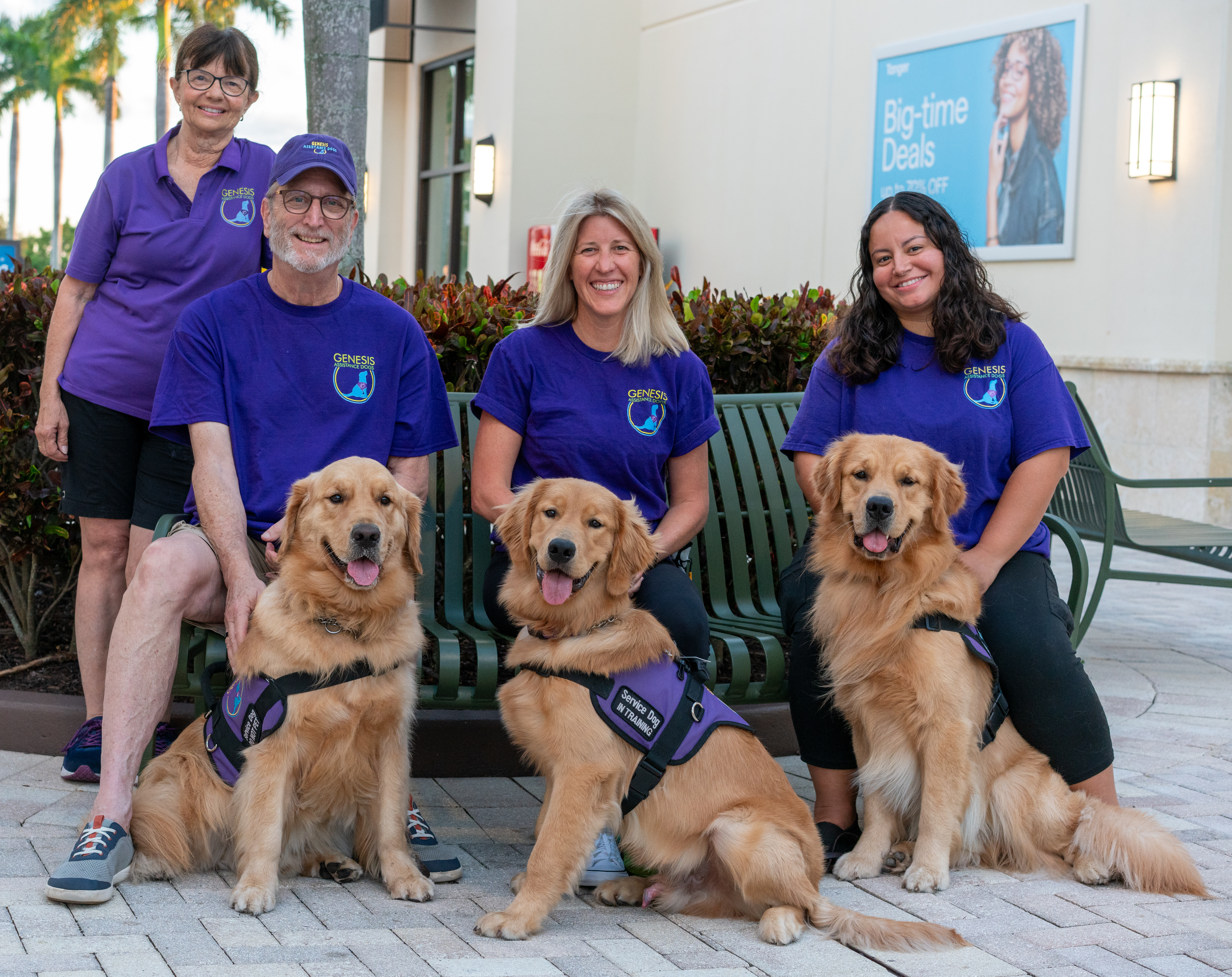
The Genesis crew is scattered across South Florida, so we caught up with them over Zoom. Everyone on the call has a job and a family, and somewhere in the house there’s typically a Golden Retriever in training.
Sharon Brucelas-Burch, Genesis’s Director of Training, has been training dogs since 2000 and runs her own business, The 1 Dog Trainer Academy. She had trained several dogs for the breeder who supplies Genesis’s Goldens, and when Genesis needed a new Director of Training, the breeder recommended her. Sharon had already trained two Genesis dogs by then, so she knew the organization well before she took the job a year ago.
Amie Schneider, who also serves on the Genesis board, joined for a more personal reason. “I had a very good friend that was in a wheelchair and had a Genesis dog,” she says. “When she passed away, my two girls wanted to give back to Genesis because Jac was such a great dog for my friend. So we decided as a family to become puppy raisers.” Amie is now on her sixth or seventh dog, and nearly every one of them has been placed.
Heather Oblaczynski, the newest member of the team, met Amie and Angelina Becerra at a green market, where they were explaining to passersby what a service dog actually is. Heather had raised puppies for other organizations, but she liked what Genesis offered and brought home Leo, her first Genesis pup, in May. Angelina joined in November 2024 and is now working with her third dog.
Life With a Puppy on the Payroll
Genesis puppies come home at eight weeks of age and rotate through different raisers every three to six months, so they learn to handle all kinds of households. By the time they’re placed, usually between 20 and 24 months old, they’ve seen more of Florida than many people have.
Angelina’s list could pass for a South Florida bucket list. Her dogs have been to Disney on Ice, a Panthers hockey game, an Inter Miami match, baseball games, equestrian events in Wellington, and a family vacation at a Disney campground. “We opted for the cabins, though, not the tents,” she adds.
Heather’s Leo goes fishing, rides along to dinner by boat, and has been to her niece’s dance recital, doctor’s appointments, Home Depot, and Publix. He also visits Heather’s mom’s parrots, which might be the most impressive socialization assignment of all.
A typical day sounds a lot like yours, with a dog along for every part of it. “I just have them fall into my routine,” Heather says. That means a few five-minute training sessions spread through the day, a lunchtime walk, and a nap under the desk while she works from home. On Tuesdays, the team has one-on-one sessions with Sharon, and in the evening, everyone meets for group training.
Heather also manages hotel renovations, and a puppy isn’t welcome on a construction site. When she has to travel, another raiser takes Leo. “There’s always someone in the Genesis family ready to help,” she says.
She’ll also tell you the arrangement has been good for her. “If you could use a little more socialization yourself, a puppy in training will make sure you get it.” People stop her all the time to ask about Leo. “Sometimes the dog is the icebreaker you didn’t know you needed.”
Vest On, Vest Off
It isn’t all ballgames and boat rides. Genesis puppies follow strict rules in public. They don’t greet strangers unless the handler allows it; they never meet unfamiliar dogs; and they keep all four paws on the ground at all times, as a grown service dog that lunges toward a friendly face could pull its partner right out of a wheelchair.
The goal is a dog so well behaved you’d hardly know it was there. “Sometimes the best compliment we get is somebody walking up and saying, ‘Oh my gosh, I didn’t even know you had a dog there,’” Sharon says. “That’s a well-trained dog.”
They still get plenty of time to be dogs, though. Sharon compares the work vest to a work outfit. You dress the part at the office, and you change into a T-shirt when you get home. “Vest on, I’m going to work. Vest off, I’m not at work.”
Most Sundays, the dogs visit Quantum House, the West Palm Beach home away from home for families of seriously ill children. The kids there use wheelchairs, walkers, and crutches, so the visits help the puppies get comfortable with that equipment early. Judging by how fast the children race down the halls when the dogs arrive, the kids get plenty out of it, too.
Why Goldens?
It mostly comes down to temperament. “Stability is super important, mental and physical,” Sharon explains. Goldens tend to stay calm and confident in new situations, and they were bred to retrieve, so picking up dropped keys, pulling open doors, and fetching pill bottles comes naturally to them. Labs make excellent service dogs too, but they usually mature later. As Amie puts it, a little less diplomatically, “Labs are crazy and take longer to settle down.”
Not Every Pup Becomes a Professional
Some dogs decide the job isn’t for them. Sharon describes one dog who was perfect on a leash downtown but did everything he could to get away the moment he was paired with a wheelchair. “We sometimes have to make those hard choices, even though we spent two years training this dog.” Aggression and health problems can end a career too. Those dogs still land on their feet, either adopted by the puppy raiser who already loves them or by a home where they can live out their years with a loving family.
Others surprise everyone. Amie remembers Harry as a difficult puppy, and she never expected him to make it. Today, Harry is the best buddy of Chad, who was born with cerebral palsy, and he even pulls Chad’s meal tray in from the kitchen. Lexi, the first dog Amie ever raised, now helps Colleen, who has MS. Steve, a master plumber, was left paralyzed after hurting his neck while lifting a water heater, and he now has Atlas at his side.
“But How Do You Give Them Up?”
Angelina says it’s always the first thing people ask her. “You have to go in with the mindset that this dog is not going to be your dog.”
Heather gets the same question. “It’s hard, but it’s worth it. I’ve shed a tear over every one of them.” With another organization, she dropped each puppy off and never heard how it was doing again. At Genesis, raisers see their puppies every week until they’re placed, and after that, they receive photos, updates, and letters from recipients. Every other year there’s a reunion for raisers and recipients. “Those stories and the happiness in those photos are what make it possible to let them go,” Heather says. “I know each dog is going on to an amazing life with someone who truly needs them.”
How Members Can Help
Become a puppy raiser. Funding matters, but as Heather points out, “there is no training without puppy raisers. We’re where every service dog’s journey begins.” Genesis needs full-time raisers and part-time raisers who can step in when a full-timer is on vacation or a work trip. “Even taking a puppy for three or four days can make a real difference,” Heather says. Raisers can also choose the kind of dog they take. Heather prefers the youngest pups (“I’ll take the potty training and the clumsy goofballs all day long!”), but helping with an older dog that’s mostly potty trained is just as valuable.
Raisers need a house with a fenced yard, and other pets are welcome. Age doesn’t rule anyone out, as long as they can physically handle a growing dog. Amie says she’s getting up there in age herself, and she’s still raising puppies. No training experience is needed, because Genesis teaches every raiser what they need to know.
Donate. Grants cover most of Genesis’s costs, but with every dog costing $30,000 to $40,000 to train and recipients paying nothing, the money has to come from somewhere.
Say hello. The team holds group training most Tuesday evenings, and guests are welcome to watch. If you’d like to attend a class, send Genesis a message on Facebook, and they’ll let you know where to find them. Just remember to admire the dogs from a polite distance and leave the petting for after hours. It’s a great way to chat with the Genesis team and learn more about puppy raiser opportunities. You can also find applications for puppy raisers and recipients at genesisassistancedogsinc.org.