The Movement That Started in Alanton
The story of the McDaniel Family, and Dorothy McDaniel's role in starting the POW/MIA Movement.
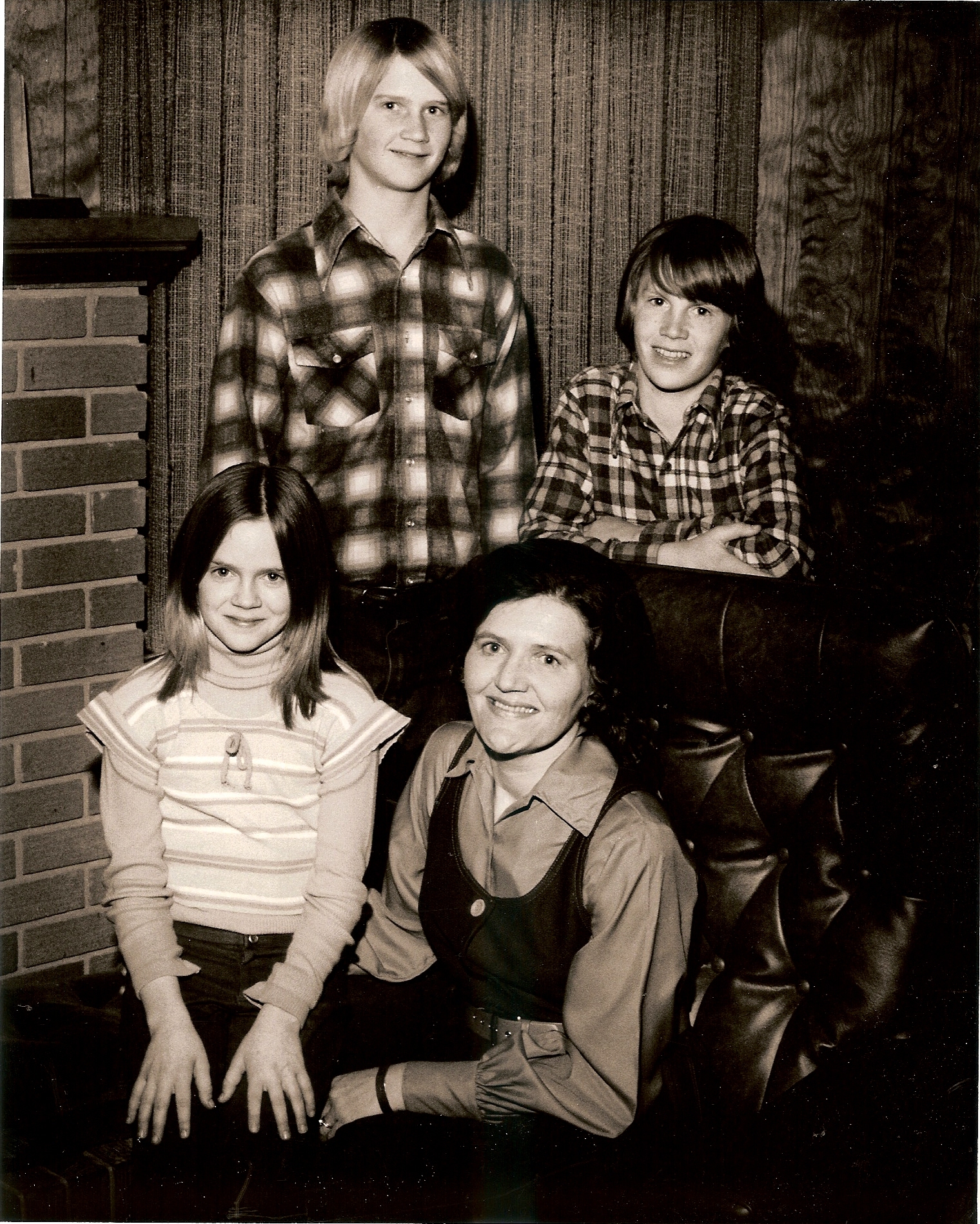
Dorothy and the McDaniel Children (B) Michael & David, (F) Leslie & Dorothy
Mike McDaniel can remember May 19th, 1967, vividly. Walking home from Alanton Elementary that Friday afternoon, he was looking forward to a typical 9-year-old weekend: little league games and playing with neighborhood friends. When he got to his house on 1716 S. Woodhouse, his driveway was filled with cars – not unusual for a military family during deployment. He walked in and was greeted by Mrs. Miles, a squadron wife and mother to Mike’s good friends, twins Larry and Gary. It wasn't until she brought him to the High's Ice Cream store on the way to their house and said, "Pick anything and get as much as you want," that Mike knew something was different. The next day, his mother sat him down and told him about his Dad. On the other side of the world in Vietnam, Mike's father, Navy pilot Captain Eugene “Red” McDaniel, had gone down in his plane.
May 19th, 1967 was day one of a six-year journey that took the McDaniel family from a typical life in Alanton to navigating their biggest fears realized, balancing hope without being too hopeful, and forging a path of advocacy through the image-consciousness and red tape of the military to keep their flicker of hope alive. What came from this collective effort is now known as the POW/MIA movement, and its roots started in Alanton with Dorothy McDaniel.
BEFORE VIETNAM
Red, nicknamed for his hair color, McDaniel grew up with a natural drive toward excellence. After two years at Campbell College in North Carolina – where he hit nearly .400 on the baseball diamond – he transferred to Elon and graduated before joining the Navy. Red McDaniel chose Navy flight school because flying off aircraft carriers was considered elite, and he wanted to be the best. It was at Campbell College in North Carolina, on his very first night of classes, that he met Dorothy Howard, the daughter of a beloved professor and pastor. Her family's deep Christian faith left a mark on him that would prove, years later, to be the difference between survival and despair.
By November 1966, Red had been deployed to South Vietnam. He was a skilled A-6 pilot, flying combat missions off the carrier Enterprise alongside his bombardier and navigator, Lt. James Kelly Patterson. Neither Red nor Dorothy imagined the war or this deployment would last long.
THE 81ST COMBAT MISSION
On May 19, 1967, during his 81st combat mission over North Vietnam, Red's A-6 Intruder was shot down. For 1,024 days, he was listed as Missing in Action. For three years and ten months, his wife Dorothy – known to friends as Dot – and their three children, Mike, David, and Leslie, did not know if he was dead or alive.
Red was held at the notorious North Vietnamese prison known as the "Hanoi Hilton,” where the brutal conditions of captivity are now well known. It was there, in the worst of circumstances, that his faith became his foundation – and a foundation for the men around him.
Back in Alanton, the McDaniel children were doing their best to understand a world that had suddenly changed. Their father was missing, and no one could tell their family whether he was coming back, and Dot was preparing for her own battle.
DOT BECOMES AN OUTSPOKEN ADVOCATE
When Dot learned that Red had been shot down, she couldn’t get any additional information – she didn't know if he was wounded, dead, or captured. She was a homemaker on S. Woodhouse Road caring for three children ages 9, 6, and 4, making a conscious effort not to project too far into the future in order to maintain the normalcy of their children’s everyday lives. The neighborhood helped – friends surrounded them, the boys stayed busy with sports, and Dot joined the Alanton Garden Club. In small acts of quiet faith, Dot collected clippings and memorabilia in a box to share with Eugene when he returned.
The military had assigned an officer to advise her on financial and legal matters, but had also implied that speaking publicly might put her husband at greater risk. Dot complied – at first.
After months of silence from the military, she traveled to Washington, D.C., meeting with Navy officials at the Pentagon, the State Department, and members of Congress, hoping for news. She grew increasingly resentful of government officials saying they were "doing everything possible" while pressuring her and other wives to stay quiet. Dot began meeting with other wives of downed Navy pilots in the area. They shared what little information they had and offered each other moral support. That small circle grew – first joining with wives from Langley Air Force Base in Hampton, then a contingent from Richmond. Virginia Beach quickly became the hub of East Coast activity. They merged with a West Coast group, and others from across the country followed to build momentum. On May 28, 1970, the National League of POW/MIA Families was incorporated, and Dot was selected as its state coordinator for Virginia.
At first, none of the wives crossed the “keep quiet” rule. Rather than going public immediately, they began with letters to newspaper editors, foreign ambassadors, and U.S. officials, asking them to publicize their husbands' status. Dot asked the Alanton Garden Club to write to WAVY-TV and help support local POW/MIA fundraisers, with all proceeds going toward raising awareness of POWs and the missing. The League's slogan, "Don't let them be forgotten," began appearing on signs, bumper stickers, and billboards. Petitions circulated to win the support of the mayors of Virginia Beach and Hampton.
Eventually, letters alone weren't enough. Dot and the other wives began giving speeches and sitting for media interviews, convinced that public pressure was the only thing that would compel the North Vietnamese – who were actively pushing propaganda films claiming POWs were receiving "humane and lenient treatment" – to change course.
AN UNEXPECTED DELIVERY AT 10 PM
Dot had written to Red many times without receiving a response. When she learned that a group of antiwar activists and journalists were planning to travel to Vietnam to meet with communist leaders, she saw an opportunity. She and other wives gathered letters and photos from POW/MIA families across the area and asked one of those making the trip to inquire about Red's condition. Dot enclosed a short letter, choosing every word carefully – signaling to his captors that she knew he was alive, and that the world was watching:
Dear Eugene, We are so thankful to know you are alive. How is your health? We are well and happy. The children are growing. We hope to hear from you soon. Keep faith and never forget how much we love you. Dorothy
Months passed. Then, on March 7, 1970, their neighbor and mailman, Van Yeager, was sorting the next day's mail at his home in Alanton when he came across a dirty white envelope postmarked "Hanoi, Vietnam." At 10 PM, he brought it to the McDaniel house. Mike, now twelve, watched as Mr. Yeager handed it to his mother. "Mr. Yeager’s hands were trembling hands," Mike recalls, "and he was barely holding back tears." Dot opened the envelope and read:
Dear Dorothy, Michael, David, Leslie, My health is good in all respects, no permanent injuries. You are my inspiration. Children, work, study, play hard, help each other and Mommy, be strong for our reunion. Invest savings in mutual funds and stocks. Your decisions are mine. Dorothy, I love you deeply. Eugene. December 15, 1969.
For years, the McDaniels had lived in a kind of suspended uncertainty – not wanting to give up hope, but afraid to hold onto too much of it. The letter broke that open. Mike describes feeling a a weight that he didn't realize he was carrying lift from his shoulders, “My Dad was alive.” For Dot, it was fuel. She redoubled her efforts on the POW/MIA campaign with a certainty she hadn't had before.
ALANTON WELCOMES RED McDANIEL HOME
Beginning in 1973, the first American POWs were released. After six years in captivity, Red McDaniel returned to Virginia on March 4th. Mike remembers watching the black sedans carrying the released POWs, knowing his father was in the one which just pulled up – and then the door opened, and the McDaniels were reunited.
Red was taken to Portsmouth Naval Hospital for monitoring and to help him readjust to life at home. Dot visited as often as she wanted, sometimes staying overnight. When Red was finally cleared to come home, Alanton was waiting. Some 500 friends and neighbors gathered at the McDaniel home at 1716 S. Woodhouse Road. The Virginian-Pilot reported people lining the street for half a mile. Schoolchildren held signs reading "Land of the Free, Home of the Brave" and "It's Nice to Have You Back." A hand-lettered banner stretched across the street: WELCOME HOME CDR. EUGENE McDANIEL. A community effort of advocacy, a collective hope, and many prayers were honored and witnessed that day.
Not long after his return, Red was reassigned, moving the family from Alanton to Alameda, California.
RED'S DISTINGUISHED NAVAL CAREER
After resuming active duty, Red was promoted to Captain and served as Commanding Officer of the USS Niagara Falls and the aircraft carrier USS Lexington. He later served at the Pentagon and on Capitol Hill as Director of Navy/Marine Corps Liaison to the U.S. House of Representatives before retiring in 1982. His decorations included the Navy Cross, two Silver Stars, the Legion of Merit with Combat "V," the Distinguished Flying Cross, three Bronze Stars with Combat "V," and two Purple Hearts.
A LEGACY OF SERVICE
After retiring, Red founded the American Defense Institute (ADI), a nonprofit based in Alexandria, Virginia, dedicated to national defense awareness and accounting for servicemen still missing in Southeast Asia. He authored Scars and Stripes, recounting his years in captivity. Dot published After the Hero's Welcome: A POW Wife's Story of the Battle Against a New Enemy, chronicling her years of advocacy.
Now in their 90s, Red continues to speak at veteran events, carrying a message forged in captivity and refined over decades, with Dorothy only recently pulling back from public speaking. "When adversity comes into our lives," Red tells audiences, "we build endurance. Endurance builds character. From that character, we get hope. And from that hope we develop faith that enables us to survive and help others through what we learned." Red remains President of the ADI, and their son Michael, a retired Navy Captain and graduate of the Naval Academy, serves as Executive Director — carrying the family's mission into the next generation.
DON'T LET THEM BE FORGOTTEN
The POW/MIA flag that grew out of the movement Dot helped build became a national symbol of Vietnam War remembrance. On November 7, 2019, the National POW/MIA Flag Act was signed into law, requiring the flag to fly alongside the U.S. flag at federal buildings, military installations, national cemeteries, and VA facilities nationwide.
Closer to where it all began, Navy Seabees volunteered to design and build the Flame of Hope Memorial at Oceana. Its inscription reads: "This Flame now burns continuously to light the way for the return of our prisoners of war held in South East Asia."
When the war ended, 2,646 Americans were listed as unaccounted for. More than 1,000 sets of remains have since been identified and repatriated. Today, 1,566 Americans are still missing from the Vietnam War. Among them is Lt. James Kelly Patterson, Red's co-pilot and navigator. Patterson ejected safely and made radio contact for several days before going silent. Red has long believed that Patterson, whose technical expertise made him uniquely valuable, was taken by Soviet forces rather than lost in the jungle. The Patterson and McDaniel families continue to search for answers.
For Red, the mission is unfinished. He came home. His co-pilot and others didn't. And so at 94 years old, he keeps going – speaking, advocating, refusing to let the names of the missing be reduced to statistics. As Red himself has said, "The greatest tragedy in life is not the pain we experience – because pain is part of life. The greatest tragedy is allowing that pain to be wasted."
He never forgets. On this Memorial Day, let us remember.