A Cautionary Tale
Craig Porter considers himself lucky to be alive.
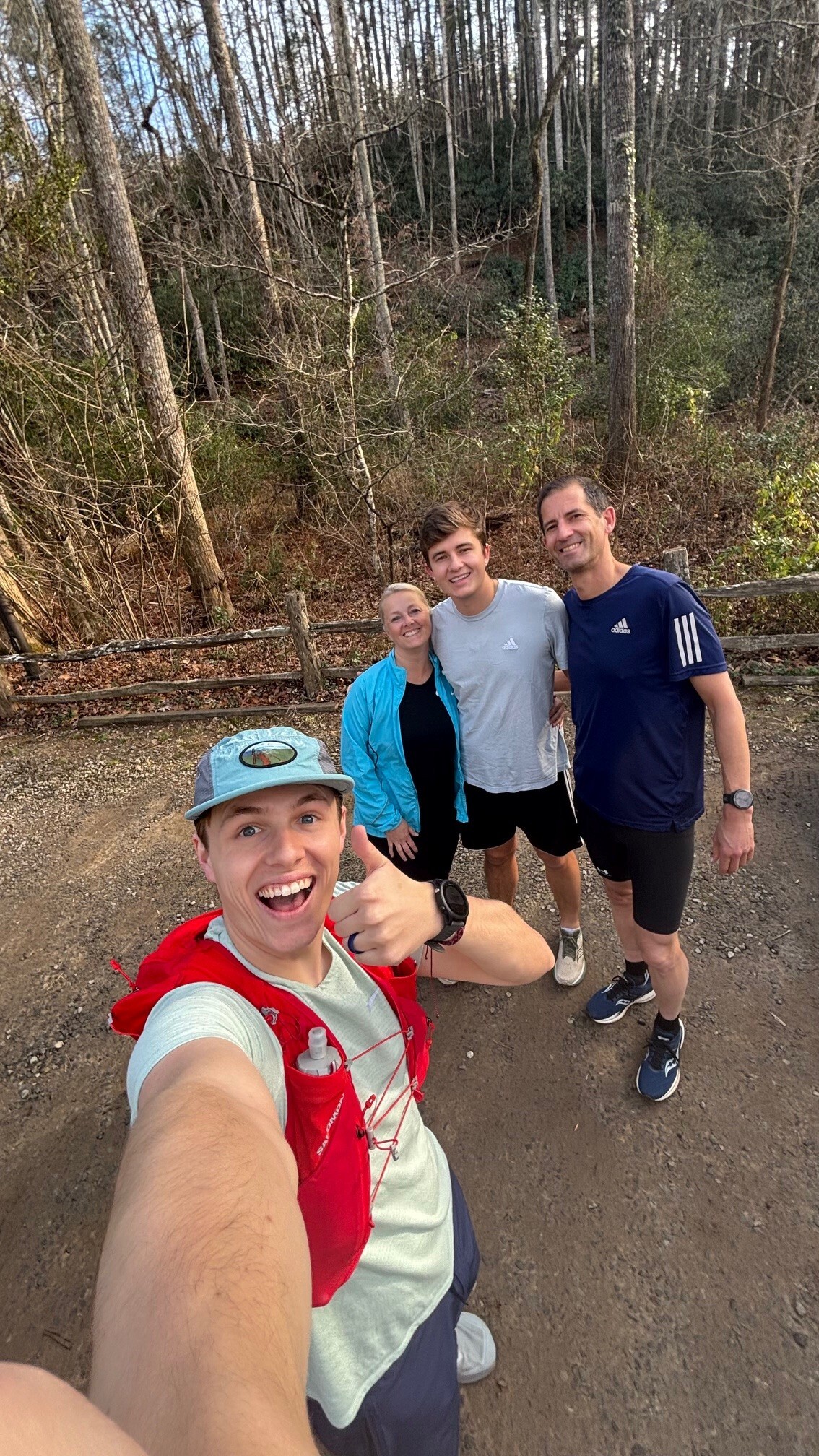
Oliver (front), Lynne, Adam and Craig Porter.
He thought he was just having an off day. He was wrong.
That’s not something you expect to hear from a man who bikes the Blue Ridge Parkway for fun, rode l’etape du tour in France, runs marathons, medals in triathlons, swims in open water and casually knocks out endurance feats most people wouldn’t attempt once, let alone repeatedly. Craig is the kind of athlete who tracks everything. A Garmin Forerunner 965 on his wrist. Thousands of activities logged. A resting heart rate in the 40s. A family that treats fitness as a way of life.
Nothing about Craig Porter suggested a heart condition.
Craig and his wife, Lynne, live on Heathbrook Circle in Biltmore Park. Their two sons, Adam and Oliver, have both graduated from college and are off living on their own. (Adam is married to Hope Ingram, who grew up on Woodvine Road, and Oliver is engaged.) Lynne is deeply involved in the Rotary Club of Asheville South and co-owns Zaniac, a STEM enrichment center for K–8 students. Craig works as the global operations development manager for UPM Adhesive Materials, often starting his days at 5 a.m. on calls with China and India.
Craig is someone who runs on discipline and data. Or, as Lynne jokes, “he’s type A+++.”
The First Warning
Six years ago, during his training for the Lake Logan Half Ironman triathlon (a 90K cycling leg alone), Craig headed out for a routine ride. Almost immediately, something was wrong. He felt weak. Slow. Powerless. He couldn’t climb even the smallest hill, something he normally soars up.
Then he looked at his heart rate.
250 beats per minute.
It didn’t make sense. He assumed the monitor was wrong. A glitch. Interference. When this had happened once in Spain, where the Porters had lived for a decade, Craig thought his high heart rate must have been caused by cables overhead. He turned around and slowly rode his bike home.
On the way, as if the universe knew his stubbornness, a spoke snapped. In more than 30 years of riding, Craig had never broken a spoke. He now views it as a bizarre coincidence that forced him to call Lynne for a ride home. Still, he rationalized away his high heart rate.
He had similar heart rate readings before from his rides in Spain, where the Porter family lived for a decade. He always put his numbers down to interference caused by cables overhead. Again, finding a plausible cause for this anomaly.
After the incident in 2019, a doctor diagnosed him with atrial flutter. He was on blood thinners for three months. His heart rate normalized. An ultrasound and EKG looked fine.
Case closed, or so it seemed.
The Data He Didn’t Want to See
Fast-forward to November 2025.
Craig and Lynne traveled to Arizona for Lynne’s marathon in Scotsdale, then on to California to see family. Craig was training for a marathon in Wilmington and feeling good. Then, on a cable car ride up Mount San Jacinto, Craig felt nauseous. At the top, he walked slowly. He was short of breath.
Again, he explained it away.
Altitude.
Travel.
Maybe a virus.
But his Garmin was quietly telling a different story: poor sleep, high stress, elevated resting heart rate, all of his numbers were off. When he tried to run on the beach in Santa Monica, he couldn’t. His body simply wouldn’t cooperate.
Back home in Asheville a week later, he still felt off. He finally decided to pop in to see UPM’s PA-C Jay Dore (a friend and fellow cyclist) who is available for employees twice a month and just happened to be onsite that morning.
That decision may have saved his life.
Jay was packing up, getting ready to leave for the day. He told Craig he’d give him two minutes. Jay checked Craig’s pulse with his hand and immediately said, “Dude, you need to go to the ER. You’re in A-Fib!” He put his own Apple Watch on Craig’s wrist. Red alerts lit up the screen indicating an irregular heartbeat.
Craig thought he’d go after lunch, a few meetings and some work.
Jay insisted. Craig finally relented.
When Everything Moves Fast
Since it’s nearby, Craig headed to Mission My Care Now. They told him they were calling EMS and he needed to be at the ER. After seeing a look of panic on multiple faces that day, Craig went to Mission Hospital, where things escalated quickly.
IV drips. Blood thinners. A team rushing in. A private room. An ultrasound of his heart. Craig was told he’d be there for a few days.
The diagnosis was atrial flutter, which can in some cases, cause dangerously rapid heart beats. If not adequately treated, it also raises long-term risk of congestive heart failure and stroke.
Craig needed catheter ablation surgery.
And then came another twist.
His surgeon was his neighbor on Woodvine Road. (He didn’t learn this until after his surgery.)
Dr. Mike Manogue with Asheville Cardiology Associates (also an avid cyclist) treated Craig's condition.
On December 5, Dr. Manogue performed the procedure at Mission Hospital.
It was a success.
“The people at Mission know exactly what they’re doing,” Lynne says. Craig agrees. He’s deeply grateful, not only for his medical team, but for Lynne, who never left his side.
The Numbers That Told the Truth
During recovery, Craig did something he hadn’t done before: he downloaded and analyzed all of his data from exercise.
Out of 4,500 recorded activities, more than half included heart rate data. Since 2008, Craig found over 100 workouts where his heart rate exceeded 200 beats per minute — and several where it topped 250.
Most striking? The spikes often happened on the while descending mountains on his bike, and not while climbing them.
His watch had been warning him for years.
A Message Worth Sharing
Today, Craig is recovering well and already returning to the athletic life he loves. But he wanted his story told for a reason.
“I ignored my own numbers for too long,” he says. “I kept justifying what my body was trying to tell me.”
His advice is simple and urgent:
Listen to your body. If something feels wrong, go see a doctor. Don’t assume it’s a fluke. Don’t blame the technology. Don’t wait.
Thanks to a persistent friend, a loving wife, a skilled neighbor and a hospital team that moved fast, he got a second chance.
He hopes his story helps someone else take action before it’s too late.