A Steady Presence
Biltmore Forest Resident Dr. Jonas Karlsson is a critical-care surgeon at Mission Health.
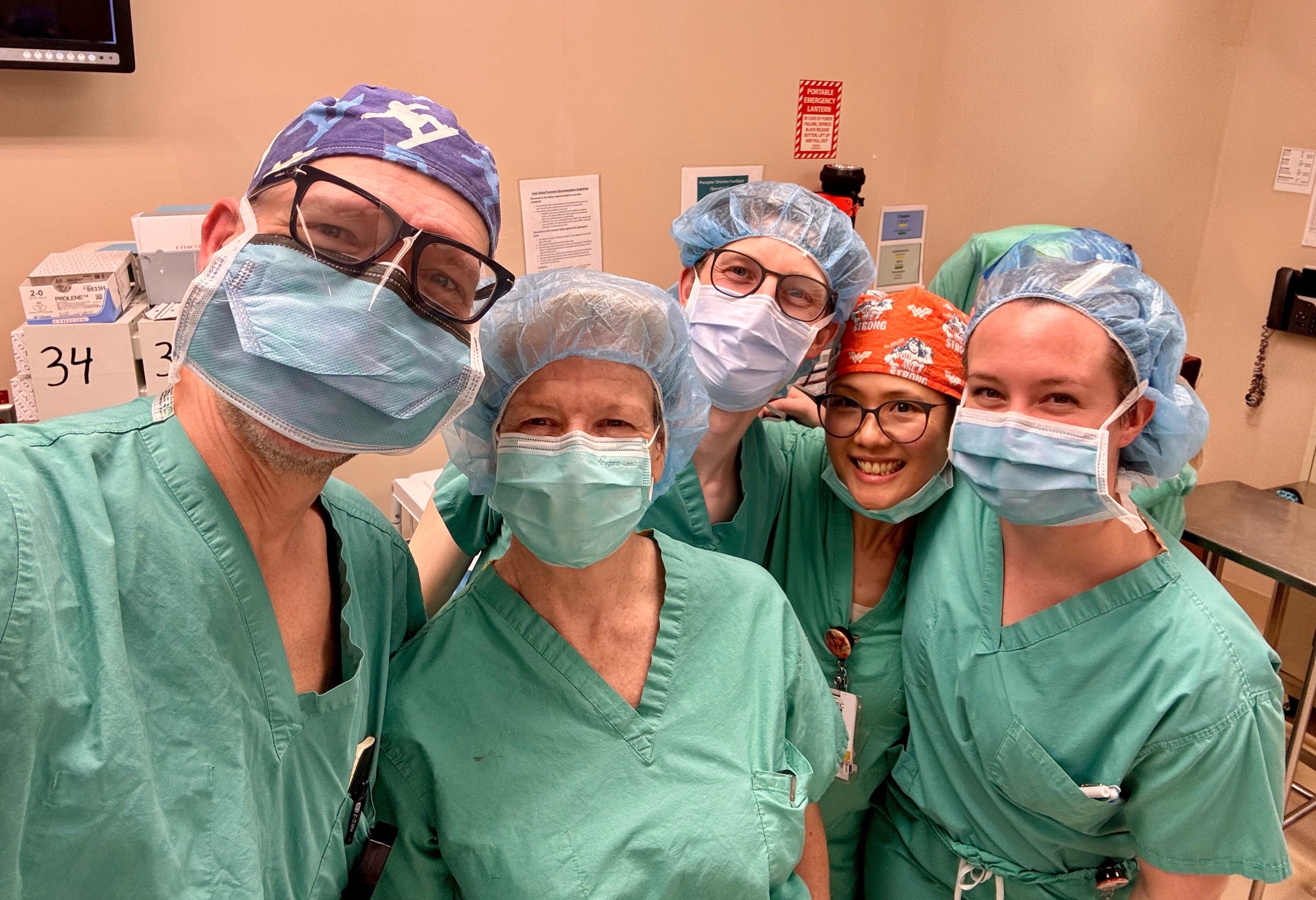
Dr. Karlsson and his team.
When most people picture a trauma surgeon, they imagine flashing lights, split-second decisions and adrenaline-fueled chaos. Dr. Jonas Karlsson sees something different.
“My role is to be the calming force in the room,” he says.
As a trauma surgeon and surgical critical-care physician at Mission Health/HCA Healthcare, Jonas cares for some of the most critically injured and seriously ill patients in Western North Carolina. Whether responding to a life-threatening trauma, managing complex ICU cases or performing emergency surgery, he thrives in an environment where every moment and decision matters.
“The more things that are happening at the same time, the calmer I get,” he says. “I tend to be less wound up as situations become more intense.” His steady presence is a hallmark of his work.
Jonas once didn’t know for sure what profession he wanted to enter.
As an undergraduate studying molecular and cellular biology at University of California at Berkeley, he spent years unsure of what career path to pursue. He loved science and engineering, and found himself drawn to teaching, working with at-risk youth and discovering how rewarding it was to help others learn and grow. Soon everything clicked.
“I realized surgery combined all the things I enjoyed,” he says. “Science, teaching, problem-solving and fixing things.”
Jonas attended Ross University School of Medicine and completed his residency at University of Illinois at Chicago College of Medicine and his fellowship at Vanderbilt University Medical Center.
A lifelong tinkerer who enjoys rebuilding engines and working on motorcycles, Jonas was fascinated by the idea of repairing the human body much the same way he restored mechanical systems.
During residency, he discovered trauma surgery and immediately felt called to the specialty. “I thought that not having long-term relationships with patients would be a drawback,” he says. “But I found the opposite was true.”
In moments of crisis, patients and families need clear communication, confidence and a plan. These experiences quickly build relationships.
“When someone is severely injured or critically ill, everything happens quickly,” he explains. “Being able to explain what’s happening and what we’re going to do and to provide reassurance can be incredibly meaningful.”
Serving a Region in Need
Mission Hospital recently achieved designation as Western North Carolina’s first Level I Trauma Center, the highest level of trauma care recognition in the United States.
The designation reflects a tremendous commitment from physicians, nurses, specialists, administrators and support staff who work together to care for patients across an 18-county region.
“People think trauma care is chaos,” Jonas says. “In reality, it’s a very structured process.”
When emergency medical services identify a potentially life-threatening injury, an entire trauma team is activated before the patient even arrives.
“We follow the same sequence every time,” he explains. “There is no fumbling for what to do. We rely on systems and a process we’ve practiced over and over.”
Contrary to what many might assume, gunshot and stabbing wounds make up only a small percentage of trauma cases.
“The most common trauma we see is falls,” Jonas says. “Gravity is relentless.”
As people age, the risk of serious injuries from falls increases significantly. Hip fractures, broken ribs, traumatic brain injuries and spinal injuries are among the most frequent cases he encounters. Motor vehicle and motorcycle crashes also account for many trauma admissions.
While trauma surgery often receives the spotlight, much of Jonas’s work takes place in the intensive care unit.
Surgical critical care involves caring for some of the sickest patients in the hospital, often managing multiple life-threatening conditions simultaneously.
“This is incredibly cerebral work,” he says. “Things can change minute by minute.”
A patient may have fractured ribs, a collapsed lung, broken bones, internal bleeding and a traumatic brain injury all at once. Determining what requires immediate intervention and what can safely wait requires constant assessment and collaboration.
“There are often multiple organ systems involved,” he says. “Figuring out what is happening and how to fix it is both challenging and rewarding.”
For Jonas, the greatest victories come when patients recover against difficult odds.
“Seeing someone walk out of the hospital and return to their life is incredibly rewarding,” he says. “Those success stories stay with you.”
Despite the technical demands of surgery, Jonas says the most meaningful part of his work is still the human connection.
“I enjoy the physician-patient relationship immensely,” he says. “Being the healer goes beyond working with your hands.”
Some patients do not survive their injuries, and supporting families through devastating loss can weigh heavily on health care providers.
“The emotional side can be difficult,” he says. Fortunately, he says Mission Health provides strong support systems for physicians, and the trauma team places significant emphasis on reviewing cases, improving processes and learning together.
“My partners are such a fabulous group of surgeons,” he says. “Not only do they provide the best care for each individual patient, they also focus on how to continually improve the entire system.”
That collaborative mindset builds trust in the team and results in better patient care outcomes.
Life Beyond the Hospital
Outside of work, Jonas finds balance in simple pleasures.
He enjoys strength training, walking 10,000 steps a day (while waving at neighbors), spending time outdoors, attending live music events and snowboarding. “Sometimes snowboarding requires going to Colorado,” he says.
He also still loves working on motorcycles. “I enjoy the mechanical side of it,” he says. “Taking things apart and figuring out how they work.”
At home in Biltmore Forest, he and his two sons, Jackson, 12, and Logan, 10, enjoy the kind of neighborhood community that feels increasingly rare.
“They have groups of friends nearby and can roam the neighborhood together,” he says. “It’s something I don’t see happening in many places anymore.”
Jackson is passionate about video game creation, artistic game design and storytelling. He’s into 3D printing and learning how to use 3D modeling software to create his own objects. He plays trombone and just finished his first year at Koontz Intermediate School. Logan is going into fifth grade at Koontz Intermediate School. “He’s a shining beacon of a kid,” Jonas says. “He loves lemonade stands with his friends and playing Gorilla Tag on his VR headset. He and his friends are thick as thieves.”
Jonas appreciates the way his neighbors rallied together following Hurricane Helene.
“Watching people come together to help each other was incredible,” he says. “We all grabbed our chainsaws and helped out. That’s the kind of community we live in.”
Looking Ahead
More than a decade after completing his fellowship training and moving to Asheville, Jonas remains grateful for the career he found almost by accident.
“No one in my family was in medicine,” he says. “I enjoy my job immensely. I wake up every morning and look forward to going to work. I feel very fortunate.”
Jonas thrives in an environment of uncertainty. “The emotional aspect of caring for people is what makes this work so rewarding,” he says. “Most of the time, we get to help fix the problem and get people back home. Seeing the impact of that never gets old.”