Mission Health's MAMA Air Medical celebrates 40 years of serving Western North Carolina
When every minute matters
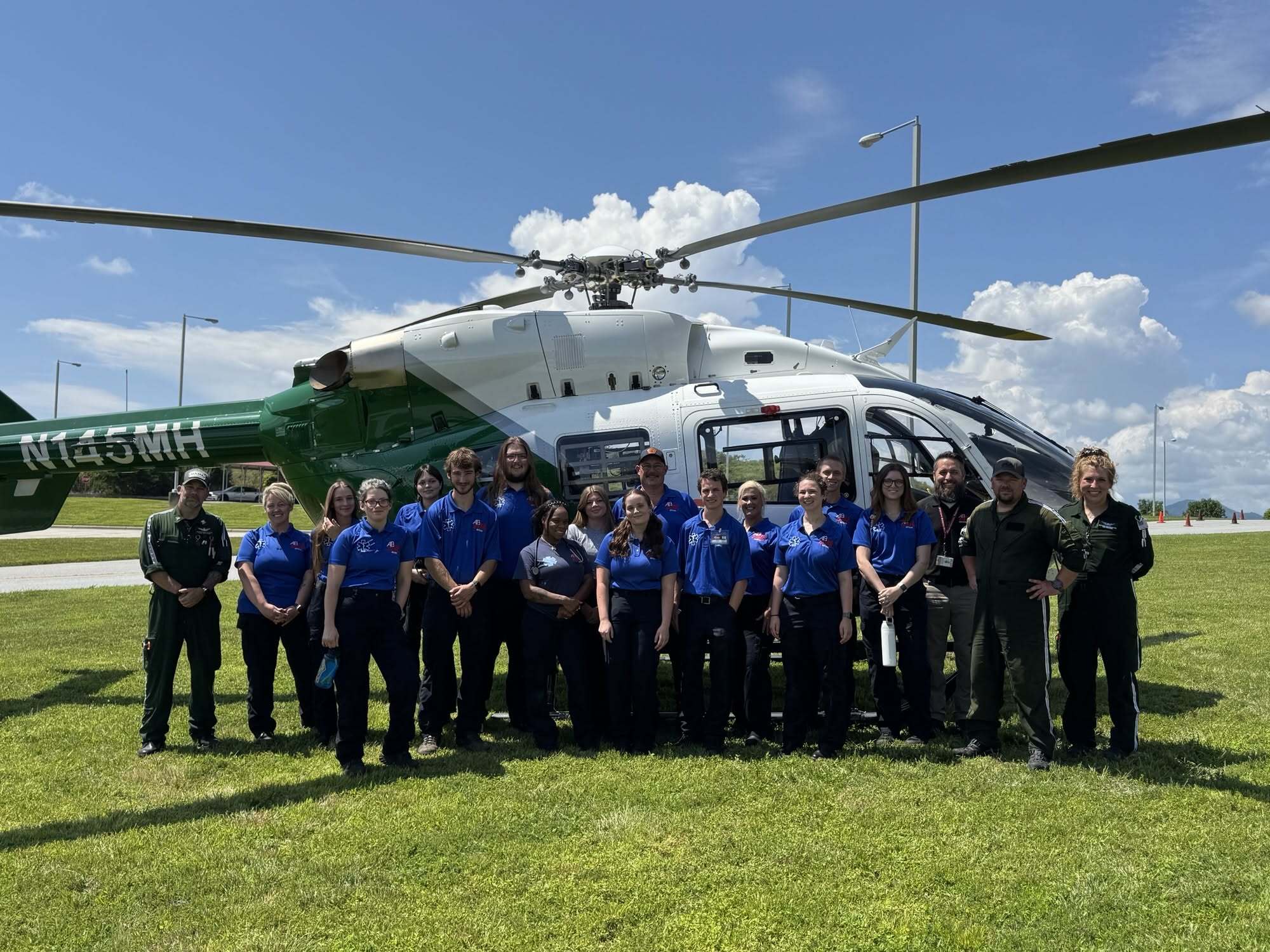
There is a sound many people in Western North Carolina recognize immediately: the unmistakable whir of helicopter blades overhead. And seeing the familiar flash of green lights.
For 40 years, that helicopter has represented hope, expertise and the promise that when a medical emergency strikes, help can come quickly.
On September 29, Mission Health's Mountain Area Medical Airlift, better known as MAMA, will celebrate four decades of serving Western North Carolina.
In that time, MAMA has transported approximately 31,000 patients, becoming an essential part of the region’s emergency medical system and part of the fabric of the communities it serves.
For John Carrico, BS, MBA, FP-C, NRP, development and outreach coordinator and critical care flight paramedic for MAMA Air Medical with Mission Health/HCA Healthcare, the anniversary is about more than a milestone. It’s about serving people and letting them know they are in good hands.
“It’s a privilege,” John says of the work. “Oftentimes, the patients we’re taking care of are having the worst day of their lives. Their families are experiencing their first day of something they never expected. I take it as a badge of honor to be able to take care of them.”
A Hospital in the Sky
MAMA began serving the region in 1986, when one helicopter was based in Mission Hospital in Asheville. Today the program operates two aircraft, MAMA One at Mission Hospital and MAMA Two at Mission Health's Angel Medical Center in Franklin, allowing the team to respond more quickly across the region.
While the helicopters may be what people notice, the real strength of MAMA is the highly trained team inside them. Every flight includes a pilot, flight nurse and flight paramedic. The pilots bring thousands of hours of experience. Flight nurses come with extensive hospital and intensive-care backgrounds. Flight paramedics spend years developing their skills on the ground before taking those skills into the air. Patients who need to be quickly transported are often in life-or-death situations.
Together, they provide what John calls “a flying ICU.” The Mission Health MAMA helicopters are equipped to provide advanced critical care to the patient. That difference matters in a mountainous region where geography can turn distance into precious time.
A patient experiencing a stroke, heart attack or traumatic injury may need a level of care that isn’t available at a smaller rural hospital. A critically ill child may need specialized pediatric care. A newborn may require transport in a neonatal isolette. A burn patient may need to reach a specialized burn center.
Most often that means flying to Mission Hospital, a designated Level 1 trauma center, able to respond and treat the most critical of patients.
“The goal is to get that patient to the care they need as quickly as possible,” John says.
A Choreographed Team
The few minutes a community sees the helicopter landing are the visible part of a much larger operation. Behind every flight is a carefully coordinated system involving dispatchers, pilots, medical crews, mechanics, EMS agencies and hospital teams.
MAMA has five full-time mechanics who work continuously to keep the helicopters safe and mission-ready. Dispatchers receive requests, gather information, coordinate with EMS crews and first responders, track the aircraft, and communicate with the receiving hospital.
By the time the helicopter arrives, everyone knows what needs to happen and they try to get lift-off within 10 minutes of landing. The crew may meet an ambulance at the roadside or another landing zone. They receive the patient’s medical report, stabilize the patient and transfer them onto a specialized helicopter stretcher. Then they lift off.
At the receiving hospital, a medical team is already waiting. At Mission Hospital, the rooftop helipad connects directly to the hospital trauma bays through elevators, allowing patients to be moved rapidly to receive the appropriate care.
“It’s a very choreographed system,” John says. “It’s a dance that starts with our skilled dispatchers and mechanics.”
Prepared for Anything
The nature of emergency medicine is that you never really know what the day will bring.
A MAMA crew might respond to a serious automobile accident in the morning, a stroke in the afternoon and a critically ill child that evening. There are cardiac emergencies, traumatic injuries, complicated deliveries and patients who simply cannot afford to lose the time it would take to travel by ground.
Some days the helicopter flies twice. On others, it may fly six times. There also are days when weather keeps the aircraft on the ground.
The mountains create unique challenges for air medical crews. Fog, storms, ice, snow and limited visibility can make flying unsafe. The decision not to fly is every bit as important as the decision to fly. “The mission of MAMA is always to transport patients quickly, but safely, and we’ve been doing that for 40 years,” John says.
Finding a Calling
John didn’t begin his career in emergency medicine. He began in education. But he had always felt a strong desire to serve his community. That calling became particularly clear through disaster-relief work with the Red Cross, including involvement following Hurricane Katrina.
He eventually enrolled at A-B Tech, earned his paramedic license and began working with Henderson County EMS. For eight years, he worked as a paramedic and field training supervisor, gaining experience and learning from mentors who were part of MAMA.
He admired the level of clinical care they provided and the reputation of the program.
Then, in 2015, an opportunity opened. John joined MAMA as a critical-care flight paramedic. More than a decade later, he remains passionate about the work.
Today, he also serves as MAMA’s development and outreach coordinator, working closely with hospitals, EMS agencies and fire departments throughout the region.
The day Helene changed everything
If there is one event that demonstrated just how essential MAMA has become to Western North Carolina, it was Hurricane Helene.
When roads disappeared, communications failed and communities became isolated, MAMA crews found themselves doing far more than transporting patients. They flew doctors to hospitals and moved critically ill patients between facilities and they flew around the clock.
“It was the most dangerous time we ever flew,” John says. “There were helicopters from all over the country in WNC at that time.” Yet the team continued answering the call.
From the air, the devastation was almost impossible to comprehend. The crew saw rivers and small mountain creeks that had become powerful forces of destruction. They saw roads disappear and communities transformed.
“It was shocking to see the damage and the impact it had on so many small communities,” John recalls.
And the MAMA team wasn’t untouched by the storm. Some crew members were dealing with damage to their own homes and neighborhoods while continuing to care for others. John said Helene reinforced something he already knew: emergency responders don’t exist outside of the communities they serve. They are part of those communities.
Inside the Mission
Emergency medicine can be intense. Crews encounter tragedy, uncertainty and situations that stay with them long after a flight is over.
MAMA has become increasingly intentional about the mental health and well-being of its team, including access to a certified flight chaplain who helps crew members process difficult experiences and decompress.
John believes resilience is also built outside the job. He appreciates that you have to stay present to do this job, and he takes that insight with him. Exercise. Family. Healthy outlets. Time away from work. And remembering that the people waiting at home need you too.
The job has given him a perspective on life that is difficult to explain without experiencing it. “There are no guarantees in life,” he says.
Seeing the consequences of accidents and medical emergencies every day can make a person more aware of how it only takes a day for a life to change. “Live fully,” he says.
Celebrating 40 Years
Mission Health's MAMA’s anniversary celebration will be both a look backward and a look forward.
There will be opportunities for the community to celebrate the program and the role it has played in Western North Carolina as well as a meaningful celebration that makes MAMA possible.
The approximately 50 members of today’s team are the newest link in a 40-year chain. They are carrying forward the work of the pilots, nurses, paramedics, mechanics, dispatchers and other professionals who came before them.
“We are carrying a legacy,” John says. “As the saying goes, ‘We’re standing on the shoulders of giants.’”
Technology has changed dramatically since 1986. The helicopters are more sophisticated. Medical equipment is more advanced. The capabilities of flight crews have expanded. The purpose hasn’t changed. When someone needs help, MAMA takes flight.
So the next time you hear that familiar sound overhead, look up. The helicopter represents 40 years of neighbors helping neighbors, highly trained professionals answering the call and a community coming together when every minute matters.