Yemen: A Divided Country
“Travel and change of place impart new vigor to the mind.” - Lucious Seneca
Yemen lies at the southwestern corner of the Arabian Peninsula bordered on the west by the Red Sea, on the North by Saudi Arabia, on the east by Oman and on the South by the Arabian sea. Primarily mountainous and arid, broad patches of sufficient precipitation make agriculture successful. The people speak various dialects of Arabic, and the official religion is Islam with a population of 36 million.
Yemen is a country in a state of civil war with the Houthis, a Zaidi Shia armed group, controlling the northern portion of the country including Sanaa, official capital of the country, and the internationally recognized government, led by the Presidential Leadership Council, operating out of Aden controlling the south and east of the country. The southern part of the country follows the Sunni branch of the Islamic religion.
The strategic location of Yemen at the entrance of the Red Sea made it a crossroad for both ancient and modern trade and communication routes. In the ancient world, the area controlled the supply of important commodities such as frankincense, myrrh as well as spices. Its fertile lands were the location of several ancient kingdoms that prospered in part because it cultivated coffee commercially and was for many years the
sole source of coffee beans in the world.
Present day Yemen resulted from the uniting of the Yemen Arab Republic (North Yemen) and the People’s Republic of Yemen (South Yemen) in 1990. Sanaa, formerly the capital of North Yemen, became the capital of the country while Aden formerly the capital of South Yemen remained the economic center of the country. These political entities include the complexities of tribal affiliations which when combined with religious and historical differences insure ongoing conflict. Part of the historical conflicts result from the fact that North Yemen never experienced colonial control from a European power while South Yemen experienced administrative control from the British Empire from 1839-1967.
Yemen’s rugged landscape and its lack of central government control in many areas makes in a country that few outside people visit, despite its physical beauty and photogenic landscape and people. Many people ask if the United States is at war with Yemen. While the Houthis in the North cause disruption in the Red Sea and are considered enemies of the United States and Israel, the South part of Yemen’s affiliation with Saudi Arabia make it somewhat pro-western leaning.
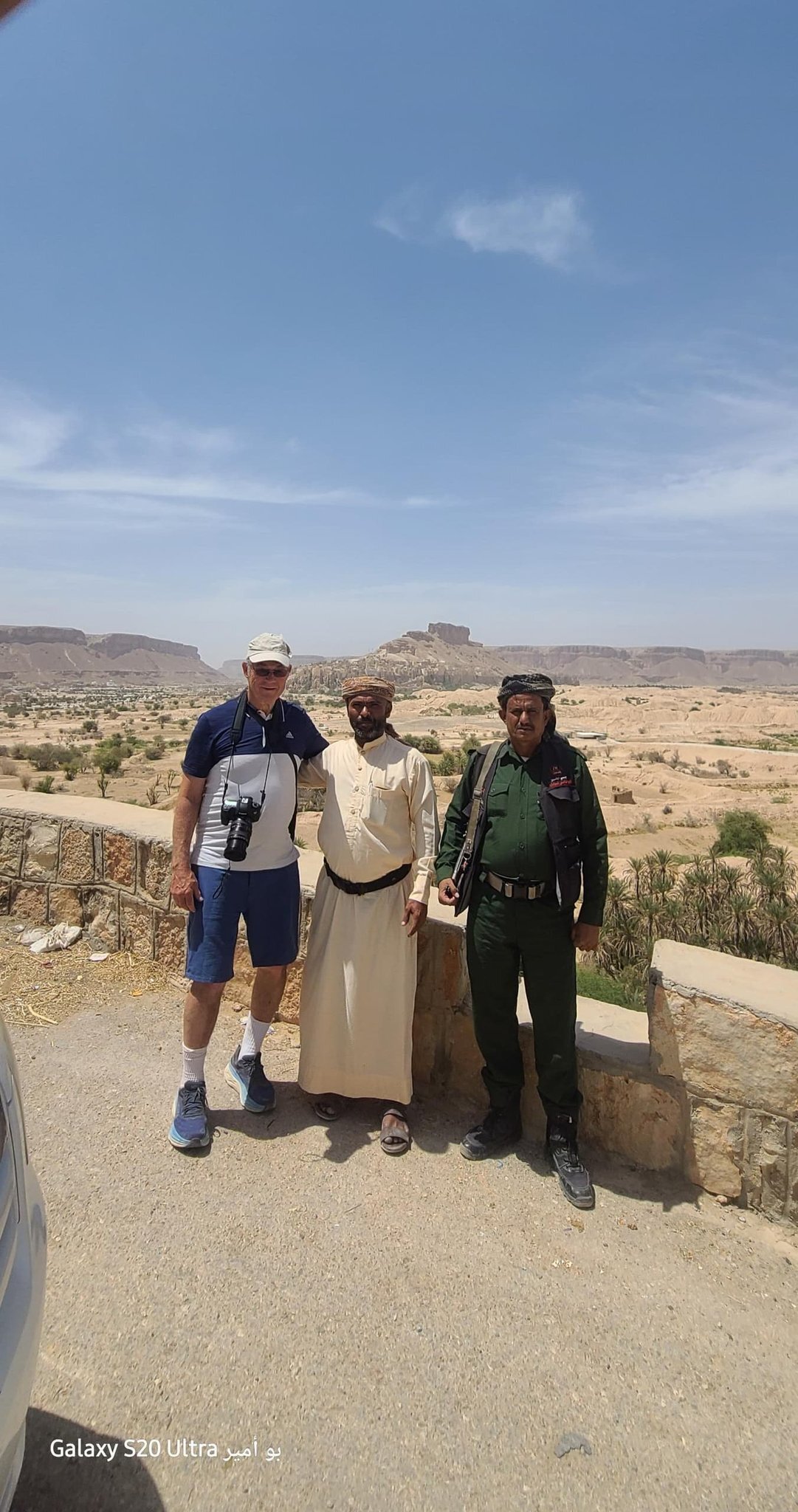
Is it safe to travel to Yemen? My experience says yes. People welcomed me wherever we traveled, and I never felt any hostility from anyone. Perhaps my safety may have come from the fact that the tour company had an armed guard at my side at all times. (I didn’t think I needed one). The countryside is arid and mountainous, punctuated by valley cities built into the sides of the mountains. Haid al-Jazil is a village in the Hadhramaut Governorate built on an isolated mesa. It looks quite cool but the inconvenient of its location has reduced its population to a single family.
The fortified wall city of Shibam is given the nickname, “the Manhattan of the desert”. A UNESCO heritage site, Shibam is one of the oldest and best examples of urban planning based on the principle of vertical construction. Tower-like structures rise out of the cliff giving the city a sense of permanence. Its origins date back to 300 A.D. and the city was an important caravan halt on the spic and incense route of the Southern Arabian plateau.
The city of Mukalla on the Arabian Sea if the capital city district of Yemen’s largest governate, Hadhramaut and the sixth largest city in Yemen with a population of 600,000. An important seaport with bustling markets and large oil tanks the city started as a fishing village 1035 A.D. During the Yemen Civil War, on April 2, 2015, Al-Qaeda seized the city and took control of the presidential palace. One year later the city was retaken by a coalition of Yemeni and Saudi troops.
Religion plays a big part in the lives of people in Yemen. Women are literally invisible as I only saw the face of two women while I was in Yemen. One was at the reception of a hotel and the other was a young widow who was begging for food. The rest of the women were covered head to toe. Yemeni people who follow Islam pray five times per day and stop whatever they are doing for prayers.
Yemen’s exotic nature makes it an intriguing place to visit, and one that imparts new vigor to the mind. The complex history of the country and the interplay of religion, geography and international relations causes one to ponder the intricacies of modern life against the traditions of an ancient civilization. Six countries to go!