In The Steps of Marco Polo
Kyle Reeder’s solo travel across Central Asia.
From Turkey to China, Marco Polo sought to explore the lengths of the Silk Roads in his book, The Travels. After finishing my junior year at Virginia Tech, I wanted to do the same. But instead of 17 years in the desert, I would do it 36 days…alone.
The first eight days were spent across Turkish villages, homesteads, and cityscapes. From Istanbul, through Ankara, Polatli, and Trabzon, I experienced a wingspan of Asian and Muslim identity. Learning about new dress codes, religious practices, and food culture, I suddenly found myself as a minority for the first time in my life. Five times a day, the loudspeakers would play from the blue, white, and yellow-tiled mosques. Days were spent exploring the spice-filled bazaars, haggling a “good price” from a shopkeeper for a new Persian lamp, rug, or silk button-down.
The following seven days were spent in Tbilisi, Georgia (after an 18-hour bus ride). Not to be confused with the state, Georgia sits at the foothills of Russia and shares a border with Turkey (and is the birthplace of wine!) I was lucky enough to celebrate their Independence Day, which involved arduous partying and wine-drinking, insisted on by the locals.
A day trip was made to Yerevan, Armenia, where I stood witness to some of the oldest Orthodox monasteries in the world, found deep in the Akhtala mountainside. Street dogs and soviet cars waited outside, while religious icons and melting candles greeted churchgoers inside.
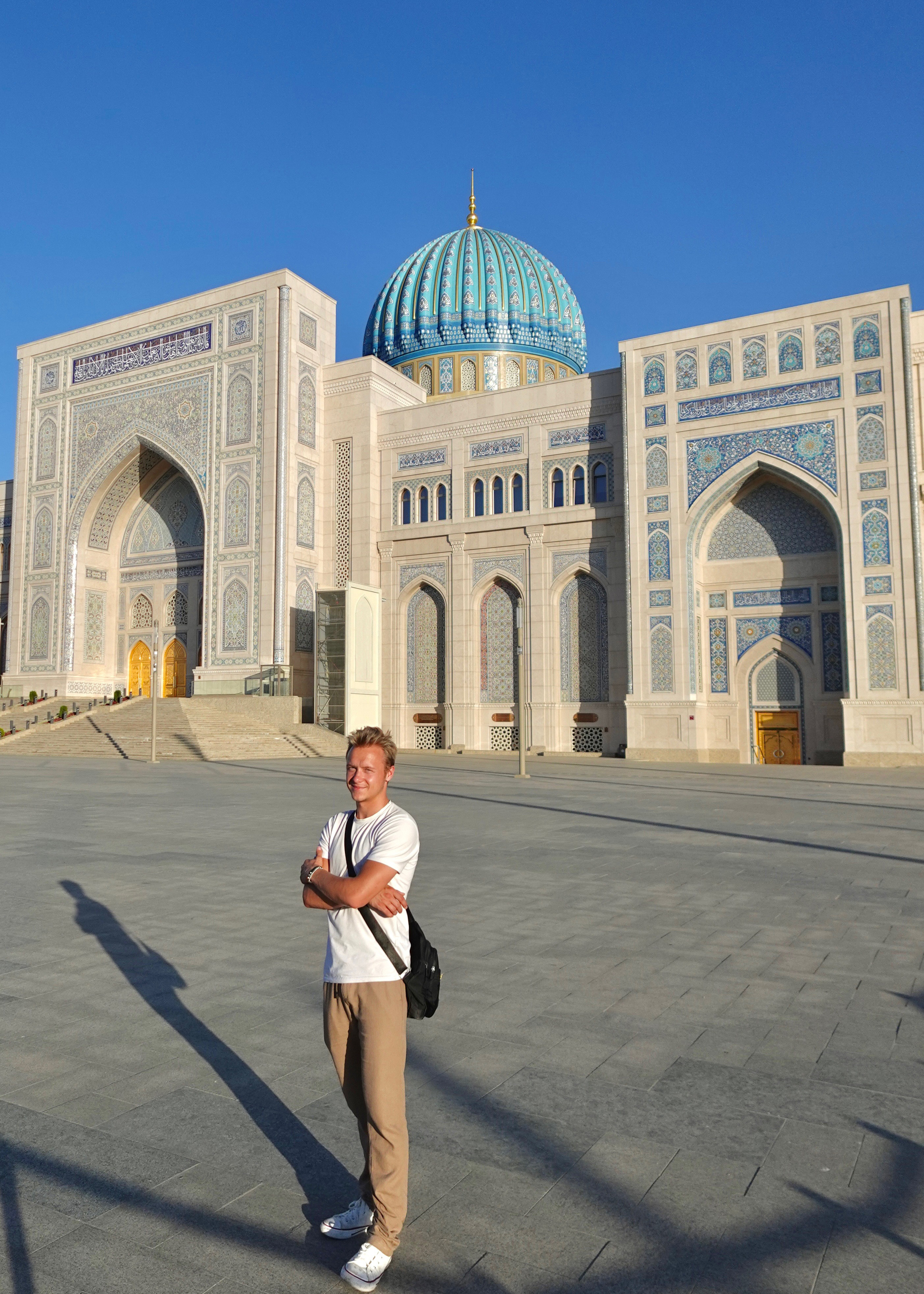
A flight from Tbilisi took me over the Caspian Sea to Tashkent, Uzbekistan. A region of the world that blends Silk Roads and Soviet heritage, the “Stans” became an landscape like no other. Small desert towns, with sand-colored buildings and dark, wooden features became a common style. Mosques older than time, decorated neatly with millions of turquoise blue tiles, domed roofs, and stained glass made the small-town American boy feel quite small.
Bishkek, Kyrgyzstan was my next stop, by way of a 15-hour bus ride. I spent days exploring Ala-Archa National Park and the surrounding areas, where yurt-living, falconry, and folk dance in ornate furs, patterns, and silks became the norm. People lived in tribal families, usually with a prefix or suffix on their name to indicate their tribe, and their foods were made without recipe, but by practice for several decades. In the moments I spent in the Tian Shan mountains, I wrote in my diary about my thoughts and findings. One thing was certain: I had never felt so alone in my life.
Five hours on another bust took me to Almaty, Kazakhstan, where strenuous hiking continued. In the Alma Arasan Gorge, through pine trees and snow-capped mountains, a glimmering mountain lake was the cherry on top. Other days in Almaty were spent shopping in the bazaars, singing at a karaoke bar, and taking a gondola lift to a mountainside amusement park. Friends were commonly made over street kebabs, live music, or while hiking.
To round out the trip, I flew from Almaty to Beijing, China, where I spent a week exploring the Tiananmen, Forbidden City, Summer Palace, the Great Wall of China, and countless historic monuments in China’s capital. In Beijing, language barriers became a fun game of hand gestures and facial expression, while food became a wonderful game of point, order, and guess. It was a city unlike any other and one week was simply not enough.
At the end of 36 days, I flew from Beijing to Eugene, Oregon to celebrate my brother’s graduation the following day. Jetlag was cruel to me. After coming home full circle to Richmond, with dirty laundry, tired eyes, and a camera full of footage, I realized one crucial thing: If you want to hate the world, read the news; if you want to love it, then you must go see it.