Why There's Mahjong at Unique Health Now
Written and provided by Dr. Eunice Jacob-Charly, Owner of Unique Health Now in Elgin
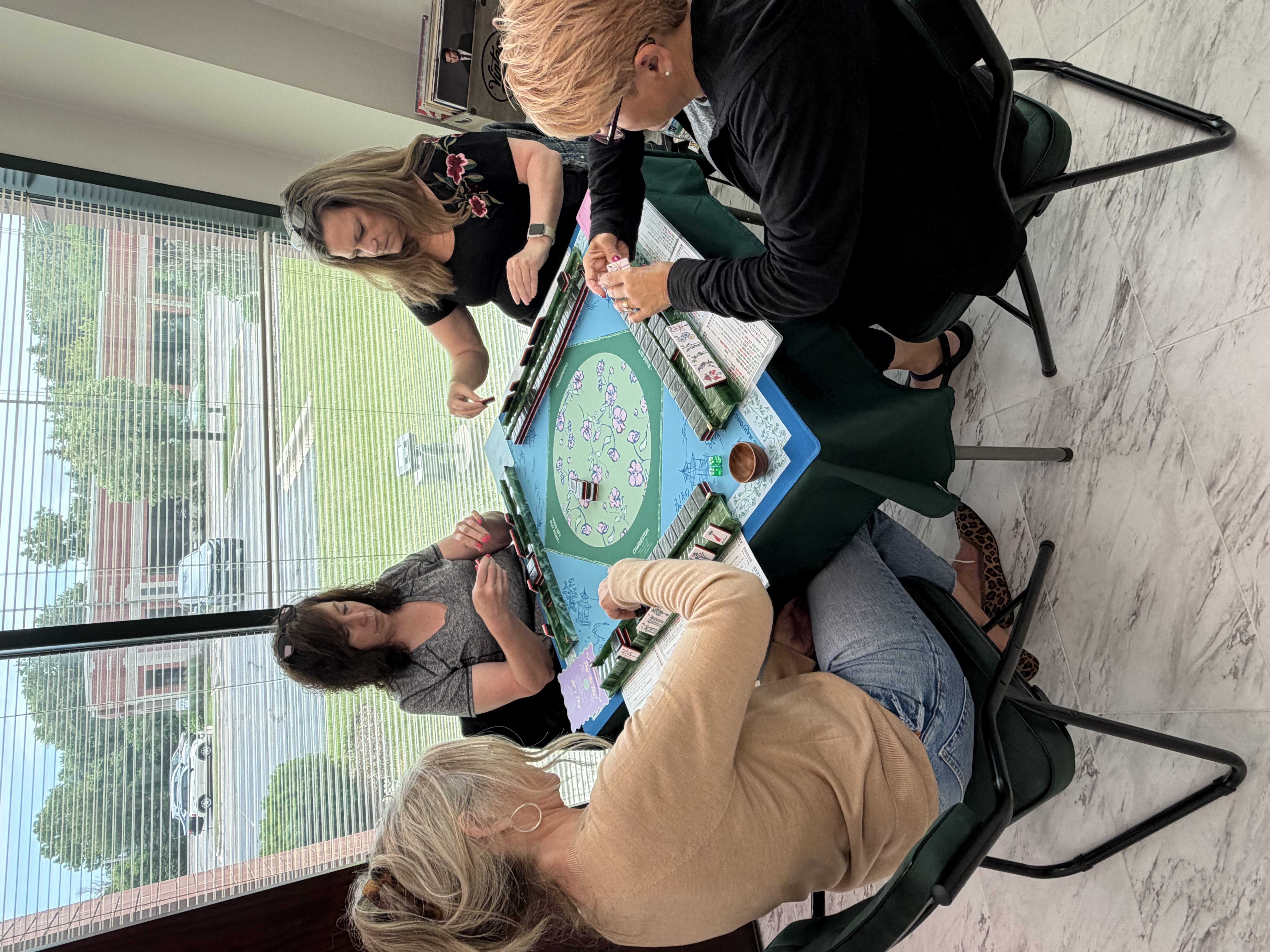
Mahjong Open Play at Unique Health Now is open to beginners, intermediate and advanced players.
If you've ever walked into Unique Health Now on the right day, you might wonder if you've come to the wrong place.
Instead of a quiet waiting room, you'll hear the click-clack of mahjong tiles, laughter filling the clinic, and players groaning over the perfect tile they just discarded. Some days it's beginners learning the game for the first time. Other days it's a room full of regulars who now look forward to seeing their mahjong friends as much as the game itself.
And that's exactly the point. We're not taking a break from medicine — we're practicing it.
Health Is More Than Lab Numbers
As an internal medicine physician specializing in obesity and lifestyle medicine, I spend my days talking about nutrition, movement, sleep, and blood pressure. But if the goal is true longevity, we have to think beyond prescriptions.
Some of the strongest predictors of healthy aging aren't found on a lab report. They're found in human connection.
I can prescribe medication. I can't prescribe friendship. Yet the science keeps telling us that social connection belongs alongside the risk factors we already treat. The 2024 Lancet Commission on dementia identified fourteen modifiable risk factors — including obesity, inactivity, and high blood pressure — that together account for nearly half of dementia cases worldwide. Social isolation is on that list too.
If social connection is medicine, maybe it's time healthcare started creating more opportunities for it.
Why Mahjong?
That led me to a simple question: what would people actually want to come back for, every week?
Not a lecture. Not another appointment. Something enjoyable, mentally demanding, and social — something that challenges the brain while building relationships.
Mahjong checked every box. It's not just a game; it's a workout for executive function — the brain's ability to plan, adapt, and problem-solve. Every hand asks players to track what's been discarded, weigh probabilities, and rebuild a strategy on the fly, all while three other people wait on you.
We teach American mahjong, whose card of winning hands changes every year — meaning the game never lets you get too comfortable. But we're not precious about the version. If you play Hong Kong style, Riichi, Filipino, or Singaporean mahjong, we'd love for you to teach us. The game isn't the medicine. The game is what gets you to the table.
The Brain Is Not Finished
For most of the last century, doctors believed the adult brain was essentially fixed — wiring set, and from midlife on, a slow loss of parts. That turned out to be wrong. The brain reshapes itself throughout life in response to what you actually ask it to do. That's neuroplasticity, and it isn't something you can swallow in a pill — it's the brain's response to effortful, novel, repeated challenge.
Large studies out of China, including one that followed more than 7,000 adults for a decade, consistently find that regular mahjong players hold onto cognitive function better than non-players. The research hasn't compared one style of mahjong to another — nobody's run that study — but what the science points to isn't a specific ruleset. It's a set of demands: recognizing patterns, tracking what's been played, changing course when the hand you wanted disappears, and doing it all in the company of other people. Every version of mahjong asks for that.
It's About More Than the Tiles
Here's what surprised me most: people don't keep coming because they're worried about dementia. They come because they genuinely enjoy being here.
I've watched people who arrived knowing no one become regulars who now meet outside the clinic. I've watched retired adults rediscover a sense of purpose, and people who were nervous to leave their homes start looking forward to "mahjong day." I've watched confidence grow, one game at a time.
I've also noticed something I never expected: people arrive at their medical appointments differently. More relaxed. More willing to ask questions. When the doctor's office is also where your friends are, walking through the door doesn't feel intimidating anymore.
Preventive Medicine Can Be Joyful
Healthcare is shifting from treating disease to preventing it. We know controlling blood pressure reduces stroke risk, and exercise protects the body and brain. We're also learning that meaningful social interaction is an essential part of healthy aging.
At Unique Health Now, prevention doesn't stop when the appointment ends. Sometimes it looks like nutrition counseling or a lab review. And sometimes it looks like sixteen people laughing around four mahjong tables.
One of my favorite quotes — usually credited to George Bernard Shaw, though it more likely belongs to Oliver Wendell Holmes — says it best: "People don't stop playing because they grow old. They grow old because they stop playing."
Our job as physicians isn't only to lower cholesterol or manage blood pressure. It's to help people keep learning, keep laughing, keep connecting. Longevity isn't just about adding years to life — it's about adding life to those years.
If a game of mahjong helps someone stay mentally engaged, socially connected, and glad to walk through our doors each week, it deserves a place here just as much as a blood pressure cuff.
So if you hear laughter coming from our waiting room, don't worry — you've found the right doctor's office.
Beginners are always welcome at Unique Health Now - UniqueHealthNow.com