An Untamed Treasure
McCarthy's Wildlife Sanctuary
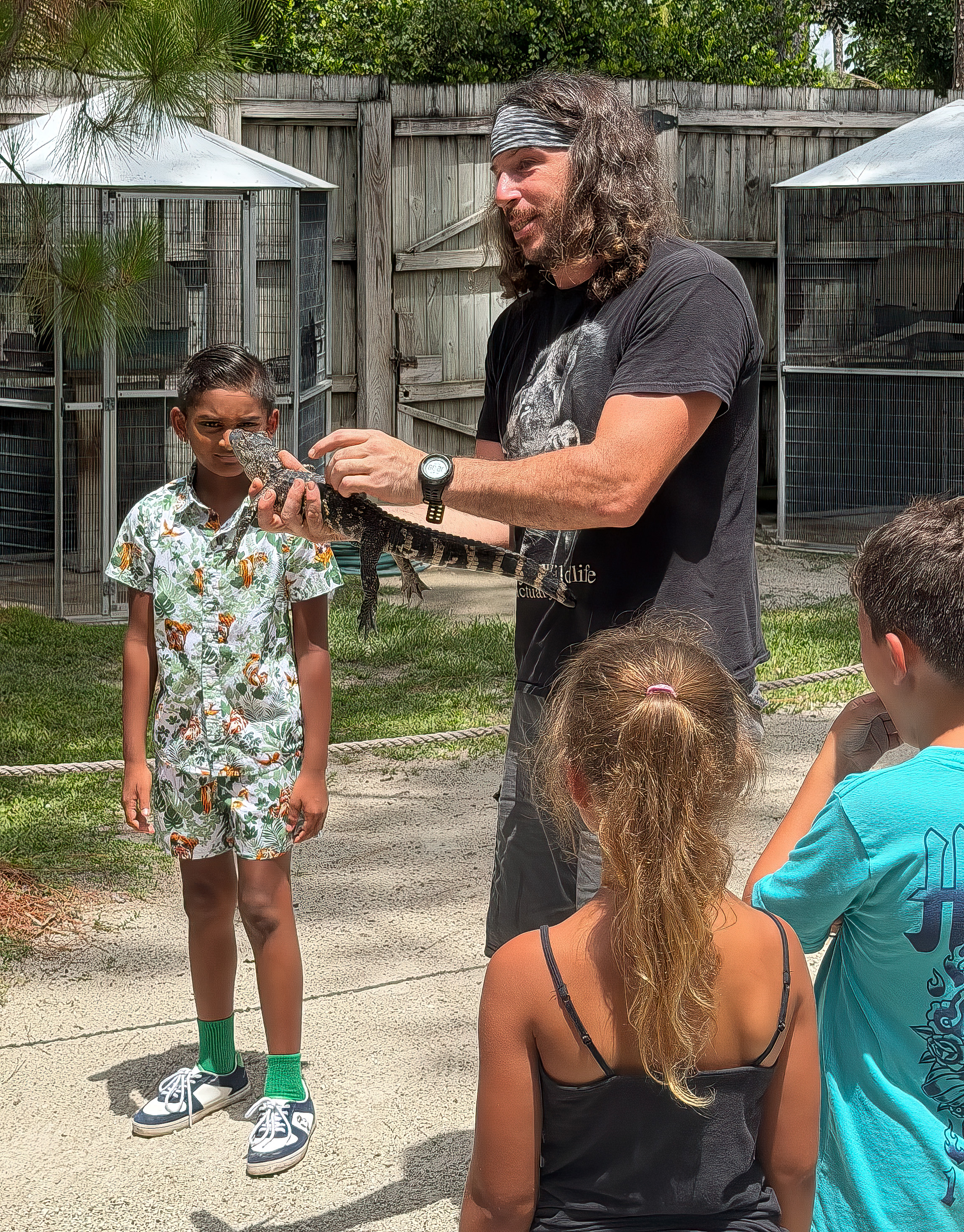
Tour Guide Jeremy
I accepted this assignment expecting to see a few exotic animals mixed in with the usual assortment of local wildlife in a modest, less-than-ideal setting. Although I had heard of McCarthy's Wildlife Sanctuary, I knew very little about it. I left Ibis, covered the seven-mile drive in under 20 minutes, and made the final turn toward the sanctuary. The low drone of a lawnmower was suddenly replaced by a loud splash, the squawk of a macaw, a lemur's whistle, and the unmistakable low, rumbling roar of a lion.
Welcome to McCarthy's Wildlife Sanctuary.
From the moment I was greeted by owner Mark McCarthy, I knew my assumptions were dead wrong. This is a true "diamond in the rough," where exotic animals find a safe haven, native wildlife gets a second chance, and guests enjoy an intimate look at some of the world's most magnificent creatures.
The sanctuary celebrated its 35th anniversary last year. During those three and a half decades, this nonprofit organization has seamlessly blended the serious work of wildlife rehabilitation with community education and unforgettable guest experiences.
Meeting Mark McCarthy was an experience in itself. He makes the "Dos Equis Man" seem uninteresting. Mark is an intensely engaging man with a larger-than-life personality, matched only by his deep passion and genuine love for every resident of the sanctuary. Spending time with Mark feels like stepping into a Netflix documentary filled with incredible adventures, ridiculous challenges, and, of course, endless stories always accompanied by laughter.
Mark's journey began as a kid with an obsession for reptiles, especially snakes. When he turned 16, he decided to leave the comforts of home in Michigan and hitchhike to Miami, leaving his bewildered and concerned parents behind. He had his clothes, $35, and a backpack full of what he considered the real essentials: his snake collection—two rattlesnakes, a gopher snake, a diamondback, and a three-foot boa.
His dream was to work at the famous Miami Serpentarium, directed by William Haast. This was the early 1970s, and trouble was no stranger to a slight, long-haired teenager wandering through the South. He was picked up in Georgia by a chain-smoking man who didn't speak during the two-hour drive. Mark became increasingly uneasy when the driver intentionally passed his exit and snickered as Mark protested.
His survival instincts quickly kicked in. Mark grabbed his backpack, and the driver finally spoke—actually shouted—"What the hell is moving in that damn backpack?"
"Snakes," Mark answered.
The car came to a screeching halt, and Mark was back on his way.
Shortly afterward, he achieved his goal by meeting and impressing William Haast at the Serpentarium. Haast initially explained that there were no positions available—until he noticed Mark's undulating backpack.
"You actually hitchhiked from Michigan with your snakes?"
Mark began work the following day.
Over the next two decades, Mark expanded his expertise to big cats, primates, and raptors while working with various animal facilities and spending time in film production. His studies and travels took him across the globe—from the Galápagos to Panama to Africa. His growing passion for big cats introduced him to an endless cast of characters, from conservationists and sheiks to questionable collectors and shady entrepreneurs.
In 1990, Mark took the first step toward realizing his vision by purchasing a plot of land in West Palm Beach that would become McCarthy's Wildlife Sanctuary.
Every great undertaking needs a terrific partner, and Mark found his in 2004 while traveling to his favorite destination, Tanzania. He fell in love with his safari guide, Aneth, and the two married in 2005. She moved to Florida that same year and quickly became the sanctuary's Assistant Director and Lead Curator.
There were a few early hiccups as Aneth adjusted to a new language and culture.
Shortly after her arrival, Mark asked Aneth to "let the dogs out." She heard "cats" instead and proceeded to let the lion and tiger out of their enclosure to roam the property.
The unsuspecting tree trimmer was less than thrilled as he scrambled up a tree, screaming in shock. Mark heard the commotion, saw the lion and tiger staring up at the frightened worker, and quickly rounded up the cats. The tree trimmer eventually climbed down, raced off the property, and was never seen again.
Known for routinely working 16-hour days, Aneth is credited with keeping the sanctuary in spotless condition. I was fortunate to watch her interact with Mufasa (not Simba), the resident lion, and she truly is the "Cat Whisperer." As Aneth approached the enclosure, Mufasa bounded over like an oversized puppy, seeking nothing more than her attention and affection.
Aneth's daughter, Sabiha Mjema, moved from Tanzania in 2012 and rose through the ranks to become the sanctuary's Lead Zookeeper. Together, the family forms the passionate heart of the operation.
McCarthy's Wildlife Sanctuary has a dual mission: providing permanent, high-quality care for non-releasable exotic animals while aggressively rehabilitating and releasing injured or orphaned Florida wildlife.
The sanctuary has now treated more than 4,000 native animals, including bobcats, sandhill cranes, owls, foxes, and hawks.
The exotic residents have a very different story. Most are victims of the illegal pet trade, abandonment, or rescue from failing, unpermitted facilities. Those rescues often involve unexpected adventures.
One memorable example came when Mark received a 3:00 a.m. phone call from the Florida Fish and Wildlife Conservation Commission requesting assistance after officers discovered a tiger and cougar illegally owned by a traveling magician staying at a Motel 6.
These rescues allow the animals to live out their lives with dignity, proper nutrition, and a supportive environment.
Today, the sanctuary is home to many incredible apex predators, including majestic white tigers, rare black leopards, cougars, and a critically endangered Amur leopard—one of the rarest big cats on Earth.
The bird collection is equally impressive. It includes vibrant scarlet macaws, black palm cockatoos, and Norma Jean, a blue-and-gold macaw who has been with Mark for more than 33 years and has participated in over 7,000 educational programs. Several brilliantly colored toucans also steal the show with their surreal appearance and oversized beaks.
Building on Mark's original love of reptiles, the Reptile House features a world-class collection ranging from massive albino Burmese pythons to deadly green mambas and a formidable Nile crocodile named Larry.
Running a sanctuary with nearly 200 hungry residents is a logistical marathon repeated every day of the year. The day begins at dawn as the team prepares hundreds of pounds of specialized diets—from fresh meat for the carnivores to fruits, vegetables, and pellet blends for the birds and primates.
Mental enrichment is equally important. Interactive feeding puzzles, novel scents for the big cats, and creative habitat structures help stimulate natural behaviors and keep the animals healthy, active, and engaged.
To maintain a calm, stress-free environment, McCarthy's Wildlife Sanctuary is not open for casual public wandering. Instead, it offers exclusive, highly structured tours by reservation from Thursday through Saturday.
The tours are enjoyable and impactful because they are intentionally kept small and led by the very zookeepers who care for the animals each day. Guests hear personal stories about how each animal arrived at the sanctuary and learn about their unique personalities.
During the two-hour walking tour, guides even introduce several smaller, friendly residents for safe, up-close encounters. On my visit, these included alligators, kinkajous, tortoises, tarantulas, and pythons.
I was fortunate to watch Jeremy and Sabiha lead tours during my visit. Jayme is also a valued guide and an integral member of the team. The guests responded with enthusiasm and appreciation, and the guides' passion was evident every step of the way.
Mark and his team are constantly looking for ways to improve the animals' quality of life. He imports a specialized meat from Canada that the cats seem to prefer. The sanctuary also combats flies using "fly predators," tiny harmless wasps that consume fly larvae.
Another creative solution came from a team of Florida State University students, who designed a cooling station for the snow leopards using technology adapted from ice rinks.
These improvements provide tremendous benefits, but they come at a cost.
This year's operating budget is expected to exceed $750,000.
McCarthy's Wildlife Sanctuary has benefited greatly from the generous support of visionary aviator George Batchelor and his foundation. Batchelor's passion for animal welfare and children's education aligned perfectly with Mark's mission.
As a registered 501(c)(3) nonprofit organization, the sanctuary receives no federal or state funding. Its lifesaving work depends entirely on tour fees, private donations, and community support.
I had the privilege of experiencing the heartbeat and rhythm of McCarthy's Wildlife Sanctuary and can honestly say that taking a tour is much more than an enjoyable afternoon. It is a direct investment in wildlife conservation.
Mark, Aneth, and their dedicated team make it impossible to leave without a renewed respect for the natural world.
I ended my interview by asking Mark which animal he most identifies with, insisting that he wasn't allowed to give the predictable answer of "lion."
I wasn't surprised when he chose "snake."
Occasionally misunderstood, equipped with incredible sensory abilities, generally gentle by nature, and inclined to strike only when directly threatened, Mark's explanation was thoughtful and fitting.
Perhaps the most touching detail came at the very end. Mark's parents eventually embraced their son's unique passion, and when his father passed away, his final request was to be dressed in a McCarthy's Wildlife Sanctuary shirt.
For Mark, the sanctuary provides refuge and solace—not only for the animals, but for himself as well.