Touched by a Harp Virtuoso
Harp Retreat in Italy
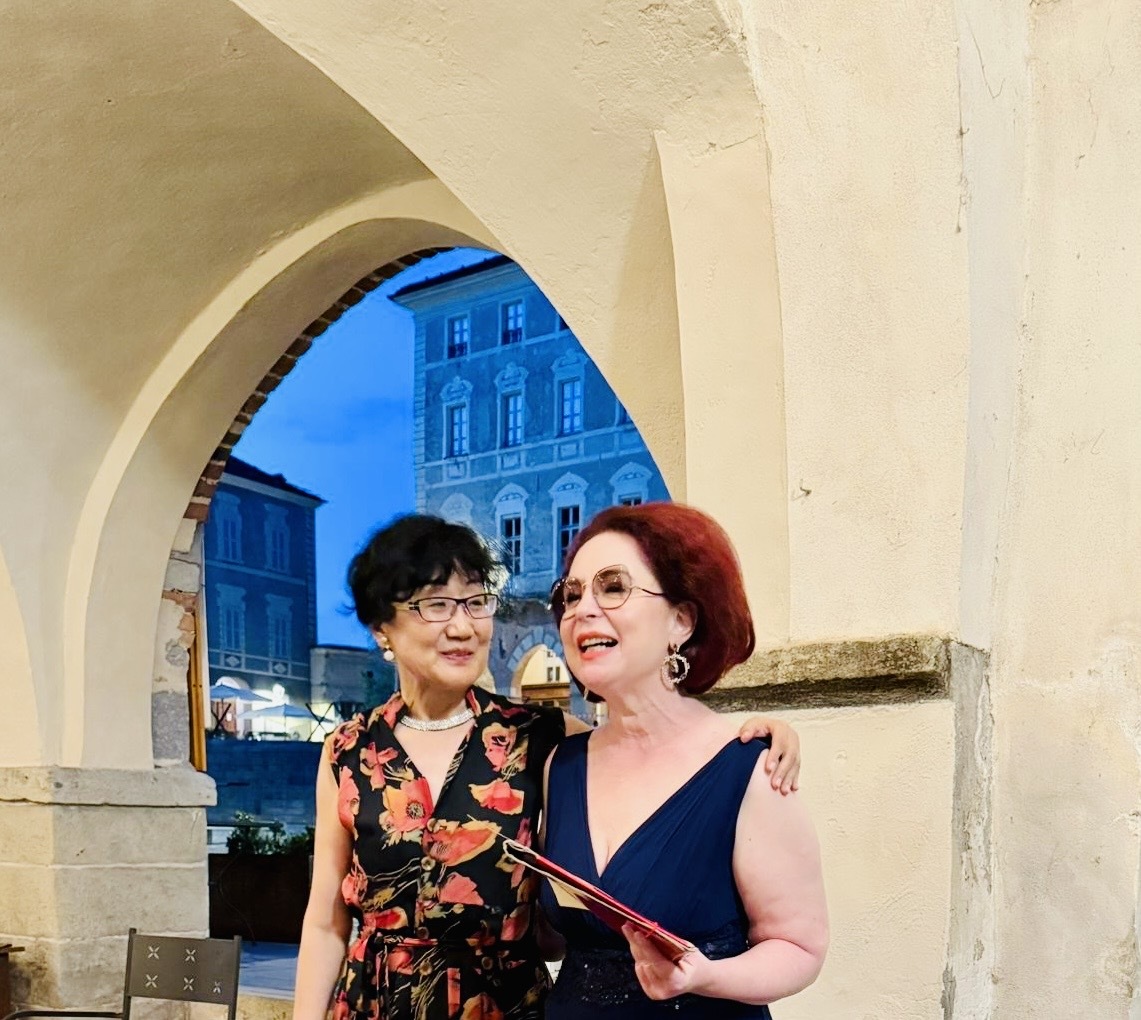
Getting my Mondovi Certificate
“I never imagined the harp could be moved so effortlessly,” I thought as I watched the professor demonstrate improvisation, guiding the instrument smoothly across the stage. With the pedal harp balanced lightly against her shoulder, she walked with ease, her right hand releasing cascades of sound while her left moved freely in the air. Golden sunset light streamed through the open windows, carrying a cool Alpine breeze. I sat transfixed in a classroom at the HarpMasters Academy summer program in Mondovi, Italy, last July.
I have played the harp for more than thirty years as a passionate hobby while building my professional career as an attorney. Unlike conservatory students and professionally trained harpists, I never had the luxury of regular classroom instruction or on-site professors. My practice was mostly at home, with occasional online lessons. For a long time, I felt isolated and longed for a chance to connect with a community of harpists and to receive guidance from true masters of the instrument.
When I first discovered the HarpMasters summer program, I was both excited and apprehensive. I worried that I might not be qualified since I am neither a professional harpist nor a full-time music student. I reached out to the organizers to inquire whether someone like me might be considered. They requested details about my harp background, including my repertoire, former teachers, and any prizes or honors I had received. To my delight, I was accepted.
I treasure this opportunity deeply. Participating in HarpMasters not only expanded my technical skills on the harp but also gave me a profound sense of belonging, in terms of harp playing, and personal growth. The program offers a rich variety of experiences: private masterclasses, orchestra audition coaching, seminars on historical performance, performance workshops, guest masterclasses, and world class harp concerts. It all culminates in a magnificent gala concert by the students, usually held in a stunning hall that had once been a church. The audience sat in awe as the space echoed with shimmering melodies. At times, the harp whispered with intimacy; at others, it poured forth like a shower of hailstones or pearls dropping onto a jade plate.
I gained a deeper understanding of the art of music itself. Beyond technique and notes, I learned how to add color and imagery, bringing each piece to life as the composer envisioned, and at times, even beyond.
During the program, I was often asked how I first came to play the harp. That question carried me back decades.
My answer always begins with a memory from 1989, when I was pursuing my master’s degree in journalism at Indiana University in Bloomington. It was there that I first met the legendary Susann McDonald and Linda Wood. As a young graduate student, I could hardly have imagined how those encounters would open the door to a lifelong relationship with the harp, one that has brought so much joy and light into my life.
At that time, I was sharing a small house near the Jacobs School of Music. Two of my housemates, Cristina Braga and Stephanie Kauffman, were harp students, and they spoke with endless admiration about their teacher, the great harp virtuoso Susann McDonald. As a young journalist, I sensed that such an extraordinary figure deserved to be written about. But would she agree to be interviewed by a student from China? With hesitation, I asked my housemates to pass along my request for an interview, and to my great joy, I was invited to prepare a list of questions.
Email was not yet in use at that time, so I typed and printed my questions and decided to deliver them by hand. When I arrived at her home in the late afternoon, I realized the mail had already been collected. Not wanting to wait another day, I slipped the envelope under her door. As I walked away, doubt crept into my mind: what if she never noticed it? On impulse, I rang the doorbell, hoping only to draw her attention to it. To my astonishment, the door opened, and there stood Ms. McDonald, with her small dog at her side. She looked tired, yet carried an awe-inspiring presence, one that came not from words, but from quiet dignity and depth. Mortified at disturbing her, I apologized and introduced myself as I handed her the envelope.
On my way home, I felt ashamed. I knew she had been unwell and needed rest, and I scolded myself for my thoughtlessness. Yet not long after, as I reached my front door, the phone rang. It was Ms. McDonald herself, her voice calm and steady, ready to answer every question on my list. In that moment, her generosity and grace became unmistakable.
During the following weeks, at her invitation, I followed her almost everywhere, into her classroom, her studio, and even to her Christmas party. I still have the gift I received that evening, a red and white striped pullover. I remember her grand living room opening onto a wide lawn, with seventeen harps of every size arranged around the room -- if memory serves me right. Yet it was not the number of instruments that struck me most, but the way her presence filled the space, commanding respect while radiating warmth.
I recall observing one of her private lessons with Cristina Braga. Afterward, we tried to call a taxi but could not get through. Ms. McDonald insisted on giving us a ride. Knowing how busy she was, and that she had not been well, we slipped quietly out while she looked for her purse, thinking we could spare her the trouble. Feeling rather pleased with ourselves, we walked toward the bus stop, until a horn sounded behind us. A car pulled up, the door opened, and there she was. “Get in!” she commanded.
Cristina later told me that she had traveled all the way from Brazil to study with Ms. McDonald. At first, she admired her as a great virtuoso. But after moments like that evening, when her kindness and generosity were unmistakable, she realized the virtuoso was also a remarkable human being.
Ms. McDonald’s kindness revealed something essential: behind her authority as a world-renowned harpist was a heart of generosity and love. Her faith in God gave her an inexhaustible source of strength and wisdom. That greatness touched me deeply as I wrote my article about her. When it was published in the local newspaper, it received wide acclaim and won first prize in a United States professional journalism competition that year.
After that experience, I fell in love with the harp and longed to learn to play. Yet I had no formal musical training and did not even own an instrument, though I had a strong musical sense since childhood. I shared my wish with Ms. McDonald and Linda Wood. Together, they found a solution: I would serve as the “guinea pig” in their pedagogy class, where advanced students learned how to teach beginners. In this way, I received my very first harp lessons. I was also given permission to use a school harp for practice at night, after the students had finished for the day. That is how my harp journey began.
There were years afterward when I had no access to a harp during my transition from journalism to law. In those times, whenever I heard harp music, my heart ached. Eventually, I saved enough to purchase my first instrument. Today I have three harps, and I practice every day whenever I am at home, often in solitude, but never without joy. I have also performed for my community, including at Christmas and Chinese New Year celebrations, bringing joy not only to myself but to others as well.
The HarpMasters program gave me the opportunity to step out of isolation, to learn in a community, and to be inspired by masters of the instrument. Among them are Mara Galassi, Patrizia Tassini, Luisa Prandina, Susanna Bertuccioli, Milda Agazarian, Hélène Breschand, Anneleen Lenaerts, and Ieuan Jones.
The program’s founder, Dr. Irina Zingg, was herself touched by Susann McDonald. She recalls attending one of McDonald’s summer programs in Switzerland, where she first found the inspiration to launch HarpMasters. Her vision was to ensure that the torch of classical harp artistry would be carried forward by new generations, guided by the same spirit of generosity and love.
Although Susann McDonald passed away in May 2025, her spirit continues to shine in all who were touched by her. The HarpMasters program, and my own journey with the harp, stand as living testimony to her enduring influence.
When I found myself at HarpMasters, watching a professor guide the harp effortlessly as golden light filled the room and the Alpine breeze drifted in, I felt a sense of completion. Susann McDonald’s legacy endures, carried forward in every note, every lesson, and every life she touched.