Neighborhood Nature: Our Resident Red-Tailed Hawk
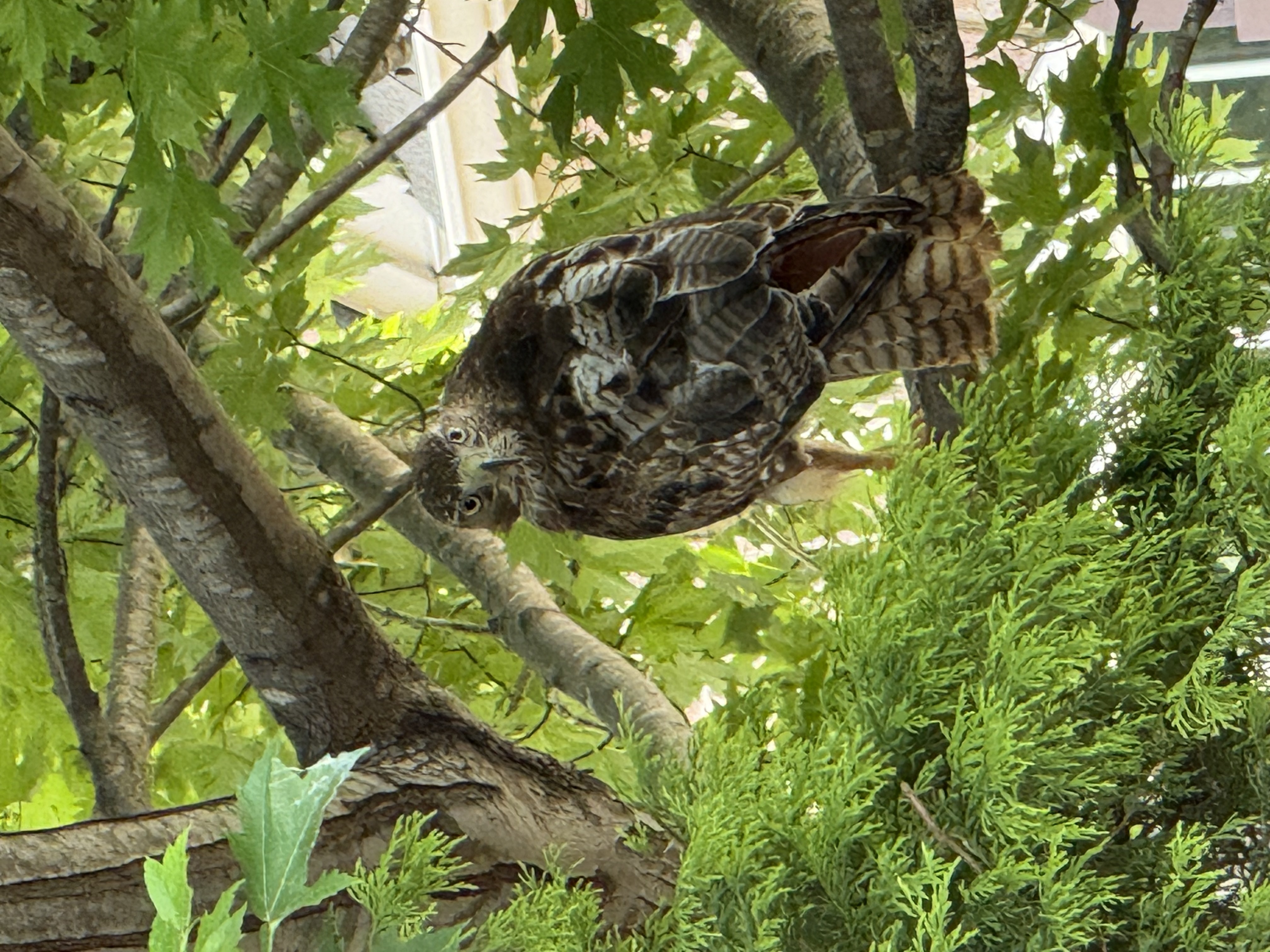
One of my favorite neighborhood sightings over the last six months has been a hawk that seems to have decided our community is home. While I can’t say with certainty it’s the same bird each time, I suspect it is. Its behavior is unlike any hawk I’ve encountered before.
Most hawks I’ve seen take flight the moment a person or vehicle comes near. This one is different. On one occasion, it calmly sat on the curb as I slowly drove toward it. I backed up and approached again, several times, in fact. Only then did it casually fly to the lowest branch of a nearby tree, where it remained, watching me with quiet curiosity.
I’ve spotted it perched on a “For Sale” sign, resting on the lowest branches of slender roadside trees, and a neighbor believes it may even be nesting in or near her chimney. She often finds it on her balcony, completely unconcerned as she steps outside to water her plants.
My phone identifies our visitor as a red-tailed hawk, one of North Carolina’s most familiar birds of prey. These remarkable hunters help keep nature in balance by feeding on rodents, rabbits, amphibians, insects, and other small animals. In the wild, they often live 10 to 15 years, so with a little luck, this could remain one of our neighborhood’s regular residents for years to come.
If you happen to spot our feathered neighbor, take a moment to appreciate its beauty and the important role it plays in our local ecosystem. Just remember that hawks are protected by both state and federal law. It is illegal to hunt, kill, injure, harass, or possess a hawk without the proper permits.
Sometimes the most memorable wildlife encounters don’t happen deep in the woods. They happen right outside our front doors.