Meet Harry Trombitas: Muirfield Resident, FBI Agent, and Published Author
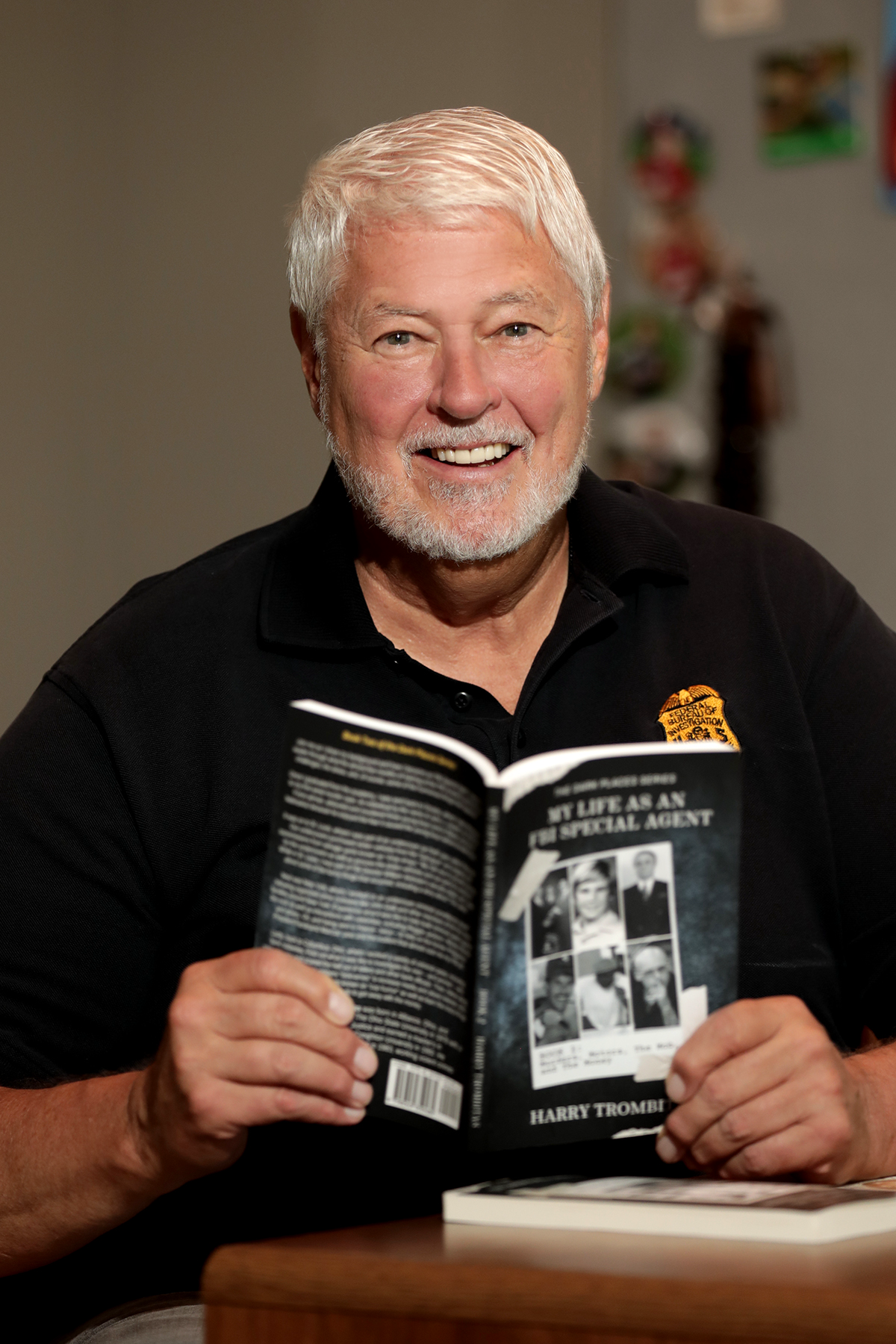
Harry Trombitas had a solid plan when he left his home in Alliance, Ohio in 1974 to attend The Ohio State University. He intended to walk on to the OSU Men’s Basketball team and study pre-med. The basketball dream panned out, but Harry’s distaste for chemistry made him pause about his projected career path. Meanwhile, Harry sought out a campus job to earn money and found his way to the OSU Police Department, which was seeking student security support. His first assignment in law enforcement was to work undercover with a walkie talkie and an earpiece, spotting and escalating to police possible car and bike thefts in progress. This job guided Harry to change his major to Criminal Justice and led to a lifelong career in law enforcement, including almost 30 years as an FBI agent.
Upon hearing of Harry’s intriguing career, it wasn’t uncommon for Harry to hear comments like, “wow, I bet you have some stories. You should write a book!” But when his wife Barb of 46 years suggested it, Harry took the idea seriously and set out to memorialize his career on paper. The rest is history – quite literally documented history – in Harry Trombitas’ four-book series entitled, “The Dark Places.”
Jumping back to Harry’s FBI origin story, upon graduating from OSU, Harry’s first job out of college was a police officer in Evanston, Illinois. His assignment area was Northwestern’s campus. From there, Harry took an opportunity at Creighton University in Omaha, Nebraska, where he became the youngest Director of Public Safety. Several important life events occurred while at Creighton. Most importantly, Harry and Barb (who he met at OSU) gave birth to a son, Matt, their first of two children. Harry also earned his master’s degree in counseling/psychology while employed at Creighton.
While at Creighton, Harry had his first exposure to the FBI. Given there is an FBI field office in Omaha, Harry regularly saw FBI agents on campus recruiting from the law school. At the time, incoming agents to the FBI needed to be an accountant or a lawyer. However, one of the visiting agents mentioned to Harry a diversified program the FBI offers that didn’t require one of these degrees. Harry and Barb made the difficult decision, as new parents, for Harry to leave a great job at Creighton to join the FBI – with no guarantee that he would pass the tests and make it through to be offered a role as an agent.
Harry’s first step was to spend 4.5 months at Quantico, learning core skills and knowledge, doing fitness and weapons training. Harry successfully made it through the evaluation period and received his first assignment in Omaha. During his first year in Omaha, Harry worked on his first serial murder case and was accepted to the SWAT team – a role he maintained throughout his career. Typically, after a year in Omaha, agents are transferred to a small/medium size office – and for Harry, this assignment was in St. Louis, MO (where he stayed for two years).
St. Louis was a formative post for Harry – he successfully brought down a car theft ring, and he had a unique opportunity to serve as personal security detail for Judge William Webster while he was Director of the FBI. Judge Webster lived on a farm between St. Louis and Kansas City, and he returned home from DC most weekends. Security detail for Judge Webster was a special assignment for an agent on the St. Louis SWAT team. While most of the senior/tenured people on the SWAT team didn’t want to do this gig, Harry immensely enjoyed the experience and has several great stories about his adventures with Judge Webster (many of which can be read about in Harry’s books)!
After serving in a small/medium office, new agents were transferred to a large city for at least a year. For Harry and Barb, this meant a move to New York City. Harry served on the undercover organized crime detail and worked on several cases centered around many mafia gangsters. One of the more notable cases was Tommy Pitera, a leader in the Bonanno crime family. Tommy was a “fixer” dubbed “Tommy Karate” due to his habit of using martial arts while in a fight. Tommy’s role was to convince business owners to pay the protection tax to the mob… pay or else. Tommy was rumored to have killed at least 30 people.
Finally, after Quantico, Omaha, St. Louis, and New York City, Harry reached the tenure when he could request an “office of preference,” which is generally where most agents work from for the rest of their career. Barb and Harry selected Columbus, Ohio to return home to the Buckeye state. Harry spent the last 22 years of his career with the FBI in Columbus (a site aligned to the FBI’s field office in Cincinnati). By this time, Barb and Harry had welcomed a daughter, Kristen, into their family. The Trombitas family saw no better place to raise their kids than Dublin, Ohio, and they found their way into Muirfield in 1999.
In Columbus, Harry worked in the violent crimes division, remained on the SWAT team, and was asked to serve as the FBI’s media relations spokesperson, with a specialty in bank robberies. For the first 20 years of his career, Harry was leery of the media – like many in law enforcement. Through working with the media he learned to respect and connect with them and was able to see how the media can help in getting information to the public. Even after retirement, the media occasionally reached out to Harry to get his perspective on current cases, and he tries to help them when he can, because the media helped Harry on several key cases throughout this career.
By his retirement, Harry worked on over 1,000 bank robbery cases. Harry shares his insights about bank robberies, and more, in his books. In book 2, Harry talks about the different kinds of robberies, and how jail is their #1 training ground to learn the trade. One of the more notable robbery cases he worked on included the tragic murder of Columbus police officer Bryan Hearst (book 3). In book 4, Harry shares the case of an attempted robbery on a Brinks facility, and these sophisticated burglars almost made off with $100 million dollars. Readers of Harry’s books will also learn about the clever nicknames he gave to robbers (and shared with the media) in an effort to drive up public interest and aid in their capture. Spoiler alert: one of these nicknames was ‘the bad breath bandit,’ as several victims interviewed shared that the robber had the worst breath of anyone they’d ever smelled!
Despite the clever nicknames, one of the most important habits Harry practiced throughout his entire career was to always maintain empathy and respect. It humanizes situations and helped him achieve better outcomes, because respectful interactions build rapport. Harry attributes his approach and reputation of being fair as one of the reasons why, over his 29 years in the FBI, he never faced a personal threat to him or his family. Harry took special care of his interactions with the many victims he supported throughout his career. They looked at him as the person who would bring them justice, and a few of the unsolved murder cases are the ones that continue to bother him the most. In general, the appreciation he has received and continues to feel from the victims gives Harry immense gratitude.
As Harry sat down to begin documenting his career, he wrote 2-3 hours per day over a 4-year period. Over 260,000 words. Harry knew he needed the FBI’s review and approval, so he sent it to their pre-publication unit for what was said to be a 4–5-week review. In reality, it took 1.5 years to hear back from them, asking for a few redactions though giving their approval to proceed, which was critical to move forward. Though Harry ultimately decided to self-publish, it was through consultation with a publisher that he decided his book was actually four books – a series. While there are many ways to measure success and impact over the course of a career, learning that the insight and outcomes of your life’s work cannot be contained in one book, but rather four, must be at the top of the list.