Millie Bull Horton
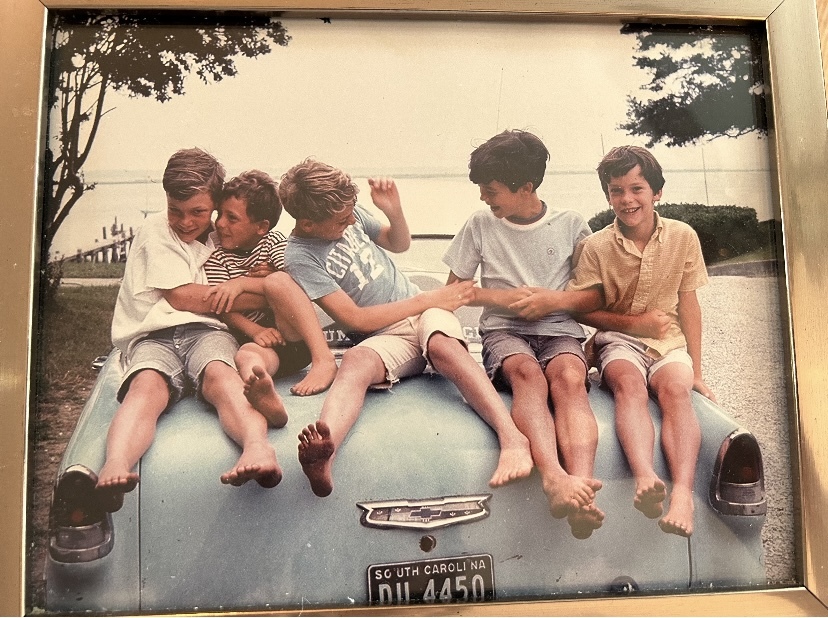
Photo from Claire Freeman - Betty Burn's sons John and Edward (pictured with the Hay boys circa late 60s/early 70s?)
When Millie first set foot in the Old Village in 1977, she wasn’t just moving into a neighborhood, she was stepping into a community with roots, quirks, and character. For someone who grew up in the country, wide stretches of land and untamed greenery had always felt like home. After years of city-living in a rented carriage house on East Battery, she longed for a little more space, what she fondly calls “elbow room.”
It was family that drew her to Bank Street. A relative by marriage, Annie Plowden, lived next door and kept an eye out for property that might suit her. When 210 Bank Street came up for sale, Millie jumped. “Annie was the reason I got my house,” she says, remembering the closing handled by neighbor and attorney Jack Mauldin, whose wife Peggy traced her own family ties back to the old lighthouse keeper’s house at the top of the hill.
First Impressions of a Village
To Millie, the Old Village was nothing short of “quaint” and “eclectic.” Unlike today’s manicured lawns and polished façades, the neighborhood in the late ’70s had a wilder charm. Across the street from her house sat what she laughingly describes as “a jungle,” where a pistol-wearing neighbor lurked in the shrubbery, jotting down license plates and phoning contacts at the DMV. Just down the street, the open lot bounded by Bank, Pitt, Royall, and Ferry served as an unofficial dog park. A gathering place for neighbors and their pets.
Even the houses carried stories. On Pitt Street, Mary White lived in a little white cottage, a simple WWII-era home now with a tin-roofed porch. Each day, Millie would see her taking her “daily constitution,” cane in hand, hair pulled back neatly with a bow. Other neighbors left strong impressions too: Judge Richter, who lived in a stately brick home on the corner of Pitt and McCants, and Annie herself, always a steady presence next door.
Houses with Character
Back then, the homes of the Old Village were diverse and deeply personal, never cut from the same mold. “They were unique,” Millie recalls. “Southern, Charleston-style houses mixed with village bungalows—much more modest than today’s imposing ‘MacMansions.’”
She remembers the Hitopolous family, with Harry known for his sought-after renovation skills, and Kim Richardson, who bought the house across from the pharmacy that had once belonged to two spinster sisters. One of them, Eunice Caldwell, taught Latin alongside Millie at Charleston Day School. Each home carried a story, layered with the lives of those who came before.
Daily Life on Bank Street
For Millie, the rhythm of village life was shaped by the harbor. Afternoons often found her walking her dogs or settling onto the low wall by the Burn home, watching shrimp boats and deep-sea fishing charters drift past Crab Bank. “The harbor was a panorama of activity and provided calmness to the day,” she says. She could even hear the Mustang, a fishing boat, leaving in the morning and returning like clockwork at 5 p.m.
Weekends meant simple pleasures: a grilled cheese and milkshake at the Pitt Street Pharmacy soda fountain, or a slow stroll across the Causeway (Pitt Street Bridge). “The Causeway is a special place,” she says. “A spot for walking, biking, reading, or just watching ships sail into the harbor.” To this day, it remains one of her favorite corners of the village.
The Ties That Bind
Life in the Old Village has always been as much about people as places. Millie fondly remembers the Royall brothers, John and Robbie, who ran the iconic Royall Hardware store. “Any nut, bolt, or screw you could ever need could be found there,” she says. “And if you couldn’t, Rusty or Dave would fix your lamp cord, sharpen knives, or make a key.” The Royalls, who also worshipped with her at Mount Pleasant Presbyterian, weren’t just merchants, they were storytellers, problem-solvers, and anchors of the community.
Her teaching years at Charleston Day School further deepened her ties to the neighborhood. Under headmaster Ned Jaycocks, she taught English and history, recalling lunches spent listening to the bells of St. Philip’s drift through the air. Though she eventually left to attend graduate school, Millie kept in touch with Jaycocks, visiting him in McClellanville and later in the Old Village before his move to Florida.
A Village Remembered
Looking back, Millie treasures not only the houses and businesses that defined the Old Village, but the moments that stitched her life into its fabric: Mary White’s daily walks, teenagers leaping from the Pitt Street Bridge, or the snowy day when her Porsche sat in the driveway, framed by a jungle of live oaks and untamed yards that have since disappeared.
For nearly five decades, Millie has witnessed the Old Village grow, modernize, and shift. Yet in her telling, it’s clear that beneath the polished lawns and new builds, the heart of the community remains—the people, the harbor, and the quiet charm that first drew her to Bank Street. “It was quaint, it was eclectic,” Millie reflects. “And it still is, if you know how to look for it.”
Weathering Hugo
But the most defining moment in Old Village memory came with Hurricane Hugo in 1989. “It began with days of preparation ahead of the storm and thoughts about when to leave,” Millie recalls. She left twice, loading up furniture to store at her parents’ house 85 miles away. That night, she and her neighbors listened to the radio, hearing reports of waves crashing over the High Battery and dire warnings for downtown Charleston.
When she returned, her house had taken on three feet of water. Neighbors swore it lasted no more than 45 minutes—hard to imagine water rushing in and out of sealed homes so quickly. “Other people had shrimp swimming in their house,” she says. With family help, she hauled out ruined furniture, drying what she could in family warehouses inland. Her sister, a baker, faced a different crisis: five freezers packed with baked goods and no power. Their father hitched an open trailer, loaded up the freezers, and hauled them inland to a generator.
The aftermath was a story of resilience. FEMA loans provided relief, but community bonds carried neighbors through. A Florida “storm chaser”—an angel in Millie’s telling—parked his camper in her front yard and worked tirelessly on repairs. Chuck Bennett, a local contractor and friend, ultimately rebuilt her home. “Hugo certainly changed all of us in the OV in a bonding that only those kind of incidents can do,” Millie says. “Even today, those who remember the storm feel like the ‘been heres,’ not the ‘come heres.’”
The Pillars of Community
Old Village has always had its “pillars,” the figures who stitched the fabric of the neighborhood. Millie remembers them well: Dr. Ward, the local GP; pharmacist Kim Richardson and his wife Katy; Betty and Cameron Burn; the Royall family, whose hardware store was indispensable; and Joe Cameron, a Citadel classmate of her father. There were the Staffords, the Sassards, and Chuck Bennett himself, whose slate-roofed home, so the rumor goes, once required workers to come from Wales to install. Each name brings a face, a story, and a reminder of the community’s closeness.
When asked if that spirit still survives, Millie smiles and quotes the old Girl Scout song: “Make new friends but keep the old; one is silver and the other, gold.”
Cars, Clubs, and New Adventures
Today, Millie’s Old Village life blends history with hobbies. After 39 years of teaching English, she embraced a new passion: classic cars. The seed was planted long ago, when her parents owned vintage automobiles and her father served as photographer for their car club. “I watched his slides and knew all the people and the cars,” she says. In 2012, the family car passed to her, sparking a new chapter.
Now, she’s a proud member of the British Car Club of Charleston and the Rolls-Royce Owners’ Club, among others. “My mechanic has tutored me well in the hobby,” she laughs. The British Car Club will celebrate its 41st anniversary this October with a public show at Palmetto Islands County Park. For Millie, these gatherings are about more than the vehicles. “It’s the stories—how people got into the hobby, what cars lurk in garages until the right moment, and the fixes people trade like recipes.”
From Coffee & Cars at Freshfields to the grand showcases on Kiawah, the events are reminders that every car, like every house in the Old Village, carries a history worth telling.