The Cutting Edge
A conversation with Fencing Phenom Jayden Hooshi
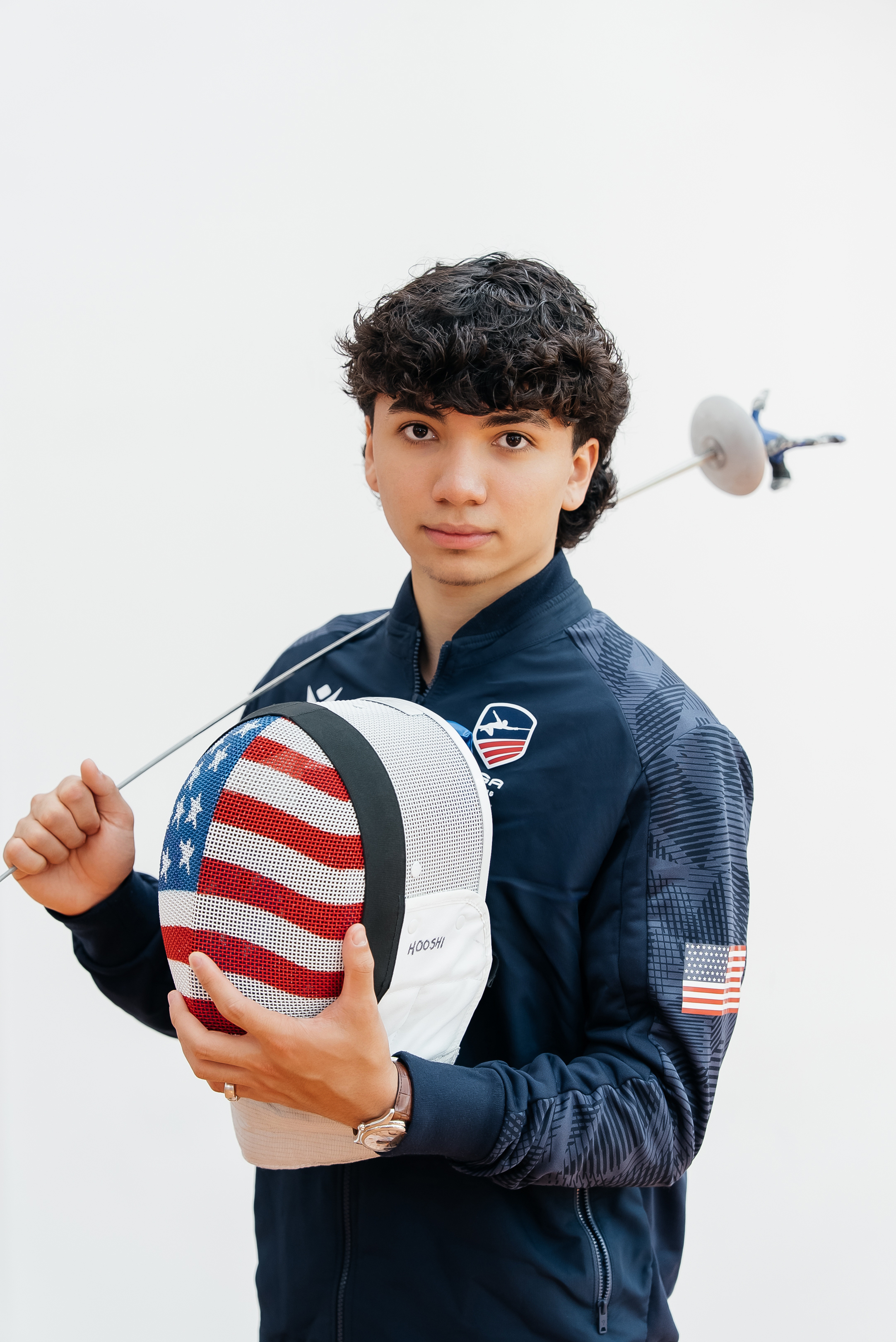
In the elite world of international fencing, where lightning-fast reflexes meet intricate strategy, Old Westbury’s own Jayden Hooshi has emerged as a true force. At just 17 and a senior at Jericho High School, Jayden has not only secured a coveted spot on the U.S. World Team (he is currently ranked U.S. No.2 and Junior World No. 11 in Men’s Foil Fencing - 20 and under) but he has also consistently demonstrated his exceptional skill and unwavering resolve against the globe's top fencers. This level of talent has earned him the distinction of being the youngest sponsored U.S. athlete by Uhlmann, a premier Olympic sporting and equipment company.
Most recently, he traveled to Asunción, Paraguay, where he fought his way to the podium with an individual bronze medal. His semifinal match ended in a razor-thin 14–15 loss, a bout clouded by questionable calls, yet Jayden handled the disappointment with the grace and maturity that have already become his hallmark.
This summer, Jayden trained to represent Team USA at the prestigious Junior Pan American Games, a competition held only once every four years and known as a stepping stone to the Olympics. Despite his demanding schedule, he made a deliberate effort to serve his Long Island community, working with children as a special needs counselor at Mid-Island Day Camp. The resilience and empathy he's learned from competing abroad now show in how he naturally uplifts and cares for others. With the same passion he brings to every bout, Jayden proves that his greatest victories aren’t only on the fencing strip, but in the lives he touches.
When we first met Jayden, he seemed quiet and a little reserved. But it didn’t take long to see the sharp humor, easy kindness, and cool confidence that make him stand out. Bright, independent, and deeply appreciative of the support that has helped him reach this level, Jayden carries himself with a natural swagger matched only by his determination. We recently sat down with this remarkable student-athlete to talk about his journey, the victories that have shaped him, and the challenge of balancing world-class competition with the demands of academic life.
Congratulations on qualifying for the U.S. World Team—an incredible achievement! Can you walk us through that moment and share some recent highlights in your fencing career?
Thank you! Qualifying wasn’t a single thrilling moment—it was the result of podium finishes across a series of World Cups and North American Cups, culminating in a final season point tally. I finished the season second overall, just a few points shy of being Junior rank No.1 in the U.S. The top three fencers in the U.S. are selected for the World Championships. In recent years, “Worlds” have been held in cities like Tel Aviv, Plovdiv, Cairo and Dubai. This year, it took place in Wuxi, China - a modern city near Shanghai.
I prepared by training with other World Team members and alternates at a USA Fencing–funded training camp in Boston and by competing at Senior World Cups and Grand Prix events. It’s an exhausting but exhilarating process.
One incredible moment was placing second at the Junior World Cup in Greece. Another was making the top 8 in Division 1 at the North American Cup in Kansas City, Missouri. Those tournaments are filled with world champions and Olympians so each performance helped prepare and build my confidence at the international level.
I prepared by training with other World Team members and alternates at a USA Fencing–funded training camp in Boston and by competing at Senior World Cups and Grand Prix events. It’s an exhausting but exhilarating process.
One incredible moment was placing second at the Junior World Cup in Greece. Another was making the top 8 in Division 1 at the North American Cup in Kansas City, Missouri. Those tournaments are filled with world champions and Olympians so each performance helped prepare and build my confidence at the international level.
You’ve competed internationally—what’s been your most memorable trip and why?
Heraklion, Greece was the most memorable. It was a designated and major Under-20 World Cup of the season, and I was immediately drawn in by the island’s rich history, incredible food, and the warm, down-to-earth people I met. The hospitality and culture in that region were truly unforgettable.
As for the competition, I finished as the vice World Cup champion, which was such a nice bonus, making the experience even more special.
As for the competition, I finished as the vice World Cup champion, which was such a nice bonus, making the experience even more special.
Any particular moment that sticks with you?
Definitely—the Senior Grand Prix in Lima. I advanced to Day 2 as the youngest fencer in the tournament and faced Italian Olympian Alessio Foconi, one of the most decorated foilists in the world. The match drew a huge crowd and ended in a heart-pounding 15–14 score. I was just one touch away from eliminating a former World No. 1.
Another unforgettable moment was my 15–14 victory over the reigning Cadet World Champion at the Junior World Cup in Greece. That final-touch win propelled me into the semifinals and ultimately the finals. Both bouts proved I could go toe-to-toe with the world’s best.
Another unforgettable moment was my 15–14 victory over the reigning Cadet World Champion at the Junior World Cup in Greece. That final-touch win propelled me into the semifinals and ultimately the finals. Both bouts proved I could go toe-to-toe with the world’s best.
You’ve represented Team USA for four years now—a major accomplishment. What’s it been like representing your country, especially as the only fencer from Long Island on the team?
It’s been an honor. I was the only Cadet, Junior, and Senior National Team member from Long Island. Being born and raised there, it meant the world to me to represent not just Team USA, but my hometown. I was also the only men’s foil cadet World Team athlete from the Northeastern U.S., so I felt empowered to represent Long Island, New York State, and my country on the global stage.
We tried everything growing up—travel soccer, baseball, competitive basketball—but when I saw my older brother take up fencing, I was instantly intrigued. Fencing involves a lot of strategy and is often described as “physical chess.” It also demands far more athleticism than most people realize. Training is intense and includes cardio, footwork drills, and strength training. It’s more rigorous than any other sport I've competed in.
To me, it felt like a real-life movie or video game: one-on-one duels, dramatic battles, scoring points with every hit. That adrenaline and challenge drew me in—and eventually, I knew I wanted to take it as far as I could.
To me, it felt like a real-life movie or video game: one-on-one duels, dramatic battles, scoring points with every hit. That adrenaline and challenge drew me in—and eventually, I knew I wanted to take it as far as I could.
Your parents are full-time professionals, yet they've been incredibly supportive of your fencing journey. What has that meant to you, and how do you manage the demands of training, travel, school, and family life?
I’m deeply grateful for the sacrifices my parents make—both in time and finances. They constantly prioritize my schedule over theirs, and I don’t take that for granted.
Balancing fencing with school and family has been one of my biggest challenges. I’ve missed countless school days due to competitions. That means when I return, I’m catching up on missed exams, projects, and new material—all while still competing and training.
It can also be emotionally taxing, as my classmates, friends, and sometimes even teachers assume I’m away on 'vacation' or holiday. They don’t realize that I’m actually under intense pressure during these trips and have very little time to relax or enjoy the travel experience.
Many of my flights are red-eyes across major time zones, which makes recovery difficult. Most competitions are in Europe or Asia, so local fencers often have a sleep and readiness advantage. During trips, I have little time to do schoolwork, and access to WiFi or necessary resources is often limited. The day I return, I usually have jet lag and am expected to take exams on material I wasn’t even present to learn in class. I often have to self-learn, make arrangements before and after school, and sacrifice my lunch periods just to catch up.
Balancing fencing with school and family has been one of my biggest challenges. I’ve missed countless school days due to competitions. That means when I return, I’m catching up on missed exams, projects, and new material—all while still competing and training.
It can also be emotionally taxing, as my classmates, friends, and sometimes even teachers assume I’m away on 'vacation' or holiday. They don’t realize that I’m actually under intense pressure during these trips and have very little time to relax or enjoy the travel experience.
Many of my flights are red-eyes across major time zones, which makes recovery difficult. Most competitions are in Europe or Asia, so local fencers often have a sleep and readiness advantage. During trips, I have little time to do schoolwork, and access to WiFi or necessary resources is often limited. The day I return, I usually have jet lag and am expected to take exams on material I wasn’t even present to learn in class. I often have to self-learn, make arrangements before and after school, and sacrifice my lunch periods just to catch up.
Looking ahead, what are your goals for the future?
In the short term, I’m focused on continuing to train and compete at the highest level while preparing to fence for a Division 1 college team. I’ve been fortunate to receive recruitment offers from top universities, and I’m excited about the opportunity to qualify for the NCAA Championships and eventually medal—or even win—during my collegiate career.
Long term, my goal is to make the U.S. Olympic team. As for a future career, I have a range of interests and haven’t decided on one path yet, but I hope to find a way to connect fencing and sports to whatever I pursue—whether that’s in medicine, business, law, or my own startup.
Long term, my goal is to make the U.S. Olympic team. As for a future career, I have a range of interests and haven’t decided on one path yet, but I hope to find a way to connect fencing and sports to whatever I pursue—whether that’s in medicine, business, law, or my own startup.
For younger kids in the community—those just starting out or dreaming big—what advice would you give about staying focused, passionate, and grounded?
Don’t get discouraged. Let your losses fuel your growth. I learned more from losing than from winning. You might lose to a tough opponent today, but if you keep fighting and pushing, you’ll eventually beat that same opponent.
Believe in yourself. Fencing teaches discipline, mental sharpness, and physical strength—but it also builds community. Of all the sports I’ve tried, fencing has truly become my passion. It’s fast-paced, mentally demanding, and incredibly rewarding. The people you meet are not only competitive and driven, but also well-rounded: academically, athletically, and most importantly, empathetically.
Believe in yourself. Fencing teaches discipline, mental sharpness, and physical strength—but it also builds community. Of all the sports I’ve tried, fencing has truly become my passion. It’s fast-paced, mentally demanding, and incredibly rewarding. The people you meet are not only competitive and driven, but also well-rounded: academically, athletically, and most importantly, empathetically.
Is there anything else you’d like to share about your journey and experiences with your neighbors?
I’d like everyone to know that our world can be united and at peace when we celebrate the passions we all share—whether it’s literature, music, the arts, or sports like fencing. These are powerful forces that connect people across borders, languages, religions, and cultures.