Trekking in Search of the Mountain Gorillas
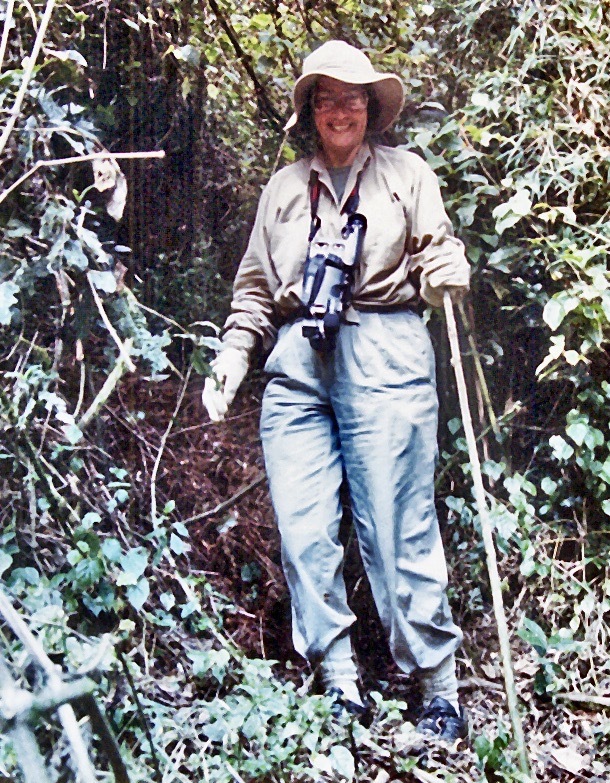
Me (Barbara) in the rainforest
There we were, you wouldn't believe it! We thought we were going to die! We were face-to-face with a humongous 550-pound Silverback gorilla, who was charging directly at us, roaring as he came!
We were warned by our guide to expect this. He taught us to slowly lower ourselves to the ground, keep quiet, make no sudden moves, and never point at or look at the Silverback – gorillas view this as aggressive behavior! And NEVER EVER turn around and run!
Try to do that in the face of a charging gorilla!
This is how my memory recalls these events when we trekked up through the steep jungle terrain in search of the mountain gorillas in Africa in 1989. But according to my trip diaries and after checking with my husband Stan, I find that my memories are not correct!
Background
Mountain gorillas primarily inhabit the cloud forests of Central Africa along the border of Rwanda, Uganda and Zaire (now the Democratic Republic of the Congo). Gorillas live in families with a leader called a Silverback, so named because the older males get silver hair down the length of their backs.
Preface
In October 1989, my husband Stan and I went on a month-long African safari. After three weeks on safaris in Kenya, we flew to Rwanda for a night to catch a small plane to Zaire. In Zaire, we spend two days trekking into a different gorilla group each day, composed of 24 and 27 gorillas each. Only eight tourists are allowed to visit any one group of gorillas each day.
The next morning, the plane which is supposed to fly us to Zaire is down for repairs. Instead, we spent a long day in a van driving through two-thirds of Rwanda to reach our destination of Bukavu, which is on the eastern side of Zaire near the border with Rwanda.
For brevity, I am combining our two days of trekking into one.
Trekking to Find the Mountain Gorillas
In the early morning, from our hotel in Bukavu we have a beautiful 45- minute drive along Lake Kivu and up into the mountains to the Kahuzi- Biega National Park. At the Park entrance, our guide and three trackers crowd into our van for a 10-minute ride to the rainforest entrance.
A Park guard with a rifle also joins us because we are going to an area where there are many elephants and rhinos who readily charge. The air in the van is very stifling during the ride due to the strong body odor of the natives!
Our guide and trackers visit the same group of gorillas each day – thus they are very familiar with them and know where they were last seen the day before. Each gorilla group travels to a different place every day in search of food, and the trackers have to look for their spoor and follow it to find them. They locate signs of the animals – their footprints, pieces of chewed mountain celery, or perhaps an abandoned nest – and the search is on.
On our trek to where the gorillas were last seen yesterday, the trackers occasionally hack a pathway for us with their machetes. As we slither through dense rainforests and up and down hills, we have to be careful not to trip on the vines running across the ground.
Fire Ants
Stan and I find ourselves standing on a fire ant nest, but we can’t move on the narrow trail with dense rainforest on each side and others ahead of and behind us. We didn’t get the word about tucking our pant legs into our socks – as a result, several stinging fire ants got up inside. We do some fast shuffling to quickly get our pant legs tucked in and spend the next half hour trying to kill the trapped fire ants. They bite fiercely and are very hard to kill – we squeeze them hard through our clothing, but it often just stuns them and they begin to bite again.
It takes us 35 minutes of trekking to arrive at the place where our guide and trackers found the gorillas the previous day. From that point, our trackers have to cut a path for us through the growth. They lose the gorilla track and lead us through a boggy swamp area where, if you take a wrong step, you go up to your knees in mud.
We trek for two more difficult hours up and down mountainous jungle terrain before we finally find the gorillas. We see elephant tracks, but fortunately we are not charged by any animals.
Young Gorilla
The first gorilla we see is a youngster on a tree limb right above us. He pounds on his chest with his fists to show off.
Mother & Baby
Back through the tree branches, we spot a mother gorilla with a fairly young baby. We snap a couple of photos, but they don’t stay around for long.
We are told that another of the mothers has baby twins (which are extremely rare for gorillas). We don’t manage to see the twins – they keep them away from us to protect them.
Five-Year Old Male Named Johnny
Soon, we see a larger, five-year-old male gorilla named Johnny sitting among the foliage on the ground. The trackers hack down some of the vegetation blocking him so we can get a better view. Johnny doesn’t flinch at all with the machete chopping going on all around him.
Fifteen-Year-Old Male Named Lambchops.
We next run into a 15-year-old gorilla named Lambchops that we spend a long time with. He allows the tracker and two members of our party to crawl up very close to him. Lambchops isn’t long for this gorilla family. He is almost fully grown and will soon become a threat to the Silverback by competing for the females. He will be forced to leave the group to join other single males in the jungle and try to start his own family.
The Silverback
Toward the end of our stay, we get a good view of the Silverback. If we thought the air in the van was bad, it was nothing compared to the body odor of a Silverback, who has special glands that give off the odor. The whole forest reeks of it!
He weighs 550 pounds and is the eldest of his family of 27 gorillas. And what's more, unlike my memories, the Silverback does NOT come charging at us, beating his chest and roaring as he comes! He must have decided that his feat of strength was enough to intimidate us.
Finale
We see only eight or nine gorillas in each group, and only a few up close. The rainforest is very dense and they are probably all around us, but you wouldn’t know it. The guide and trackers only allow us to remain with each gorilla family for 45 minutes so the gorillas are not overly disturbed. It takes us 45 minutes to trek out to the road. We arrive around 1 pm and eat a picnic lunch before our drive back to town.
Postscript
This was the most exciting and adventurous sightseeing trip that we have ever taken. It cannot quite compare to our sports adventures like our whitewater kayaking or my skydiving, scuba diving, sailing across the Pacific, etc. – but for regular touring, there is nothing that we have done that compares to this one.