Having a cup of Tea with an Icon
Dr. Joseph Murray, 1990 Nobel Prize winner in Medicine
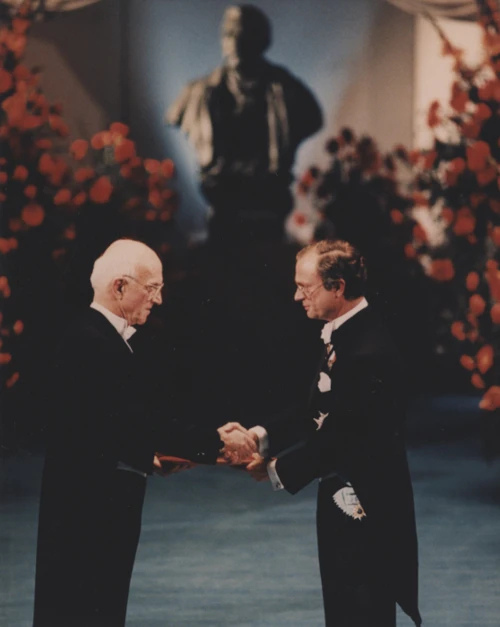
Dr. Murray Receiving Nobel Prize
It was mid-August of 1983, and I was in my plastic surgery training at William Beaumont Hospital in Michigan. A week earlier, Dr. Robert Pool the chairman of our department had informed all the staff and residents, of a visit by a prominent plastic surgeon who would be visiting us this day for a day of discussing different plastic surgery related topics.
After our morning surgeries were over, we got to meet Dr. Joseph Murray around two o’clock. He was a pleasant, smiling, humble and rather short gentleman wearing glasses. Dr. Pool introduced him to us as the “father of Transplantation”.
At that moment I realized that I am meeting a very special and innovative physician who had revolutionized the field of medicine by his unparalleled work in skin and kidney transplantation. I consider that day to be the most memorable day of my life.
For about an hour, Dr. Murray talked about his life and the fact that as a young boy he got interested in becoming a doctor by observing how popular and comforting his family physician was.
He was born on April 1st, 1919, in Milford Massachusetts and as a young physician, served in the army during World War II. He was taking care of injured and burned soldiers that got him interested in organ transplantation.
As a plastic surgeon he was treating a large number of burned soldiers that required skin grafting and in some of them, there was no healthy skin available in their bodies to be used for grafting, as a result he and his team started using other people’s skin for their treatment, and soon realized that within a couple of weeks the grafted skin would be rejected by the patient’s immune system.
As he said in his talk, those days, immunologists were not interested in developing immunosuppressive medications and the dilemma was unresolved.
His mentor Dr. James Brown assumed that if the donor and recipient of an organ were genetically close then the rejection would be less likely and with that understanding, Dr. Brown, in 1937 experimentally cross skin grafted a pair of identical twins and documented the permanent graft survival in both twins. This became Dr. Murray’s impetus to his interest in organ transplantation.
In the late 1940’s Dr. Murray joined the kidney transplant team at the Brigham Hospital in Boston. He started the laboratory for organ transplantation in dogs, mice, rabbits etc.
He developed a surgical technique for kidney transplant in dogs that was reproducible and safe.
After his lecture, all the staff left and Dr. Pool asked me to take Dr. Murray to cafeteria for coffee and said he will join us after seeing a patient.
In cafeteria we ordered coffee and tea and sat on a corner and now it was my turn to ask Dr. Murray some questions.
I felt at ease talking with him and he would answer my questions in detail and with some excitement.
I asked him about his famous breakthrough and how he decided to go through with it.
He said the successful experience of Dr. Brown convinced him that an organ transplant between identical twins would be successful, but he had to work hard for about two years on preparing his institution and people in his community that an organ transplant is medically, ethically, legally and religiously ok.
So, he ended up getting a patient, Richard Herrick, who was dying of kidney failure at the young age of 23. Fortunately, Richard had an identical twin brother, Ronald, who was healthy.
Dr. Murray and his team were facing a golden opportunity to perform a kidney transplant on Richard without worrying about it being rejected by his immune system.
On December 23, 1954, Dr. Murray’s team operated on them and Richard got a kidney from his brother.
The operation was hugely successful and became a landmark in the history of medicine. Richard did not require any immunosuppressive medications and lived normally for eight years and died of a massive heart attack at age 31.
I was fascinated spending time with Dr. Murray and hearing about his work in transplantation field firsthand.
During his conversation he emphasized the role of so many physicians before him and his colleagues that made it possible for him to perform such a life changing procedure. I think he was a noble and humble surgeon.
His work opened the door to the field of transplantation surgery that involves all different organs of the body. These days transplantation of heart, lungs, kidney, liver, pancreas and intestines are done routinely at major medical centers.
A few years later, in 1990, while I was in practice in Walnut Creek California, I heard that Nobel prize in physiology or Medicine was given to Dr. Joseph Murray. I definitely believe that he deserved that recognition.
DR. Murray died on November 26, 2012. I will remember him as the pleasant, smiley and down-to-earth surgeon who is rightly known as the father of all transplantation surgeries.