Where America Began: Lexington and the Dawn of Independence
A Special thank you to Diane Sperandio RO Resident, for sharing her beautiful photos with us.
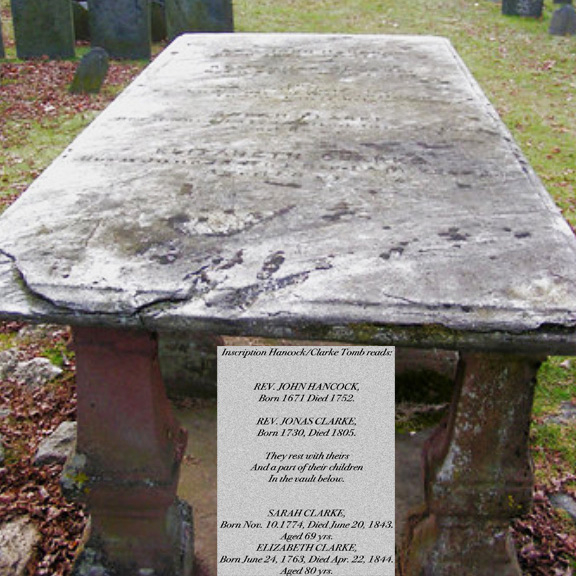
Hancock/Clarke Tomb - Rev John Hancock, John Hancock's grandfather, and his successor, Rev Jonas Clarke are buried at Ye Old Burring Ground in back of the First Parish Church where both men were ministers.
As the United States marks its 250th anniversary, there is something powerful about looking back to where it all began, not in grand halls or formal declarations, but on a quiet village green in Lexington, Massachusetts.
In the early hours of April 19, 1775, Lexington was just a small colonial town. The sun had not yet fully risen when local militia, ordinary men known as Minutemen, gathered on the Green. They were farmers, craftsmen, and neighbors, standing together with a shared purpose. They had heard that British troops were marching from Boston, intent on seizing colonial weapons and asserting control.
What happened next would change the course of history.
A tense standoff formed between the colonial militia and the advancing British soldiers. No one knows exactly who fired first, but a shot rang out, what would later be called the “shot heard round the world.” In that brief moment, the Battle of Lexington began, and with it, the start of a movement that would ultimately lead to the birth of a new nation.
Though the skirmish itself was short, its significance was enormous. It marked the beginning of the American Revolutionary War, a conflict that would span eight years and result in American independence. But beyond the military outcome, Lexington represented something deeper, the willingness of everyday people to stand up for what they believed in.
That is what makes Lexington so meaningful, even today.
The men who stood on that Green were not professional soldiers. They were members of a community who believed in the idea of self governance and the right to shape their own future. Their courage came not from training, but from conviction, and from standing side by side with their neighbors.
Two hundred fifty years later, that same spirit still resonates.
Communities like ours understand the importance of connection, shared values, and looking out for one another. While our daily lives look very different from those of 1775, the underlying principles remain remarkably similar. Lexington reminds us that history is not just something that happened long ago, it is something that continues to shape who we are.
Today, Lexington stands as a preserved and vibrant town, where visitors can walk the same Green, see historic landmarks like Buckman Tavern, and reflect on the moment when a group of ordinary individuals helped set extraordinary change in motion. It is both a place of remembrance and a symbol of enduring ideals.
As we celebrate this milestone anniversary, Lexington offers an opportunity not just to remember the past, but to appreciate the values that continue to define our nation, courage, unity, and a commitment to something greater than ourselves.
In many ways, the story of Lexington is not just America’s story, it is a reminder of what can happen when a community comes together with purpose.
And that is something worth celebrating.