Shaping a More Sustainable Future
Kim Burke shares how the Climate Action Collaborative is bringing local partners together to guide Eagle County toward cleaner energy and long-term resiliency.
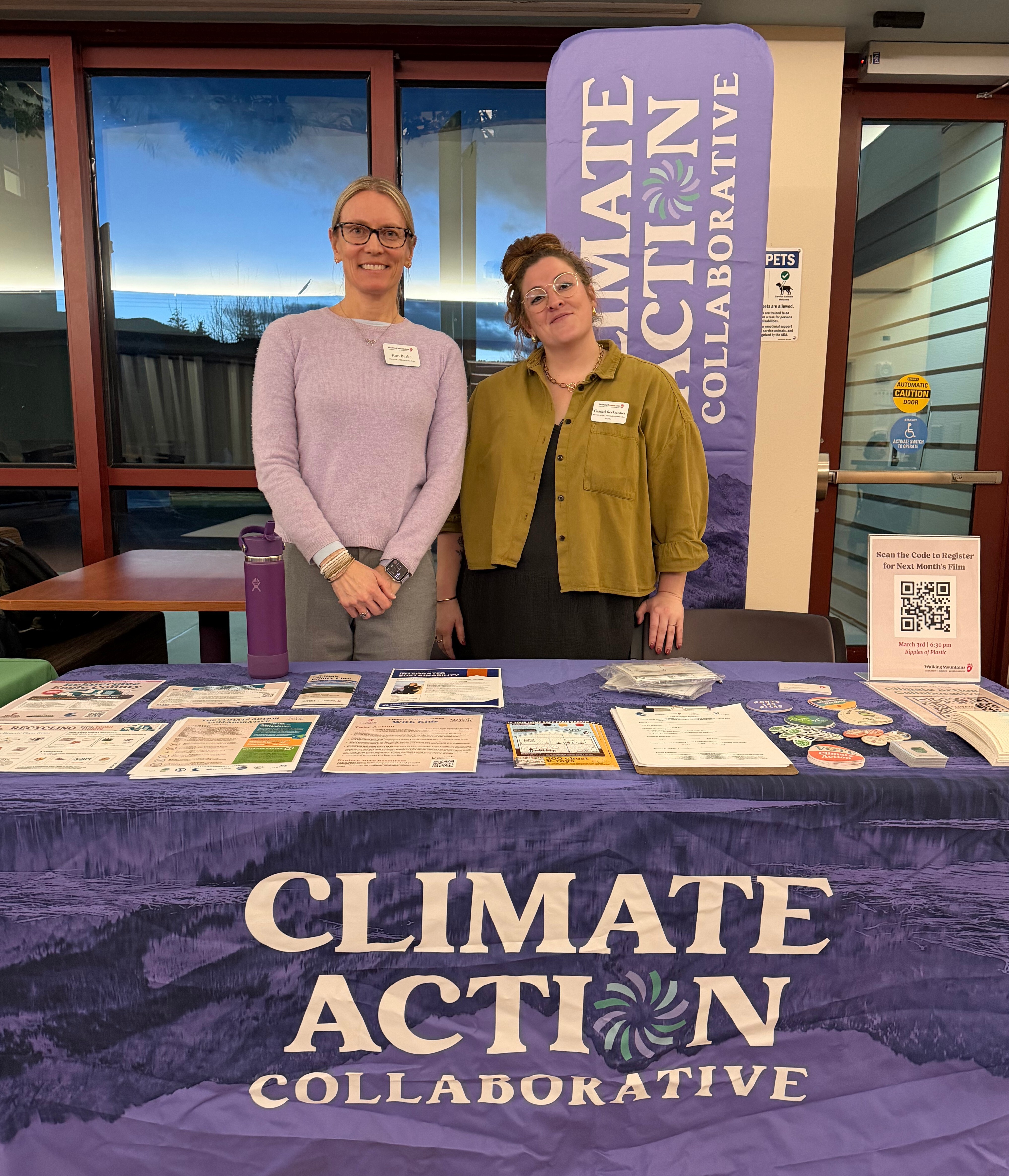
Kim Burke (left) and Chantel Recksiedler represent the CAC at the Walking Mountains' Climate Speaker Series event in February.
On any given summer evening, neighbors gather on trails, patios, and parks, soaking in the beauty that makes Eagle County such a special place to live. Behind the scenes, a different kind of community effort is underway, one focused on protecting that very landscape for generations to come.
At the heart of this work is the Climate Action Collaborative (CAC), a coalition of local governments, businesses, nonprofits, and special districts working together to reduce greenhouse gas (GHG) emissions and to strengthen the resiliency of the Eagle River Valley’s ecosystem. The CAC’s mission is ambitious yet essential: cut emissions 50% by 2030 and 80% by 2050, ensuring a thriving environment and economy well into the future.
What makes this effort unique is its collaborative nature. Rather than a single agency leading the charge, the CAC brings together a wide range of voices to tackle climate challenges from multiple angles. Supported by Eagle County and its towns, plus partners including Walking Mountains, Eagle River Water & Sanitation District, Vail Health, Vail Resorts, and Holy Cross Energy, the CAC is translating big-picture goals into tangible local action.
Progress Worth Celebrating
In 2024, Eagle County reached an important milestone: GHG pollution decreased 11% compared to 2014 levels. Even more striking, emissions fell 16% from the previous year. While global climate trends can feel overwhelming, this local progress tells a hopeful story, where collective action truly makes a difference.
A major driver of this success has been the shift toward clean energy. Holy Cross Energy now sources about 85% of its electricity from renewables, primarily wind and solar power, with a goal of reaching 100% clean energy by 2030. This transition has dramatically reduced emissions from electricity use in homes and commercial buildings.
The Next Frontier: Buildings and Transportation
Today, buildings and transportation account for the majority of emissions in Eagle County. Buildings alone make up about 42%, largely due to continued reliance on natural gas for heating. To address this, the CAC is helping communities adopt updated building codes through a regional “Net Zero Roadmap.” These changes will ensure that new construction is increasingly more energy-efficient, powered by clean electricity, and better aligned with long-term sustainability goals.
For homeowners and business owners, this shift is supported through rebate programs administered by Walking Mountains and its partners, making it easier and more cost-effective to upgrade to energy-efficient systems.
Transportation is another area where the CAC is encouraging momentum. In 2024, transportation emissions dropped 9%, thanks in part to increased public transit use, a surge in electric vehicle adoption, and expanded access to bike-sharing programs like Shift Bike.
These trends point to a broader cultural shift, one where residents are rethinking how they move through the valley, whether by walking, by bus, bike, carpool, or electric vehicle.
Small Changes, Big Impact
Beyond energy and transportation, we’re also making strides in reducing waste. Although waste only accounts for 8% of the County’s emissions, 24% of our waste is diverted through recycling and composting, well above the statewide average. Even more impressive is the growing effort to recycle construction and demolition materials, which saw a 49% increase in diversion from the landfill from 2023 to 2024.
These numbers highlight an important truth: climate action isn’t just about large-scale policy. It’s also about everyday choices: what we throw away, how we get around, and how we power our homes.
A Collective Effort
Throughout the year, the CAC hosts events, workshops, and meetings designed to inform and engage residents. From electric vehicle showcase events, such as the Electric Social, to Climate Action Week programming, these gatherings make sustainability approachable and actionable.
They also reinforce a central idea: this work belongs to everyone.
Whether you’re a homeowner considering an energy upgrade, a commuter exploring new transit options, or simply someone curious about how to get involved, there are opportunities to participate. The CAC hosts several working groups focused on buildings and energy, transportation, waste, and resiliency, which includes water conservation, natural climate solutions, and reducing wildfire risks. These groups include sustainability staff from towns and the county, representatives from nonprofits and businesses, and community members who come together to discuss and implement policy, projects, and educational initiatives to achieve our climate goals.
Looking Ahead
As Eagle County continues to grow, so too does the importance of thoughtful, forward-looking planning. Climate action isn’t just about reducing pollution. It’s about preserving the outdoor lifestyle, economic vitality, and natural beauty that define the region.
The progress made so far is encouraging, but the road ahead will require sustained commitment from everyone. Fortunately, if there’s one thing this community has demonstrated, it’s a willingness to come together for a common goal.
In a place like Singletree, where neighbors look out for one another and the landscape is part of daily life, that may be the most powerful resource of all.
Kim Burke, a Singletree homeowner, is the Director of Climate Strategy for the Climate Action Collaborative at Walking Mountains. To learn more or to get involved, visit https://climate.walkingmountains.org or email Kim at kimb@walkingmountains.org.