A Front-Row Seat to Cycling History
Cheryl Lindstrom recalls covering the 1987 Tour de France as one of the first American women to report the race from start to finish.
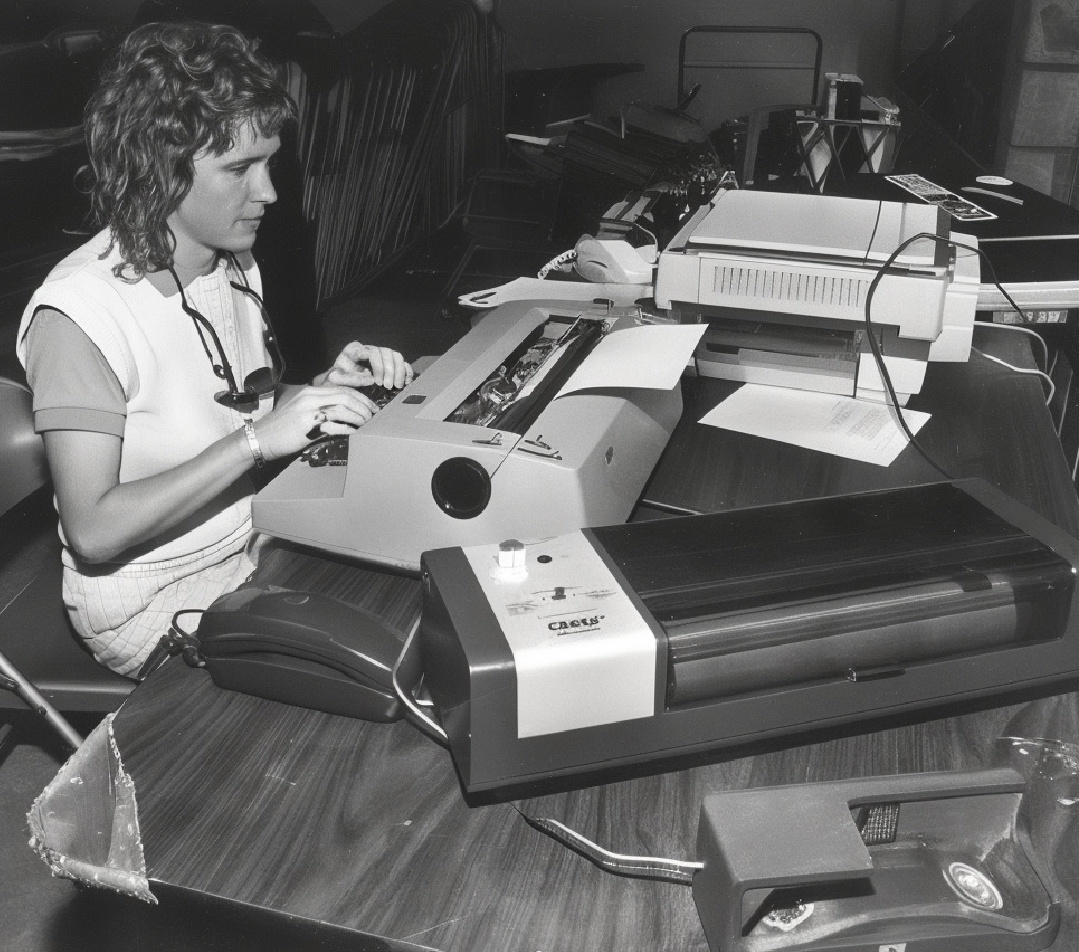
Reporting the stories at the Coors Classic in 1982
Long before laptops, smartphones, and live race coverage, Cheryl Lindstrom was traveling across Europe covering the world's most famous bicycle race. As a sportswriter for the Boulder Daily Camera, Cheryl found herself at the center of a pivotal era in American cycling—one that saw Boulder emerge as the sport's unofficial U.S. capital and American riders begin making their mark on the international stage. In this firsthand account, she shares stories from the road, the press room, and the unforgettable summer she spent covering the 1987 Tour de France.
Boulder Becomes Bike Town USA
For a number of years, Boulder was the center of the universe, so to speak, of cycling in the United States. As the birthplace of the Red Zinger Bicycle Classic in 1975, a modest three-day stage race that was the brainchild of Mo Siegel, founder of the Celestial Seasonings tea company, Boulder soon became a mecca for endurance sports. Its elevation (5,345), clean air, and embrace of healthy living made for the perfect environment for Siegel and his friends and associates to start a race as part of his vision to get more people to ditch their cars and adopt bicycle transport.
The closing day of the race — which in 1980 became the Coors International Bicycle Classic — became a colorful spectacle as several thousand fans filled North Boulder Park to watch a criterium around the park’s perimeter. In those early years, a young Davis Phinney, born and raised in Boulder, was inspired to try the sport for himself. His physique was well suited to the criteriums that marked American racing — numerous laps around a short course, often ending with a mad scramble sprint. He became a prolific winner of races that ended with sprints to the line, possessed with power and speed that were hard to beat.
In the fall of 1977, I became part of the madness when I offered to go to a press conference regarding the next year’s Red Zinger Classic. I had recently been hired as a sportswriter by the Boulder Daily Camera, the first female to join the “toy department,” as we often referred to ourselves. A year earlier, I first watched the Red Zinger on that final electric stage, which took place just blocks from the duplex I had recently rented after moving from Ft. Collins.
None of my colleagues wanted anything to do with cycling — it didn’t involve a ball or a stick, the riders wore spandex and, for the love of all things holy, shaved their legs. But as Phinney rose up through the ranks, so did my workload. I started learning about the rich history of cycling and its heroes — Anquetil, Bartoli, Coppi — along with the contemporary luminaries — Merckx, de Vlaminck, Van Impe. The race schedule in Colorado and beyond was expanding almost exponentially each year. With the U.S. set to host the 1984 Summer Olympics in Los Angeles, a new era was ushered in: corporate sponsorship. In this case, 7-Eleven became the lead sponsor for cycling, which included supporting a team of riders, men and women, from both the road and track disciplines.
Heady times. Phinney’s new wife (married in 1983), Connie Carpenter, was the first-ever women’s cycling road race gold medalist. Alexi Grewal, a fiery personality from Aspen who had moved to Boulder, managed to foil Phinney’s plans in the road race and took the gold, but Phinney rebounded, and along with three teammates won the bronze in the team time trial. Both gold medalists were living in Boulder, as were most of the American road racing team, many of them on the 7-Eleven squad.
The American Cycling Revolution
During those years, I wrote story after story about all levels of cycling, as Boulder was now spawning a cadre of road cyclists, who competed in everything from local training events to Olympic qualifying races. The Coors Classic was now a 10-day event across Colorado, and would later expand to California, Nevada, and Hawaii. In those years, which had concurrent races for men and women, I would be joined by another two or three reporters along with photographers. Since this was long before the internet, I was told the Camera’s sports section was being FedExed to distant points so others could read and see what we were producing.
The following year, Phinney and most of his teammates turned professional (at that time, there were distinct rules, and therefore separation, between amateur and professional ranks for athletes, though the lines often blurred, especially in sports like track and field). The next big dreams were the iconic European races, and the team had modest success in its 1985 debut in Italy and other races.
A First Taste of the Tour
In 1986, 7-Eleven made its first Tour de France appearance, a race ultimately won by Greg LeMond, a Californian who was denied his Olympic quest in 1980 due to the U.S. boycott of the Moscow Games. He made the leap to pro racing in 1981 when he signed to ride alongside Bernard Hinault, a temperamental Frenchman.
LeMond was a generational talent, and his build lent itself to the grueling climbs of the Alps and Pyrenees — slight with a high power-to-weight ratio. Off the bike, he was in a locked-horns battle with Hinault, who would win his fifth Tour de France in 1985, for leadership of the team, then under the colors of La Vie Claire. Earlier in that 1986 Tour, Phinney won a stage, and his 7-Eleven teammate Alex Stieda of Canada became the first North American to ever wear the yellow jersey signifying the race leader. Stage races are measured by time — each day (stage) there is a winner, and the rider with the lowest accumulated time is the overall leader in what is called the general classification, or GC, for short.
As it happened, I was in France during that 1986 Tour, travelling with my then-boyfriend, now husband, Eric Johnson. A close friend in cycling told me I should introduce myself to Phil Liggett, at the time a leading race promoter and voice of the Tour for British television. Today, he still calls a few races for Peacock alongside Bob Roll, a member of that 7-Eleven team that forayed into the European ranks. For a few days we were inside the envelope of the race and were on the slopes of L’Alpe d’Huez when LeMond and Hinault finished hand-in-hand atop the unrelenting climb. After LeMond’s win, I was given an invite to the American Embassy in Paris for a reception for this groundbreaking victory; though I wasn’t an active working reporter on that race, my name had floated its way onto a list. All these events made the decision to cover the 1987 race fairly easy.
Destination: France
We (I traveled with a photographer, Darcy Kiefel, who at the time was married to a 7-Eleven team member, Ron Kiefel) secured credentials through ski racing channels — Serge Lang, one of the founders of the World Cup, was also a cycling journalist and steered me to the Tour’s press office. Darcy and I floated the idea of a behind-the-scenes book about 7-Eleven to various entities, an idea that never really took hold with the team itself. In retrospect, it was probably a relief as we had our hands full with the day-to-day logistics of traveling the 2,600 miles the Tour covered that year.
In 1987, the press corps was roughly 700; today it’s well into the thousands. By the opening stage in Berlin (the race starts outside of France semi-regularly), I had writing assignments from USA Today, Velo News, and Bicycling Magazine on top of my duties for the Boulder Daily Camera. My boss wasn’t entirely thrilled about my European venture, but he softened his stance — a little bit — as the race progressed and 7-Eleven had success.
Reporting the Old-Fashioned Way
There were early laptop-style computers, a Radio Shack product (TRS-80) that we lovingly called “trash 80.” It was really just a keyboard with a small screen above it that showed about four lines of text at a time and had hard-wired couplers into which a landline phone handset was placed for transmission. It had the outside dimensions of some of today’s smaller laptops but was about two inches thick. However, my big error was not investigating the baud rate (how fast or slow the bips and boops of transmission occurred) of European phone lines. My American “computer” would not “talk” over European phone lines to those in Boulder. A big problem that I was never able to resolve.
I had brought along a small, portable typewriter, so I resorted to typing on paper and faxing my stories home. No one in my office was crazy about having to re-type my missives, a task exacerbated by the 8-hour time difference. The newspaper industry was among the first to computerize — the Camera had done so roughly 10 years prior — so this hiccup was a big step backward.
Breaking Barriers on the Road
In France, Darcy and I were treated as a novelty, because until a few years prior, women were simply not allowed to be a part of the visible cycling race operation, other than the “podium girls” who awarded the day’s prizes in coordinated cocktail attire — sleek dresses in the colors of the sponsor, high heels, perfect hair and makeup. No doubt there were secretaries in offices far away from the event, but in true American fashion, we were among the first to crack the glass in the ceiling.
Shelley Verses was a soigneur for 7-Eleven, an unheard-of role in the male-dominated world of rider support well before the team launched its European adventures. And while a Boston Globe reporter, Susan Bickelhaupt, had covered the end stages of the Tour in 1986, and perhaps prior, Darcy and I were the first American women to cover the legendary event from start to finish.
Nearly every day we heard some variation of “Are you lost?” Darcy spoke fluent French; mine was middling at best at the time. We just laughed. No one knew I was in my 10th year of cycling coverage and had followed every move of American racing as it progressed internationally over the prior decade. That I would get phone calls at home about so-and-so winning a race in some state or far-off nation.
Life Inside the Tour
Earlier that year, Greg LeMond had been accidentally shot by his brother-in-law as the two hunted wild turkeys near Sacramento and came distressingly close to bleeding out were it not for swift evacuation to life-saving surgery. Though he was left with approximately 35 pellets in his body, some distressingly close to his heart, LeMond recovered and went on to win the Tour in 1989 and 1990. I had many phone calls with Bob LeMond, Greg’s father, over the course of that period, as well as a result of his prior conflicts with Hinault. During my brief experience with the 1986 Tour, Bob expounded on the growing tension within the La Vie Claire team. In English. He wasn’t going to try to sugarcoat his feelings in French, which his son commanded easily having lived in Belgium for several years.
There is no way to know what might have happened had LeMond raced the Tour in 1987, but I was grateful the English-speaking world had good storytelling in the form of 7-Eleven stage winners Phinney, Norway’s Dag Otto Lauritzen, and Jeff Pierce, who took the final mad sprint on the Champs Elysees that year. Stephen Roche, an Irish racer, was the overall winner, part of a spectacular trifecta that included the Giro d’Italia and World Championships that year.
The days were long and stressful. Darcy and I were winging it as far as booking hotels, something that would be impossible today, but as riders went home due to illness or injury, hotel rooms opened up. Lunch often consisted of torn pieces of baguettes and peanut butter, which I brought with me since that’s not a commodity found in France, or sausage and cheese. I remember keeping a jar of mustard between the front seats of the car.
Stages ended in one small town and started in another 65-100 kilometers away (40-60 miles). Open restaurants were hard to find at 9:00 p.m. One night, a Dutch soigneur commented to me “American women drink beer?” at a bar where I was able to get an omelet and a beer at about 9:30 p.m. To which I answered, “American women drink whatever they want. What do Dutch women drink?” “Tea or cola,” came the response.
We spent our days leapfrogging around the race route, and that meant a lot of interaction with the Gendarmes who escorted the race. Some scowled, others eventually greeted us with smiles. We were just two crazy Americans trying to do our jobs. A few days I rode with other print journalists, or Liggett and his broadcasting partner, the late Paul Sherwen, and Darcy took the car to better get the shots she wanted.
One day, I ended up in one of the 7-Eleven team cars when I mis-timed the start of the race, which is against the rules, but we again played the crazy American card and promised never to do it again. I came to know the members of the CBS production team, which packaged one- or two-hour special segments that ran on Sundays in the U.S.
We ended up having three different cars due to mechanical issues, each of which required a new windshield “eyebrow” decal after the previous vehicle was towed away. “This wouldn’t happen if you were driving a French car,” admonished the Chief of Press, a taciturn man by the name of Claude Sudres. That much French I understood and was able to reply, “Yes, I’m sorry, I’m embarrassed.” He gave me a little squeeze around my shoulders.
The Americans Arrive
The tide in cycling was starting to change, tilting ever so slightly to the United States and what was happening with this mad bunch of racers who dared to live the dream that is second nature to many Europeans. Cycling was a way out of the life of a farmer, or a tradesman, or shop proprietor, noble as those professions are. It was bold, colorful, and dashing, much like skiing unfolded in the 1960s. Its heroes to this day are lionized.
At one point, someone gave me a copy of the Daily Camera they had brought with them to France with a large photo of Phinney winning in Bordeaux dominating the layout of that day’s sports section. I triumphantly handed it to the Philippe Sudres, Claude’s son and associate press chief, who (thankfully) spoke English. This is what we do on the other side of the pond.
The Road Ends in Paris
On the Champs Elysees, after Pierce’s stunning victory, and as I wrapped up my final stories, I was physically and mentally drained from the previous three weeks. But across the Tour, whether as a rider, team staff, journalist, TV production, or the hundreds of others that comprise the entourage, there is also a sense of joy and accomplishment as the spectacle draws to a close.