A Journey Across Southeast Asia
Lai White embarks on a southeast Asia journey aboard the Norwegian Sun and experiences the wonders of Thailand, Vietnam, the Philippines, Hong Kong, and China
Before setting sail from Singapore aboard the Norwegian Sun, Lai White and her travel companion, Susan Wheeler, knew they were in for an incredible adventure. Over the course of more than two weeks, the pair explored bustling cities, ancient temples, historic landmarks, and remote islands across Southeast Asia — experiencing the beauty, history, and cultural traditions of Thailand, Vietnam, the Philippines, Hong Kong, and China along the way. From Buddhist temples and war memorials to hot springs and world-famous cityscapes, their journey offered a fascinating glimpse into a part of the world rich with history, contrast, and unforgettable experiences.
SINGAPORE
Our flights went well, although 18 hours from San Francisco to Singapore was really long.
Upon arrival, we were required to fill in an Arrival Card for Singapore, which turned out to be good practice for all the others we needed to do on this cruise.
After a long walk, a short train ride, and a 45-minute bus ride, we arrived to board the ship. Everything went well and there, we surrendered our passports to the cruise company and signed up for the Vietnam Visa. We were concerned that we would miss the country stamps in our passports, but when they were returned, we were pleasantly surprised that they were stamped for each country visited.
FIRST DAY AT SEA
Being at sea gave us a chance to become familiar with the ship and the various activities planned. We took a long walk on deck and then watched a presentation on the shore excursions that were offered. Additionally, we completed our safety briefing, the Thailand Visitor Card, and the mandatory visit to our muster station (a designated meeting where passengers and crew gather in the unlikely event of an emergency).
KO SUMAI, THAILAND
We were informed that E-cigarettes are not permitted in Thailand. The tenders used were boats made of wood. Really interesting!
For our first tour, we chose the Ancient Temple Tour where we visited the Kunaram Temple and saw the body of Samui’s most famous mummified monk, Loung Poh Deang, who is seated in a meditation position. Covered shoulders and ankles were required as well as removing shoes.
We learned that the Precepts are the foundational ethical guidelines for Buddhist laypeople, designed to foster harmlessness, self-control, and mindfulness. They are not commandments, but voluntary commitments to abstain from killing, stealing, sexual misconduct, lying, and intoxication, supporting the cultivation of virtue and mental clarity. Fully ordained Monks must follow 227 precepts.
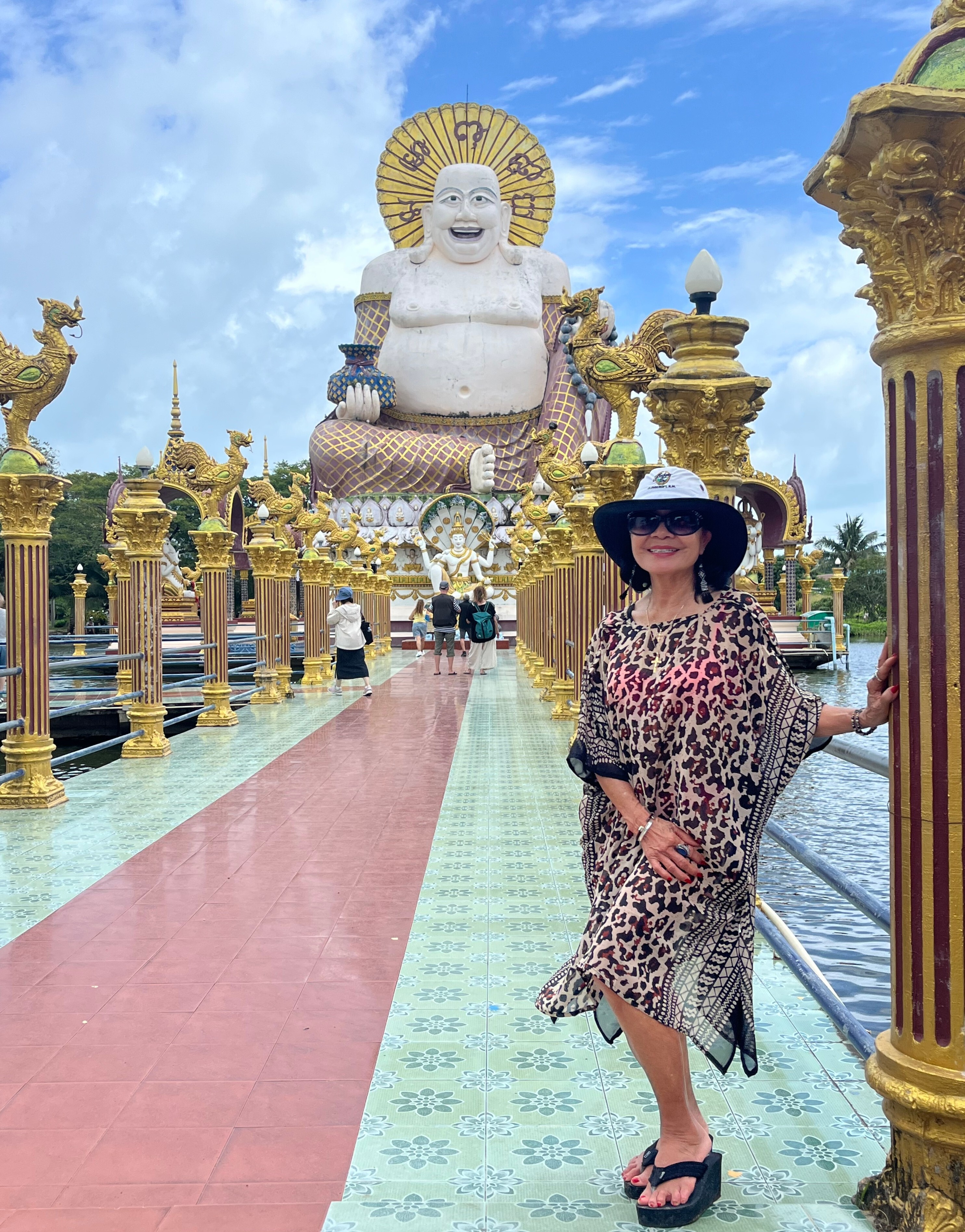
We drove on to see the Big Buddha Temple, a 36-foot golden statue perched atop a wide staircase decorated with dragons. This area included street markets which were quite interesting. In hindsight this was the best shopping of the whole cruise!
We saw the 18-armed Buddha, known as the "Mother of the Seventy Million Buddhas," symbolizing vast compassion and merit. The famous, massive 18-armed white statue of Guanyin (Goddess of Mercy) stands at Wat Plai Laem and symbolizes her ability to aid many people simultaneously.
BANGKOK (LAEM CHABANG), THAILAND
We had selected the Grand Palace and Emerald Buddha tour; however, the palace was closed due to the passing of the Queen Mother. The royal body was moved on October 26, 2025, followed by a year-long mourning period and funeral rites until her 2026 cremation, so we were unable to see inside but instead spent time outside in 100-degree heat.
The Grand Palace is a complex of buildings at the heart of Bangkok. The palace has been the official residence of the Kings of Siam since 1782. The king, his court, and his royal government were based on the grounds of the palace until 1925. The complex features intricate, dazzling gold details and diverse architectural styles, housing the sacred Temple of the Emerald Buddha (Wat Phra Kaew), which is regarded as the most sacred Buddhist temple in Thailand. The Buddha is made of translucent green jasper, and the king changes its vestments three times a year during a solemn ceremony.
We learned that in Thailand, each day of the week is associated with a specific color based on Hindu astrology and the color of the deity protecting that day. Wearing the color of your birthday, or the color of the current day, is believed to bring luck and good fortune, a tradition widely observed by wearing corresponding shirts.
Daily Color Association Table:
- Sunday: Red (Day of Surya)
- Monday: Yellow or Cream (Day of Chandra)
- Tuesday: Pink (Day of Mangala)
- Wednesday (Daytime): Green (Day of Budha)
- Wednesday (Night-time): Light Green
- Thursday: Orange or Brown (Day of Brihaspati)
- Friday: Blue (Day of Shukra)
- Saturday: Purple or Violet (Day of Shani)
BEHIND THE SCENES
Susan scheduled a tour of the ship, which was fascinating to see the food preparation areas as well as the amazing laundry room. Visiting the bridge gave us the opportunity to visit with the captain for a bit.
HO CHI MINH CITY (PHU MY), VIETNAM
This day, we chose the Good Morning Vietnam tour. We explored sites that illustrated the American military presence in Saigon during the Vietnam War. We saw the helicopter that transported evacuees from the roof of the American Embassy before the communists took over during the Fall of Saigon in 1975, as featured in the play, “Miss Saigon”. We then visited General Westmoreland’s residence and the War Remnants Museum, the focus of which is the “American War of Aggression” and is uncomfortably un-American.
Next, we walked through a section of the mangrove commando tunnel, an extensive underground network used by Viet Cong soldiers in Vietnam's Cu Chi region. Having been built beginning around 1948, the tunnels are narrow, hand-dug tunnels that served as hiding spots, communication routes, supply lines, and bases for combat, often allowing surprise attacks. The tunnels also served as critical, hidden infrastructure for living quarters, hospitals, storage, and surprise attacks during the war.
We visited the Ben Duoc Martyrs Memorial Temple. The flowers, bougainvillea, plumbago, and especially the apricot blossom trees, were spectacular. We enjoyed a wine and sweet potato snack served by the monks, which admittedly, was not the tastiest snack.
PUERTO PRINCESA, PHILIPPINES
Susan and I took the Puerto Princesa Highlights tour. We learned that the Philippines includes 1800 islands, 180 languages, and has a central government. We visited the Immaculate Conception Cathedral which was built in 1872. Across the street was Plaza Cuartel, a historic site that served as a Spanish garrison (cuartel) in the late 19th century.
The next point on our tour was the open-air Iwahig Prison and Penal Farm where prisoners are allowed to farm the land and learn skills that will help them find jobs after their sentence is completed. There are no walls or fences and all prisoners from anywhere in the Philippines are housed here. Our guide explained that this prison offers more security than many of the inmates had ever known. The degree of their crime is reflected in the color of the shirts they wear. Blue is minor, brown medium, and orange more serious. The blue and brown men performed some dances which were very well done. They also had a place to purchase crafts made by the men.
We went on to visit the Palawan Special Battalion World War II Memorial Museum - featuring five galleries highlighting the profiles of the major countries that participated during WWI, US, Japan, Germany, Great Britain, and Russia. Each room features a collection of relics, weapons, aircraft carrier and bomber plane models, uniforms, bayonets, and other significant relics.
CORON, PHILIPPINES
Susan and I took the Coron Town and Hot Springs tour. We toured the wet market and a cashew factory. It was interesting to learn how much work there is in processing cashews. Once the acidic shells are removed, the cashews are toasted, sun-dried, and may be sugar-coated or flavored.
We drove on to see a traditional fishing village where they were drying many bins of fish. The living conditions are extremely crude, but the people are very friendly and seem happy. We continued on very rough roads to the Maquinit Hot Springs, a natural saltwater hot spring surrounded by mangroves; heated by subsurface magma from a nearby underground volcano, the water was quite soothing.
HONG KONG, CHINA
Our tour in Hong Kong was very enjoyable. Susan and I learned there are four tunnels under the sea and no bridges connecting the island to Kowloon. The tallest building is 118 floors. We took a double decker tram (the only one in the world) through the older portion of town on Hong Kong Island. Kowloon is on the other side.
We learned that the longest outdoor covered escalator system in the world is the Central–Mid-Levels escalator in Hong Kong, stretching over 800 meters (2,624 ft) in length and rising 135 meters (443 ft) in elevation. Opened in 1993, this system consists of 16 escalators and 3 moving walkways, transporting roughly 99,000 people daily between the Central and the Mid-Levels districts.
We drove down Antique Road where there are many shops selling porcelain, silk and tea, and
we wandered through the Wet Market, where we found souvenirs at the Jade Market.
TAIPEI (KEELUNG), TAIWAN
Disembarking the ship was a 3-hour ordeal due to issues with technology and Taipei immigration being overwhelmed by such a large group of people. Eventually, we found the bus for the one-hour drive to the airport for our 14 ½ hour flight to San Francisco and ultimately arrived back in Denver without incident.
After thousands of miles traveled and countless memorable experiences, we arrived home after our journey through Southeast Asia grateful for the opportunity to explore such fascinating places together. It was truly a trip we will never forget.