The Art of Listening
How Spring Valley Shaped Podville Co-Founder Charlie Birney
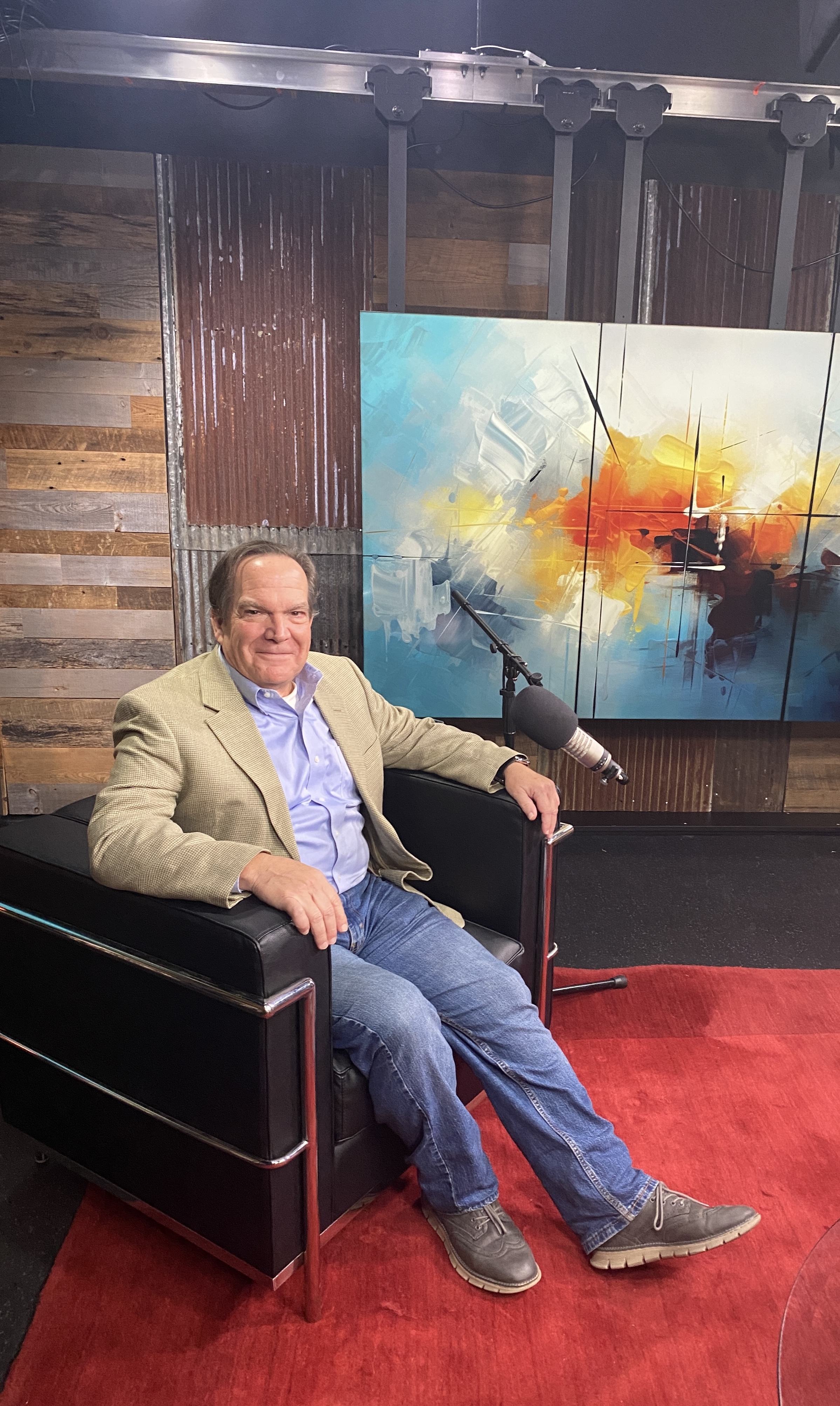
Charlie in his interview chair in the Potomac office of Podville Media
Charlie Birney did not come to podcasting with a pitch deck or a five-year plan. He came to it the same way he approaches most things, by listening. As co-founder and President of Podville Media, Birney traces his path into modern media not to a single professional pivot, but rather to a lifetime shaped by family, community, and a belief formed early that stories matter when people are truly heard.
Before launching Podville, Charlie spent more than 25 years working alongside his father, Arthur A. Birney, Esq., and his brother, Lex Birney, at The Washington Brick & Terra Cotta Company, a Washington institution founded in 1892. When that chapter closed, the work that followed felt new, but the instincts behind it were familiar. Looking back, he sees the origins of his media career not in business school or broadcasting, but in growing up in Spring Valley and observing how his parents moved through the neighborhood, engaged, generous, and deeply connected to others.
One of the earliest influences came from his mother, Alison Bean Birney. As a teenager, Charlie watched her volunteer as a sound engineer and reader for Recording for the Blind and Dyslexic, now known as Learning Ally. With no formal training, she ran the recording booth and read textbooks aloud so blind students could access their coursework. At the time, it felt like just one of many quiet acts of service she took on. Only later did Charlie recognize how closely that experience mirrored his own professional life. Podcasting, he often notes, is not so different from reading aloud for someone who needs access.
His father, Art, added another layer. A lover of recorded books, he regularly announced to Charlie when he had finished one, offering it next as if passing along a good conversation. Through those recordings, Charlie encountered history and ideas not as abstract lessons, but as shared experiences, something spoken, personal, and alive. It was an early education in narrative and in the power of the spoken word.
Podcasting entered Charlie’s life through philanthropy. While still working in real estate, he wanted a way to spotlight volunteer efforts and community initiatives without spending money. He began creating simple videos about grants and volunteer work and posting them on social media. He admits he did not fully understand the platforms at first, and Twitter took some time, but the process sparked deeper questions about communication, reach, and storytelling. Years of listening to podcasts followed, along with a gradual realization that this medium could do something different.
That realization found a home at Launch Workplaces in Gaithersburg. His concept was straightforward. He interviewed the people working there so they could actually get to know one another. Those conversations became podcasts, distributed through the Launch newsletter on SoundCloud.
In 2017, Birney partnered with established podcaster and entrepreneur Oscar Zeballos to launch what would become Podville Media. From the start, Podville was built on the idea that podcasting is not just content. It is infrastructure. A way for organizations to communicate internally and externally with clarity, humanity, and trust.
That philosophy continues to shape the company today. Podville works with best-in-class organizations across healthcare, higher education, advocacy, sports, and the public sector, including partners such as ESPN, the George and Barbara Bush Foundation, and the International Spy Museum. Across every project, the company takes seriously the responsibility that comes with stewarding other people’s stories, approaching its work with care, intention, and respect for the audiences those organizations serve.
As the media landscape continues to evolve, podcasting itself is increasingly treated as a cross-platform format, and Podville has adapted its production approach accordingly. Several Podville co-produced shows now extend beyond audio to television, including ESPN’s The Domonique Foxworth Show, hosted by Domonique Foxworth, and SVPod with Scott Van Pelt and Stanford Steve, which air both digitally and on the ESPN television network.
Asked about his favorite broadcast, instead of citing one of his major network productions, Charlie points to an interview with Barry Louis Polisar, a children’s musician from upper Montgomery County. Years earlier, Polisar uploaded a batch of songs online, padding a paid submission with two tracks he did not think much about. One of those songs was discovered by accident when a producer searching for music for the film Juno mistyped a title. It opened the movie, later appeared in a Super Bowl advertisement, and changed Polisar’s life. Birney had followed his work for years and remembers watching the Super Bowl thinking one simple thing. Barry is on TV.
Music runs quietly throughout Charlie’s own life as well. He plays guitar and writes songs. His father was also a musician who composed roughly 25 folk songs, including a Halloween tune written after being challenged to create something simple enough for children to sing together. Charlie still shares that song each year and remembers performing it at Concord Hill Elementary for Charlotte Sears, a close family friend who taught there.
More recently, Charlie’s thinking has turned even more deliberately toward listening itself. In his book, The Tao of Podcasting: An Interpretation of the Tao Te Ching, he examines the conditions under which listening and creation occur. He explores different modes of listening, attentive, distracted, and empathic, and the cognitive and social forces that shape what people are willing, or able, to hear. In a media environment saturated with opinion, Charlie argues that listening demands greater intentionality, not just in interviews, but in everyday life.
That perspective was shaped early, in the neighborhood where he grew up. Charlie was raised on Van Ness Street in Spring Valley, when much of the surrounding area was still undeveloped. Across from his home was a small patch of woods. Down the block was an open field where kids built forts and spent entire days outside. There was a movie theater where an American University building now stands, a sports store where his father bought his first baseball mitt, and an underground garage where Charlie rode his bike for hours because it was almost always empty.
As a child, he wandered freely onto the American University campus, listening to live music drifting from the amphitheater. Spring Valley, for Charlie, was a place where people noticed things, sounds, stories, and one another. In many ways, it taught him how to pay attention.
Today, he resides in Chevy Chase with his wife, Alice Birney, and their twins, Isabel and Dion. The community remains central to his life and work, reflecting the same values of connection and attentiveness that continue to shape Podville Media.