More Than A Straight Smile
Sullivan’s Island resident and orthodontist Dr. Kathryn Bullwinkel looks beyond the teeth to what the architecture of a child’s mouth can reveal about breathing, sleep and healthy development.
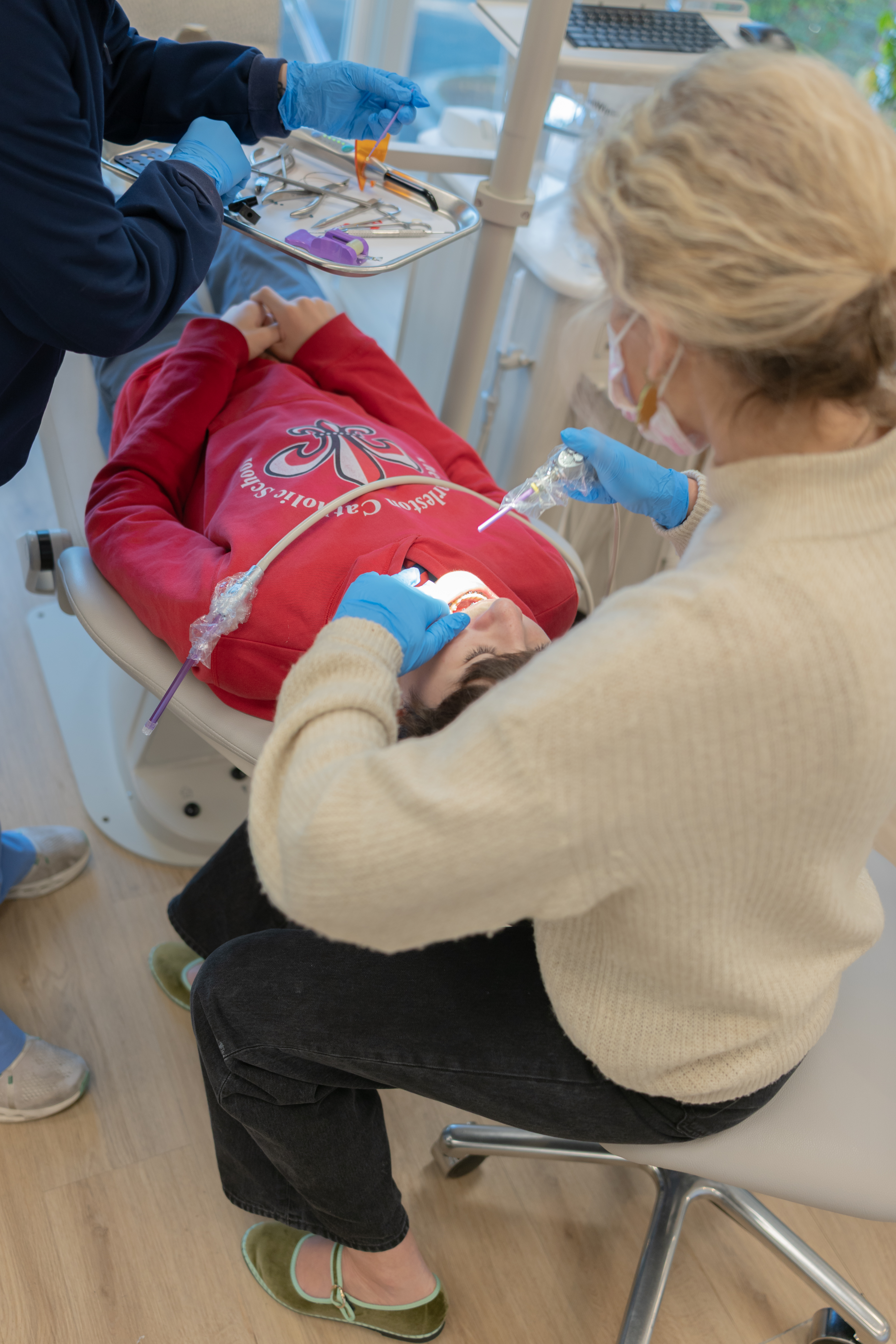
Long before Dr. Kathryn Bullwinkel was thinking about jaws, airways and smiles, she thought she might become an architect.
She loved design and math and had a natural ability to think in three dimensions. But after shadowing an architect in high school, she quickly realized something was missing: people.
Around that same time, her own orthodontist, Dr. John Pitner, suggested that if she liked architecture, she might like orthodontics. The connection wasn’t immediately obvious. Then Bullwinkel began looking more closely.
Orthodontics, she realized, was designing and building too, only in mouths and faces.
At 16, she asked Pitner for a job. He said no. So she wrote him a letter explaining what she could bring to the practice and why the experience mattered to her. It worked. She spent afternoons working on models and sterilization and returned for several summers during college.
“He’s a big part of why I do what I do,” she says.
Today, Bullwinkel still uses that architectural brain every day. Every mouth requires three-dimensional thinking and planning. She compares deciding where a front tooth should sit within a face to an architect determining where the front door belongs on a house.
And, just like a house, the foundation matters.
“The floor of the nose is the roof of the mouth,” Bullwinkel explains.
When a child’s upper jaw develops too narrowly, the nasal passages above it narrow too, and the tongue can lose the space it needs to rest properly. That can affect breathing, sleep and even facial growth.
It is why Bullwinkel wants parents to understand that orthodontics can be about much more than straight teeth.
“Crooked teeth are only one clue, and often not the most important one.”
Parents can look for snoring, mouth breathing and restless sleep at night. During the day, a child who wakes tired, has dark circles under the eyes, struggles to focus, grinds their teeth or habitually rests with an open mouth may warrant a closer look. None of those signs necessarily means something is wrong, she cautions, but they are worth discussing with a pediatrician and an orthodontist who evaluates airway health.
Childhood also offers an important window because growing jaws are more responsive to guidance. While the American Association of Orthodontists recommends a first orthodontic visit by age seven, Bullwinkel often likes to see children earlier, particularly when breathing is a concern.
That does not mean braces are coming.
“Most of the little ones I see leave with a baseline, a plan and zero new hardware,” she says.
There is another side of treating young patients that matters deeply to Bullwinkel. During her residency in Chicago, her research explored how participating in orthodontic treatment could influence a child’s self-efficacy.
For many children, orthodontics is one of their first opportunities to take ownership of their own healthcare. They learn to care for their braces, wear their rubber bands, ask questions and understand how their own effort affects the outcome.
The lesson can extend far beyond their smile: I can do hard things.
That desire to keep learning has shaped Bullwinkel’s own career, too. She continues to pursue advanced education and believes the best care comes from collaboration, whether that means working alongside a pediatrician, dentist, ENT, sleep physician or another specialist.
“Orthodontics is a team sport,” she says. “I’m just one piece of the puzzle.”
And sometimes that team sport follows her home.
Bullwinkel and her husband, Matt, live on Sullivan’s Island with their three children, Molly, Charles and Thomas, and their 12-year-old Cavalier, Hudson. She jokes that she occasionally operates a tiny Sullivan’s Island practice too, trimming a wire or checking an expander at the park or on her porch.
For their busy family, the Island has become a refuge.
“We try to say ‘hi’ to the ocean whenever we can,” she says. The boys head for the marsh or water to fish, while the rest of the family might walk or settle onto the sand with a book. Hudson comes along, too, somehow acting 10 years younger the moment she reaches the surf.
Between a full-time practice and three children, life can move quickly. Coming home to Sullivan’s Island is what resets them.
And for a doctor whose career is built around understanding how all the pieces fit together, that seems particularly fitting.