Geaux Gastro:
Cooking Between Memory and Imagination
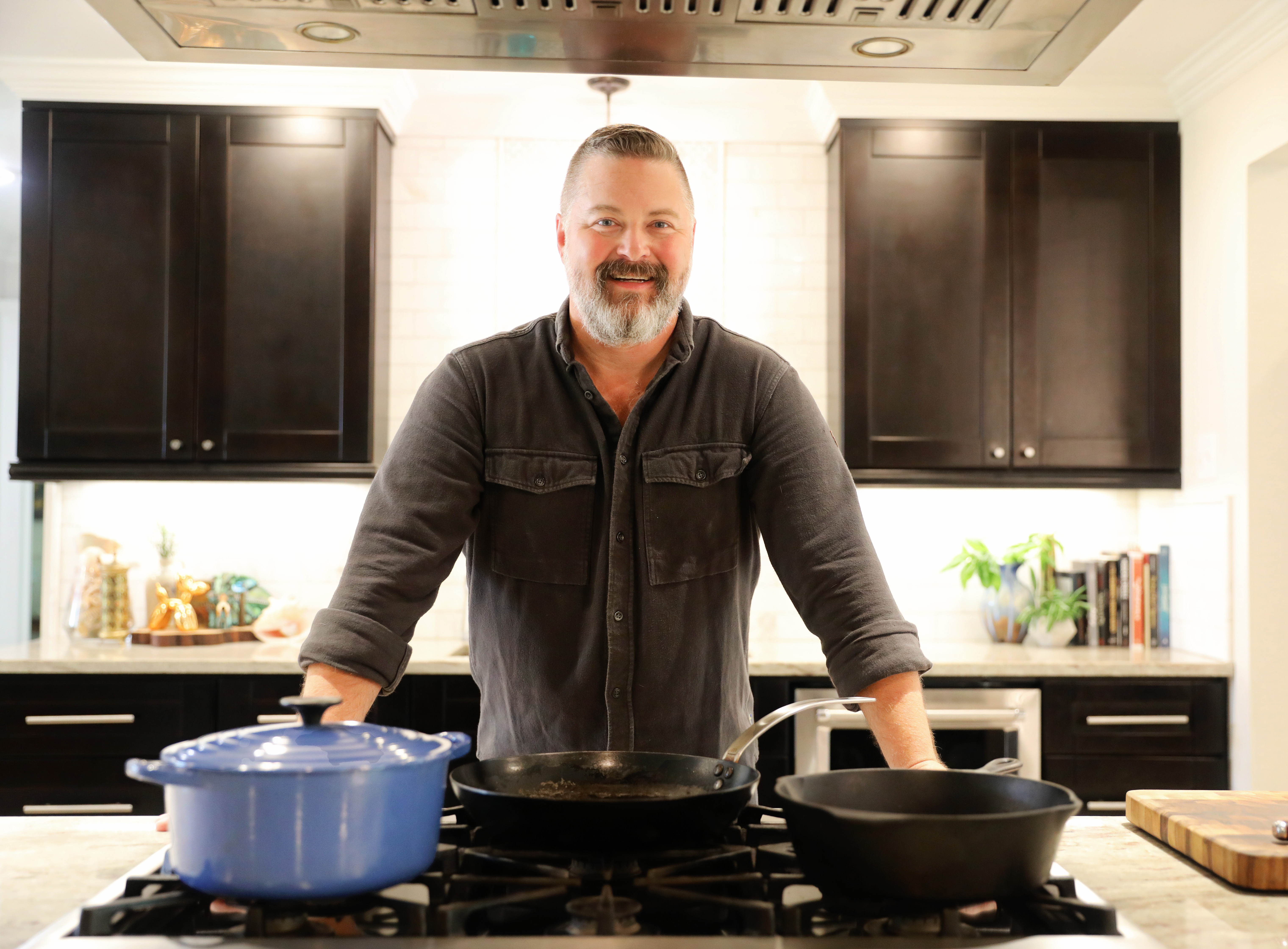
By day, Nat Parks is like many of his neighbors in Tchefuncta, balancing work, family, and the steady hum of everyday obligations. By night, though, he becomes Geaux Gastro, a self-taught chef whose inventive, heartfelt recipes have found a devoted audience both online and in the pages of Stroll Magazine, where he’s a monthly contributor.
Nat’s culinary voice is as much about storytelling as it is about food. His dishes often come wrapped in humor, memory, and a little improvisation. “It’s a combination of things,” he says of his inspirations. “Sometimes I’ll start out wanting to feature something fresh from the farmer’s market, but I usually end up creating something with whatever’s already around the house. Being flexible in the kitchen is one of the most useful skills you can have.” That flexibility fuels his imagination. One of his more playful ideas was a social media concept called What’s in the Fridge, where he’d show up at a random house and make dinner with whatever happened to be inside. Another was a pop-up restaurant dedicated entirely to recreating viral internet dishes. “I was going to call it Viral,” he jokes. “Someone said that might not sell. They were probably right, but I still think it’s funny.” And while Nat is quick to experiment, he’s also guided by seasonality. “No one wants scorching hot soup in the middle of summer,” he adds with a grin.
For Nat, the challenge isn’t just in creating the food, it’s in writing about it afterward. “Balance is an optimistic word,” he admits. “It’s usually more like a downhill race trying to outrun an avalanche.” Living in a community full of high achievers, he feels both inspired and stretched thin. After a full day of work and family commitments, he shifts into what he calls his “dinner shift.” Feeding the kids comes first; recipe testing sometimes doesn’t start until well after 8 p.m.
Some dishes come together quickly, while others get divided into prep and assembly days. The writing usually comes last, pieced together from memory. “If the story is personal, it just flows,” he says. “But when I’m weaving in cultural or political references, like in my Chicken-Kiev-Greenbrier piece, it can get complicated. I like sarcasm, and I’m usually my own favorite joke. Laughing at myself helps.”
When it comes to recipe development, his process is equal parts dreaming and studying. He spends more time than he cares to admit scrolling through haute cuisine photography, observing how world-class chefs plate and garnish their food. His goal isn’t to replicate fine dining, but to borrow inspiration for one-off creations that balance flavor, composition, and visual appeal. One of his proudest results was blackened snapper over macque choux with jumbo lump crab and tarragon sauce. “Everything about it was Southern and local, and it absolutely smacked,” he says. “You could sell thousands of copies of that plate.”
Not every experiment is a triumph, though. Nat is candid about his misses, particularly his January black-eyed peas, cabbage, and pork recipe. “The flavors were there, but I got out over my skis on the assembly and plating,” he recalls. “It wasn’t pretty.” Another dish, cheekily named Mardi Gras Ball, looked as planned but felt off. “It was cartoonish. A costume, not fashion,” he laughs. “Sometimes ambition needs practice. Most of the time, I wing it really well, but every now and then, you just end up with a plate of calories.”
If his most ambitious dishes show off his creativity, the recipes dearest to him are rooted in family. Two stand out: chicken rice for his mother, and oyster stew for his father. Chicken rice, roasted chicken with steamed rice, gravy, and broccoli with cheese, was the ultimate comfort meal of his childhood. His mom made it for birthdays, sick days, or whenever he asked. “It never failed to satisfy,” he remembers. The oyster stew came later, inspired by his father’s church trips in the early ’90s to Cajun restaurants along Highway 190. It became a Parks family Christmas tradition, the most expensive dish his father ever cooked, and one of the most memorable. “He’s not as handy in the kitchen now, but he still makes oyster stew at Christmas,” Nat says with admiration.
What counts as “unexpected” in today’s global food culture? Nat believes social media has flattened those borders. Still, he urges home cooks to embrace ingredients they might otherwise toss, like skin. “Chicken skin, fish skin, pork skin, stop throwing it away,” he insists. “Fry the skin off a rotisserie chicken like bacon. It’s lights out good.” He’s especially fond of crisping fish skin after smoking it on the grill. “There’s a reason restaurants do it. Try the salmon skin roll at your sushi spot next time.”
Technique-wise, he champions sous vide cooking and the humble carbon steel wok. “It’s like cast iron, just seasoned metal. I cook everything in mine, from green beans to burgers. The high sides keep grease from spattering everywhere. It’s super handy.”
Whether he’s laughing about failed experiments, celebrating a dish that “smacks,” or honoring the memory of his parents through food, Parks sees cooking as a way to tell stories. His recipes are not just meals but narratives, personal, funny, and often nostalgic. “I probably spend more time thinking about food than anyone should,” he admits. But for Geaux Gastro, that thinking turns into something tangible: a plate of food that carries both flavor and meaning, served with a side of storytelling.