The Hover Bird
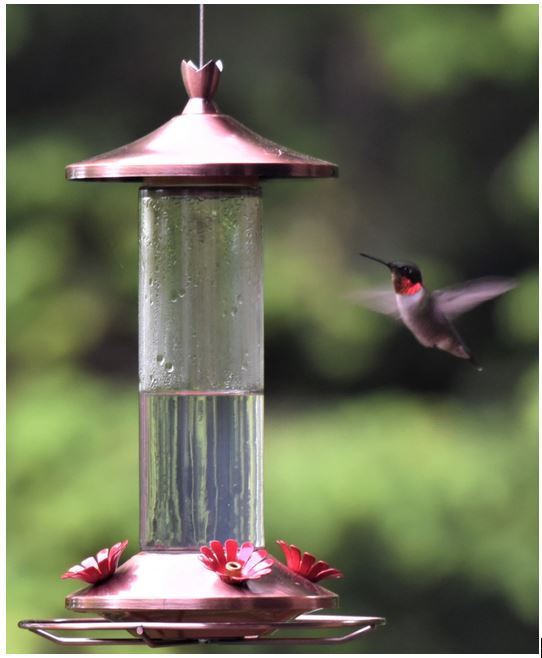
Figure 1: Male Ruby-Throated Hummingbird and Bird Feeder
The Hover Bird
Contributors Drs. Betty & Paul Kuhnert
What is the smallest migratory bird that can travel 500 miles over the Gulf of Mexico without stopping? Hint: the wings flutter at such a fast rate they appear invisible; it weighs less than an ounce and is only 3-4 inches long; it can be very aggressive; and it inspired a helicopter's name.
The answer is the hummingbird!
The only hummingbird found regularly east of the Great Plains is the ruby-throated hummingbird (Archilochus colubris) (Figure 1). It migrates to southern Florida, Central America or Mexico during the winter but is a typical visitor to South Carolina from mid-March to mid-October.
The male has the iridescent ruby-red throat patch that gives it its name. Depending on the sun's angle, the red shade can appear black. The larger female (Figure 2) displays more muted colors, with a white stippled throat.
Like many bird species, the less colorful female builds the nest and raises the young. She also lives longer than the male, who spends a lot of energy defending his territory. The female lays one to two pea-sized eggs in a small nest made from lichens glued with spider webs and lined with plant fluff. The opening to the nest is the size of a half dollar. And there may be two broods per season.
The hummingbirds have fast, squeaky chirps, but most of their sound comes from the "humming" of the beating wings (thus the name). The wings can beat up to 80 times per second, so fast that you can’t see them. Often you will hear the humming before you see the bird.
These flying jewels have one of the highest metabolic rates of any animal. To flap its wings at 80 beats per second, it needs a heart rate of up to 1260 beats per minute. During flight, the hummingbirds’ energy consumption is approximately 10 times that of elite athletes. At night, they may enter a hypothermic state, or torpor, to save energy.
Their flight is more like an insect’s than a bird’s (think dragonfly). It can fly forward, backward, up and down, and hover. It may have been the inspiration for the hovercraft because it can suspend or stay static in the air better than even the most advanced military aircraft. There are several helicopters called hummingbird helicopters.
Planting sunflowers or flowers with nectar-rich, tubular shapes can attract hummingbirds to your garden. These could include red columbine, salvia, hardy fuchsia, delphinium, petunias, common yarrow or others. But be careful with two flowers that hummingbirds love: the red trumpet flower (Figure 3), also known as the hummingbird vine, is a native plant but can be very invasive; the tubular foxglove flower is perfect for hummingbirds but is poisonous to pets and children.
Hummingbird feeders are another way to tempt these small flyers, but they should hang where they will not attract bears. Feeders are widely available; the best ones have a lot of red on them and should be purchased with an ant trap. Anyone can easily make nectar with a 1:4 sugar-to-water mix. Commercial nectar powder often comes with unnecessary, possibly harmful, food coloring and is expensive. The feeders require cleaning every 3-4 days. At summer's height, hummers may visit feeders every 10 minutes throughout the day.
The birds are solitary and very territorial. You may witness pugnacious birds jostling each other and scuffling over food if you have a feeder.
Besides nectar, hummingbirds will feed on very small insects for extra protein. However, giant insects such as a praying mantis can eat them, and so can orb weaver spiders. The hummingbirds move so quickly that they are hard for a predator to catch. Thus, ambush strategies are needed. For example, a praying mantis hanging out on a feeder can easily pounce on an unlucky bird. The eggs are defenseless against bats, squirrels, and chipmunks.
Feel grateful if you have these delightful hummingbirds hovering around in your garden or visiting your feeder. They are extraordinary!