Thief, Thief, Thief!!
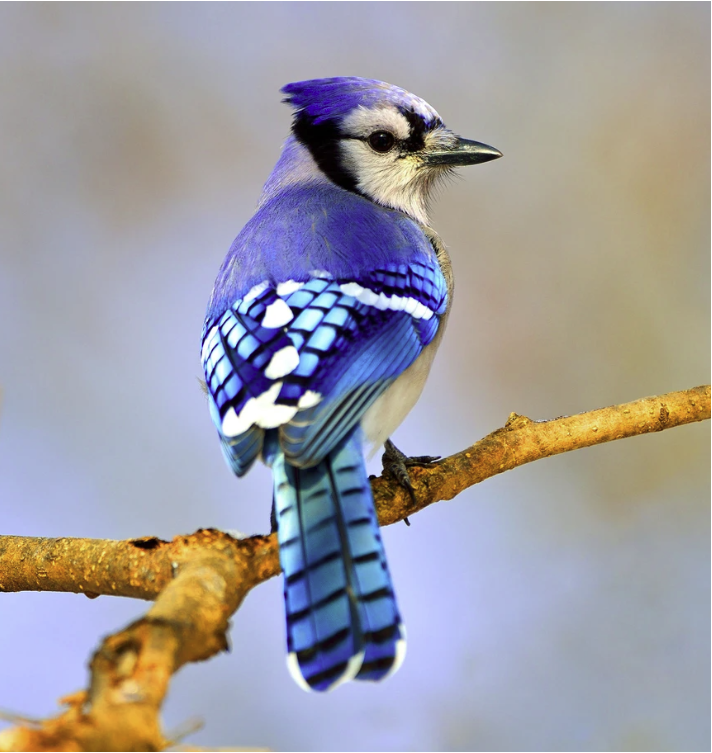
Figure 1. Adult blue jay.
"Thief... thief... thief!!" That is the call of the garrulous blue jay (Cyanocitta cristata) (Figure 1.) The scientific names roughly translate to blue crested chatterer. The beautiful blue and white bird is about the size of a robin and is not to be confused with the indigo bunting or the eastern bluebird, which are much smaller. It is part of the Corvidae bird family, including crows and ravens. Besides the unique "thief" call, it has an impressive repertoire of noises, including hawk imitations and warning calls. Blue jays are frequently heard on the Glassy Mountain golf course.
(Please add Figure 1 Photo Here)
The blue jay is the only blue bird with a crest and black neckband. The crest may be uniquely positioned depending on the bird's emotional state – a truly unique characteristic. The bird fully raises its crest when it is excited or aggressive. When frightened, it resembles a brush. A flattened crest occurs when the bird is relaxed.
The sexes are identical although males may be slightly larger than females. The black bridle across the face, nape and throat varies widely and may help blue jays recognize one another.
The bird's feathers appear blue, but their pigment is melanin (brown). The structure of the feathers' barbs causes blue light to be refracted when hit by light, while melanin absorbs other wavelengths of visible light. If you find a blue jay feather and mash up the feathers, it will no longer look blue. Also, backlighting will make it look brown.
The chatty blue jay is an abundant permanent resident in the Carolinas. People can hear, if not see, the chatty blue jay near all the Cliffs golf courses, and it has readily adjusted to human activity. The number of them in the winter may increase because of migrants from more northern areas. Blue jays range from southern Canada through Florida and west to the eastern foothills of the Rocky Mountains. The Steller’s jay, a related bird, inhabits the western states, but there is some overlap in range and hybridization.
The jay, an omnivore, eats just about anything. It prefers vegetable matter such as nuts, corn grains, seeds, acorns, weed seeds, grain, and fruits. It will also catch caterpillars and small invertebrates, eat human scraps in parks, frequent bird feeders, and rarely eat eggs and nestlings of other birds. Peanuts in the shell are one of their favorite foods. They will also cache food, such as acorns, contributing to the spread of oak and other trees.
John J. Audubon depicted the jay in 1825 (Figure 2) “… sucking eggs that they had pilfered from the nest of some innocent dove or partridge” (J.J. Audubon, The Birds of America). He goes on to describe them as beautiful but rogues, thieves and knaves.
(Please add Figure 2 Photo Here)
Blue jays also eat ants, but they rub the ants on their feathers before they eat them. This behavior is called "anting." Researchers aren't sure if the formic acid in the ants acts as a pesticide for the jay or if the ants taste better without it.
While not picky about food, they are about their significant others. They are monogamous and mate for life. The mating season begins mid-March and peaks in April but may extend into July. They will also make themselves at home almost anywhere when building a nest. The nest is a bulky collection of sticks, twigs, leaves, roots, pine needles, rags, wastepaper, and mud placed close to the main trunk of a tree 20-50 feet up. They prefer pine trees but sometimes nest in rural mailboxes or robin nests.
Both sexes build the nest and rear the young. But only the female broods them. The male feeds the female during this time. However, remember that the sexes appear nearly identical, and sometimes, it is difficult for researchers to tell who is watching the kids. Four or five eggs are laid and incubated for 16-18 days. The young are brooded for 8-12 days after hatching. After fledging (Figure 3), the family stays together until fall. Sexual maturity occurs after one year. The average lifespan of these birds is around seven years, but researchers have discovered banded birds that have lived into their 20s.
(Please add Figure 3 Photo Here)
Blue jays are among the most intelligent birds, like their cousins, the crows. Researchers have observed them using “tools” like newspaper strips to reach for food that’s just out of their grasp. They warn other birds of predators, and they can mimic human speech and cell phone rings. They also may hoard light-colored paint chips as a source of calcium. If they are pecking at your house, you can put down crushed eggshells, which should stop this behavior.
Even if you're not an experienced birdwatcher, you can still recognize and enjoy the charming behavior of this stunning, lively, intelligent, and chatty bird. But be cautious if you encounter an angry jay with a tufted crest! You might hear it loudly exclaiming, "Thief! Thief! Thief!"