Russian Nesting Dolls that contain history
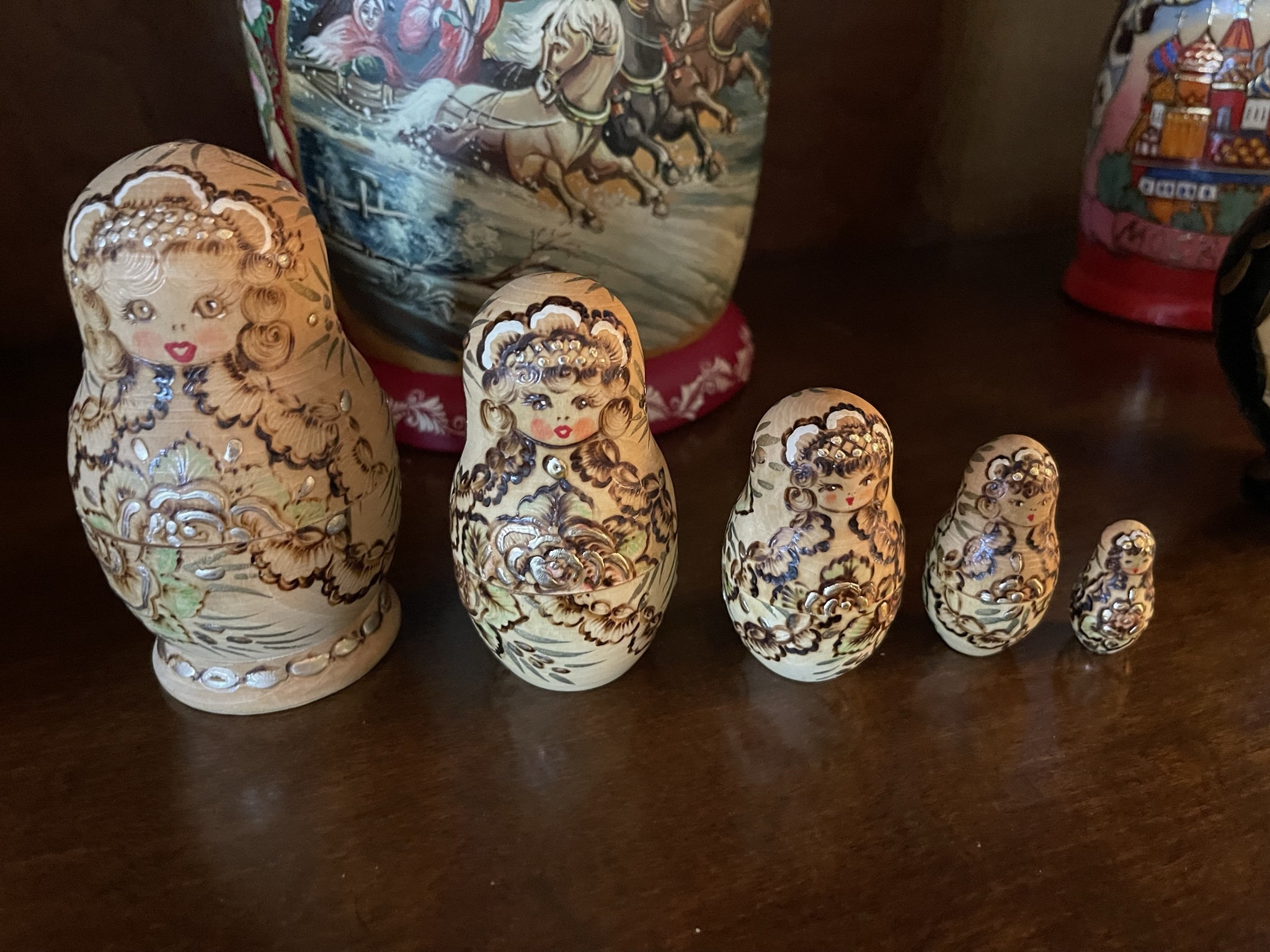
Nesting doll sets were rare in the United States prior to the 1970’s. Today, in contrast, the dolls are being collected and enjoyed by many groups. I have been collecting the artistic nesting dolls since 1993. One of the greatest pleasures is knowing that no two “matryoshka” or “nesting dolls” are alike.
The collecting of objects can become an obsession, costing time, money and anguish when trying to find the next outstanding piece. Each doll is made from a single piece of Linden wood. After the tree is cut down, the branches are removed so the logs can be cured to prevent the dolls from cracking or warping. Each top and bottom is cut from a separate section of the log, then hollowed out to create the figurine, which is later hand-painted, often with elaborate and intricate artwork.
The dolls are made in a great variety of sizes, shapes and paint styles, reflecting the cultural differences found throughout Russia. When opening up the doll, another smaller figurine is revealed, depending on the size of the previous doll. A model may contain up to 70 dolls. Often a doll is given as a gift to newborn infants, implying fertility, eternal life, and timelessness.
The first dolls appeared in 1899 in the city of Sergeyev Posad north of Moscow. The name Matryoshka is derived from the female name Matryone or Matryosha a name popular before 1917. The meaning of the name is literally "Little Mother" or "Grandmother" portraying a strong family matron and a symbol of motherhood and fertility.
The Matryoshka dolls contain many subjects: lessons, folk tales, politics, family life and everyday life from around the world. Some other countries, such as Poland, Japan, India, China, Argentina, Czechoslovakia, Germany, Hong Kong, Italy, Korea, and others, have produced nesting dolls. In the mid-1980s, nesting dolls were imported to the United States from at least thirteen different nations. My collection contains dolls from several of these countries, but the majority of them are from Russia, where they were used as a tool to teach children about various Russian costumes in the 1800s. One of my favorite sets depicts members of the Romanov family - the rulers of Russia from 1613 until the Russian Revolution in 1917.
Whether you are an avid collector or a novice or would just like to own a set of dolls, here are some shopping trips to remember: Old Soviet sets marked "Made in Russia" were made pre-1917. From 1917-1924, sets were marked "Made in the Soviet Union." From 1924-1991, sets read "Made in U.S.S.R." and today they are again marked "Made in Russia". The more dolls in the set, the greater the value. The size of the largest doll, the age, and the detail (carving, painting and inlay) all affect the price of these collectibles. It's not how many dolls I may have in my collection, but the quality of the dolls that really matters.