Prague: The Paris of Eastern Europe
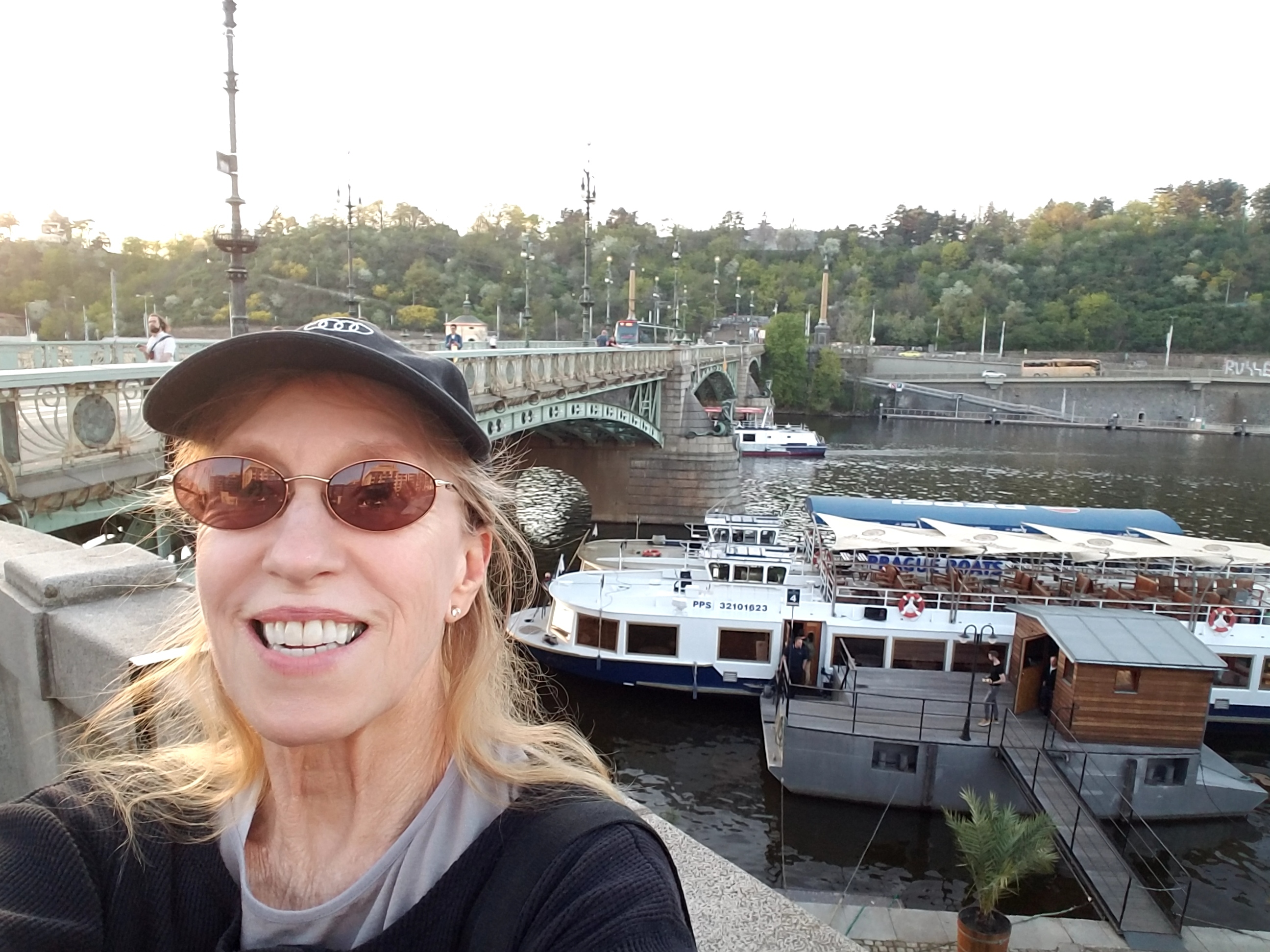
Me at the Prague boats on Vltava River
Prague, the capital of the Czech Republic, is a city rich in political, cultural, and historical significance, often referred to as "The City of a Hundred Spires." Situated on the Vltava River, Prague is known for its stunning Romanesque, Gothic, Renaissance, and Baroque architecture, as well as its sweeping views, beauty, and rich history—making it the Paris of Eastern Europe.
My hotel, the Grand Majestic Plaza, was centrally located across from the cobbled square where stands The Municipal House, Smetana Hall, the most famous and largest concert hall in Prague. Bedřich Smetana, father of Czech classical music, stirred the Romantic nationalist spirit of the Czechs. I walked past the black Powder Tower, which housed the city's gunpowder and served as the gate to the old town wall, built to defend the city in the 1400s. The road from Vienna entered through this gate. Further on was Mozart’s Estates Theater, where he premiered Don Giovanni—a performance I had seen three years before in Vienna at the Vienna Opera House. His Marriage of Figaro was sold out, but fortunately, I was able to enter a private box overlooking the stage to see where Mozart had performed after leaving Salzburg. It was a sentimental experience to be in this historical theater, built in the 1780s, where Mozart premiered and directed his most beloved works.
Returning to Smetana Hall with its magnificent mosaic façade and Europe’s finest Art Nouveau decor and acoustics, I enjoyed a fantastic Vivaldi concert featuring The Four Seasons Concertos and music by Mozart, J. Brahms, and Johann Strauss.
As I walked through the city, I admired the Neo-Gothic, Neo-Renaissance, and Neo-Baroque architectural styles that flourished in the 19th century, eventually arriving at the Old Town Square, where I saw the statue of Jan Hus, the Old Town Hall, the medieval Astronomical Clock, the Church of St. Nicholas, and the Týn Church. Continuing towards the Vltava River, I reached the Rudolfinum, home to the Czech Philharmonic Orchestra since 1946.
The next day, I crossed the Charles Bridge and enjoyed the fantastic view of Prague Castle overlooking the city and the Vltava River. I walked up to the Petřín Tower, a replica of the Eiffel Tower built as part of the Jubilee Exhibition in 1891. Climbing 299 steps, I was enthralled by the beautiful views of Prague. Here, by the Observatory in his honor, stands a statue of Milan Rastislav Štefánik, the pilot and general in the French Army during WWI, who, along with Tomáš Masaryk, a former university professor and close friend of Woodrow Wilson, helped create the nation of Czechoslovakia. Coincidentally, Milan Štefánik was the great-grandfather of one of my best high school friends! Traversing the hillside, I attended a Mass at the beautiful, bright Baroque Strahov Monastery.
Another morning, I entered the remarkable Týn Church with its impressive spires and elaborately decorated interior, built in 1360. The church is especially beautiful at night. Behind it lies Ungelt and the Church of St. James, with its gilded woodwork, frescoes, and bejeweled Madonna Pietatis, where I was mesmerized by the sounds of Prague’s grandest pipe organ. Walking to the Vltava River, I visited the beautiful National Theater. I had the chance to sit in a private box directly above the Prague State Opera Orchestra while enjoying the French ballet La Fille Mal Gardée (The Wayward Daughter).
The following day, I entered the Church of St. Nicholas, the most famous Baroque church in Prague, with its monumental interior. I toured the Old Town Hall, climbed to the top of the tower, then descended to the Romanesque and Gothic cellars. Later, I marveled at the third-oldest Astronomical Clock in the world, with its revolving wheels and intricate inner and outer dials. Afterward, I meandered through the Jewish Quarter, past the Cemetery, down steps into the Old New Synagogue, and saw the interesting tower clocks atop the Maisel Synagogue.
Taking trams to Pražský hrad (Prague Castle), I found that St. Vitus Cathedral was closed for Sunday Mass, so I explored the Old Royal Palace, St. George’s Basilica, and the Golden Lane. After taking in the spectacular view of Prague from the hill, I walked through the Little Quarter.
On my last day in Prague, I ascended to Prague Castle and marveled at St. Vitus Cathedral, with its stunning National Czech Church. Its two soaring Gothic towers, ornate façade, pointed arches, rose window, and dozen statues of saints made for an unforgettable sight. Here, kings were crowned, and the royal tombs and crown jewels are kept. I continued to the Lobkowicz Palace, the Masaryk Statue, the Archbishop’s Palace, and the Loreto Church before descending over the Charles Bridge. Later that evening, at the magnificent Karlin Theater, built in 1881, I enjoyed a performance of Rusalka, an excellent opera by the famous Czech composer Antonín Dvořák.
It was a fantastic conclusion to an unforgettable week in Prague, filled with history, culture, and unforgettable experiences.