Stories Set in Stone
From horse-drawn wagons pulling Chagrin River stone in 1929 to an open-air garden sanctuary built within historic ruins, Agnes and Scott Lane have spent 33 years preserving the unique heritage of Echo Glen.
Stepping through the opening of the stone doorway into the space Scott and Agnes call "The Ruin," you at once notice the change in light. Most of Echo Glen sits in deep, cool shade under a thick canopy of mature beech, hemlock, and yellow birch. Step inside this open courtyard, however, and the afternoon sun beams directly down onto stone paths, potted tropical plants, and river stone walls overlooking the valley.
In the middle of one wall, a sunburst-patterned opening frames a view of trees across the ravine. Look closely at the stones nearby, and a small wheelbarrow seems to emerge from the masonry, its shape created simply by the placement of the individual stones. It was a subtle detail pointed out to Agnes by her friend, former neighbor, and local historian Jim Stafford, who, as a young boy growing up in the house, spent hours dreamily gazing at the stonework.
Turning an abandoned, collapsing structure into a sunlit courtyard garden is not the typical approach to property management, but for Agnes and Scott, preserving local history has always gone hand in hand with making a home.
The Meister House: Built in 1929
Scott and Agnes bought their home on Echo Glen in 1993. They were in their early 30s at the time, looking for a place to plant long-term roots and raise their family. Echo Glen is a private drive off Mayfield Road that most drivers pass by without a second glance. It holds about a dozen homes, almost all connected to the handiwork of master stonemason George Brown.
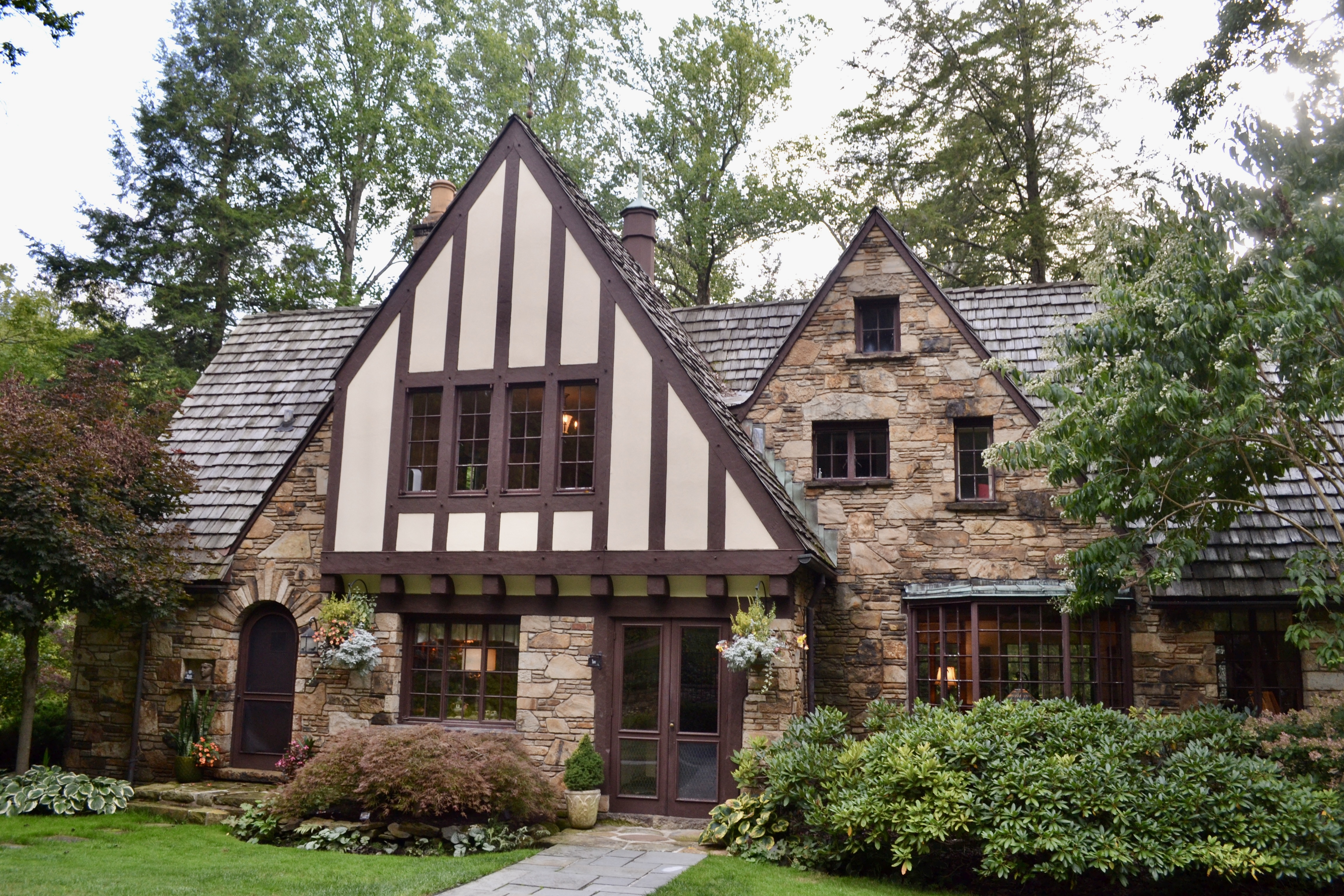
In 1929, George Brown received what would become his last major residential commission from publisher Edward and Elsie Meister. The Meisters purchased the three-and-a-half-acre parcel tucked into the gully of "Brown's Woods," setting out to build an English Tudor residence that complements the natural landscape around it.
Building the house was an immense physical undertaking; teams of horses and mules pulled heavy river stone directly out of the Chagrin Riverbed, hauling the rock up dirt trails wide enough for wagons. Brown set up a dedicated workspace right in the woods on the property, where his crew chiseled each stone. Remarkably, those original stacks of split river stone still rest in the beech and hemlock woods along the driveway today, exactly where George Brown's crew left them nearly a century ago.
When Scott and Agnes moved in, their nonagenarian neighbor, Ms. Stitt, a retired Cleveland Public Librarian who lived on Echo Glen most of her life, shared her memories of sitting on the bank in 1929, watching the horse-drawn sledges drag the river stone up from the riverbed to lay the foundation.
Brown built the Meister House with remarkable architectural detail. He crafted curved wooden doors with hand-forged strap-iron hinges, half-timbered English Tudor framing, and a sunburst-patterned stone lintel over the entryways. Inside, he paneled the reading room with wormy chestnut, laid wide-plank oak flooring, and exposed heavy ceiling joists. On the roofline, he added a copper-topped martin birdhouse cupola. In the upstairs bathrooms, he installed Art Deco Vitrolite glass tile, an ultramodern material from the 1920s rarely seen today.
A Century of Village Stewards
Over the last century, the house has passed through the hands of an extraordinary sequence of caretakers, each leaving their own distinct mark on the property.
The original owners, Edward and Elsie Meister, raised their two sons, Edward Jr. and Richard, at Echo Glen. While living there, Edward Sr. established the American Fruit Grower Publishing Company. His sons later took over and expanded the business into Meister Publishing Company in Willoughby, known today as Meister Media Worldwide.
In 1955, the house was purchased by Daniel Rhodes Hanna Jr. and his wife, Lucia "Queenie" Otis Hanna. Dan Hanna was the publisher of the Cleveland News and later operated Forest City Publishing, which produced the Plain Dealer. Queenie's father, Charles A. Otis Jr., had helped organize the Chagrin Valley Hunt Club, and the Hannas were deeply involved in Gates Mills social life.
The Hannas were also avid dog lovers who co-founded the Kennel Club of Cleveland and organized the Chagrin Valley Dog Show. They raised dachshunds on the Echo Glen property, constructing a dedicated doghouse and mounting a custom outdoor lantern featuring a dachshund silhouette next to the kitchen door. “That original doghouse is still standing" Scott said with a smile. "It's where I keep my lawnmower today." The detail turned out to be oddly prophetic. Scott had a dachshund as a child, and today, he and Agnes share their home with two miniature long-haired dachshunds, Charlotte and Opal, both 16 years old.
In 1964, the home was sold to Ronald and Susan Kohn, who were active in the Cleveland arts and theater community during the 1960s.
Architect Thomas Zung and his wife Carol purchased the home in 1974, raising their son there over a 16-year stay. Zung, who was a partner with visionary thinker R. Buckminster Fuller and worked alongside Edward Durell Stone on projects like the Kennedy Center in Washington, D.C., played a critical role in revitalizing the home on Echo Glen. He installed central air conditioning, added a new cedar shake roof and copper gutters, and placed custom forged-iron glass doors on the main fireplace. Folk singer John Denver, a friend of Zung through their shared interest in Buckminster Fuller, visited the Echo Glen house during their time there, as did Zhang Wenjin, a Chinese diplomat involved in negotiations with Kissinger and Nixon before later becoming Chinese Ambassador to the United States.
In 1993, Scott, an ophthalmologist, and Agnes, a healthcare administrator, became the next stewards. They raised their two sons, Hayden and Graham, on the property, spending the past three decades vastly expanding the gardens while preserving the historic structure.
The Legend of George Brown
To appreciate the property on Echo Glen, one must understand the larger-than-life personality of George Washington Brown. Brown lived in Gates Mills for 67 years until he died in 1964 at age 94, serving as road commissioner, member of the first Village council in 1921, and long-time Village Marshal.
Brown was an iron molder turned carpenter turned master mason who fell head over heels in love with the Chagrin Valley. He reportedly declared that in the entire world, there was no stone equal to Chagrin River stone in texture, color, and working qualities.
He was also a famous Village character. Every Fourth of July, Brown rode on top of the fire truck playing his glockenspiel in the parade. He played French horn in the Shrine Band, hosted annual parties in his thatched-roof cottage on Old Mill Road for visiting performers from the Metropolitan Opera, and built a remarkable fireplace containing over 200 stones collected during his global travels, including pieces from Tutankhamun's tomb, the Great Wall of China, and the Acropolis in Athens.
Brown was notoriously opinionated, often arguing with architects and altering building plans to suit his artistic judgment. His favorite architectural habit was setting homes precariously near the edge of steep ravines, creating dramatic views of the valley below while trusting his heavy masonry foundations to hold fast against gravity.
Reclaiming "The Ruin"
That ravine placement eventually created a rescue mission for Scott and Agnes on the lot next door.
Adjacent to their house stood another original George Brown home. It belonged to longtime resident Marge Stafford, a physical education teacher and beloved village tennis instructor, who lived there until her death at age 94 in 2016.
With the house sitting vacant for years on the steep slope, time took a severe toll. The heavy stone chimney began pulling away from the frame, the floors cracked, and the wooden sections rotted completely through. The property eventually went up for public auction.
Agnes and Scott could not bear the thought of the historic George Brown stonework being lost or bulldozed, so the couple decided to buy the property two and a half years ago. Then, together they decided to honor the craftsmanship of George Brown, as well as the lives of those who lived there before.
Working alongside an excavator, Scott and Agnes came up with an inventive plan: demolish the unsalvageable wooden portions of the structure, but carefully preserve the standing stone walls to create an open-air courtyard garden.
Demolition was a high-wire act. Heavy machinery had to bring down rotted timber and falling chimneys without collapsing the freestanding stone walls. To secure the remaining masonry, Scott and Agnes hired a team of skilled Amish stonemasons, led by a master mason who was deeply inspired by George Brown's original artistry.
The masons reinforced the original walls with hidden cinderblock and a protective finish to prevent cracking. To cap the tops of the exposed stone walls against rain and ice, they harvested flat river stone directly from George Brown's original 1929 stone pile resting in their woods.
Beyond the stone restoration, the land required massive environmental cleanup. Decades of wild grapevines, rampant wisteria, and thick ivy had wrapped around mature trees, threatening to pull them down. Scott tackled some invasive plants himself, using a chainsaw to cut through ivy trunks as thick as tree limbs. “The secret with the big ivy is cutting through the stem at the base and leaving it alone for two or three months," Scott explained. "Once it dies off, the grip releases, and you can pull it right off the tree trunk."
To stabilize the hillside along the ravine, large boulders were brought in to build a solid foundation. Scott and Agnes then planted hardy native species like goldenrod and ironweed to hold the soil and compete with invasives, as well as placed perennial beds along the path leading down toward the elementary school.
Life in Full Bloom
Inside the stone courtyard of The Ruin, Scott and Agnes created a tranquil retreat. They chose river stone fountains to encircle an abstract corten steel sculpture by Bryant K Tubbs, as well as planned an adjacent seating area where they enjoy the afternoon sun. Thick, 100-year-old rhododendrons surrounding the stone walls burst into bright blooms every summer around the Fourth of July.
Agnes also uses the courtyard for her collection of tropical potted plants, which spend the warm months outdoors before moving into the property's greenhouse for the winter. “Our main house sits in fairly deep shade, so having full sun and an open view across the valley here has completely changed how we enjoy our property," Scott said.
Gardening has always been a central part of their shared life, and Agnes is taking that passion into community leadership this year as she steps into a two-year term as Co-President of the Gates Mills Garden Club. From caring for the flower boxes along the Chagrin River bridges to supporting local conservation efforts, she is looking eager to keep the Village blooming. Scott looks forward to supporting Agnes in her role as he continues to practice at the Cleveland Clinic.
After 33 years on Echo Glen, Agnes and Scott’s affection for Gates Mills has grown equally rooted in its history and in the quiet, everyday moments that make the place home. “That’s really the best part of living here,” Agnes said. “Listening to the church bells from St. Christopher’s, spotting a Barred Owl in the morning, and watching the sun pass through the tree canopy across the Chagrin Valley. You just want to stop and take it all in.”
If you see Scott and Agnes walking their miniature dachshunds down Echo Glen, working along the hillside perennials, or grabbing a morning coffee at Addie's Cup, be sure to stop and say hello.