Built for the Backwoods
Why the Toyota Land Cruiser FJ40 Still Belongs in Hunting Country
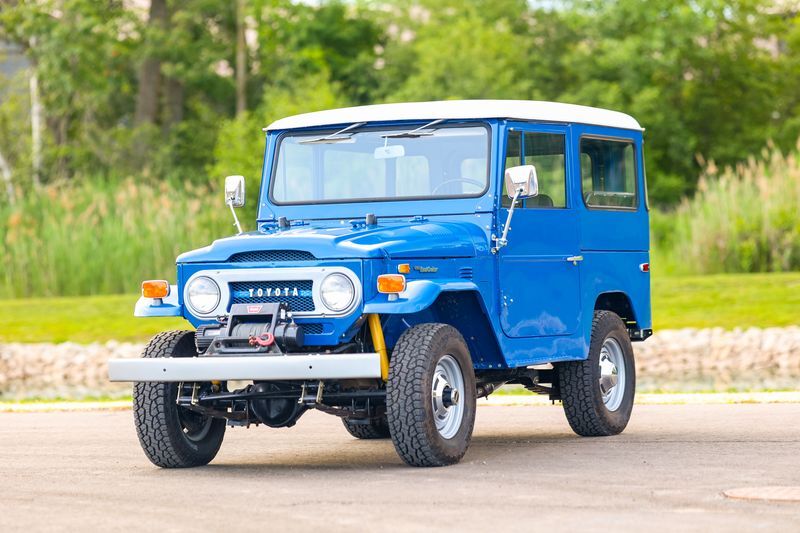
As fall settles into Wisconsin and hunting season gets underway, trucks begin trading pavement for gravel roads, muddy trails and long mornings in the woods. Four-wheel drive becomes less of a luxury and more of a necessity, muddy boots are inevitable, and sometimes the best vehicle is simply the one you aren't afraid to use.
Long before today's pickups and SUVs came loaded with technology, there was the Toyota Land Cruiser FJ40.
By the 1970s, the FJ40 had already established itself as a remarkably capable utility vehicle. Its formula was straightforward: rugged construction, four-wheel drive, simple mechanicals and enough capability to venture far beyond paved roads. Land Cruisers found their way onto farms and ranches, into mountains and remote communities, and just about anywhere reliability mattered more than comfort.
It's not difficult to understand why they also made excellent hunting rigs.
The FJ40 was compact compared with many modern four-wheel-drive vehicles, with a short wheelbase that made navigating narrow trails and wooded areas easier. Four-wheel drive and a low-range transfer case provided capability when roads turned to mud or snow, while the upright body offered excellent visibility over the trail ahead.
Then there was the interior.
There was nothing particularly precious about it—and that was exactly the point. Vinyl seats, simple controls and utilitarian finishes meant an FJ40 was designed for work. Throw your gear in the back, climb in with muddy boots and head down the trail.
This is a vehicle that doesn't ask you to worry about the carpet.
Picture an early Wisconsin morning: frost still clinging to the grass, a thermos of coffee in the cup holder, blaze orange tossed in the back and a hunting dog settled in behind the seats. The heater is doing its best against the cold as the road to deer camp turns from pavement to gravel, then eventually to little more than two tracks disappearing between the trees.
That's where an old Land Cruiser starts to make sense.
There is also something appealing about the mechanical simplicity of an FJ40. There are no terrain-management screens or electronic drive modes deciding how to tackle the trail. In a traditional Land Cruiser, four-wheel drive is something the driver engages. On many examples, that means getting out, locking the front hubs and then climbing back behind the wheel.
It requires a little more involvement, but perhaps that's part of the appeal.
Today, of course, the FJ40 occupies a very different place in the automotive world. The utilitarian 4x4s that once earned their keep working on farms and exploring back roads have become sought-after classics. Nicely preserved and restored examples appear at collector-car auctions, shows and weekend Cars & Coffee gatherings.
Yet underneath the collectibility is still the same machine.
The exposed hinges, upright windshield, rear-mounted spare and unmistakably boxy silhouette weren't originally styling exercises. They existed because the Land Cruiser was intended to be practical, durable and capable of going places where ordinary vehicles couldn't.
That authenticity is difficult to recreate.
Modern off-road vehicles may be faster, quieter, warmer and considerably more comfortable. They can automatically adjust suspension settings, distribute power between wheels and show the trail ahead through cameras.
An FJ40 gives you a steering wheel, a gear lever and four-wheel drive.
And sometimes, that's enough.
Especially when the point of the trip is to get away from everything else.
There's a particular kind of quiet that comes with an early morning in the Wisconsin woods. The sun hasn't quite made it through the trees, the air is cold enough to see your breath, and for a while, the only sounds are boots against fallen leaves, a dog moving through the brush and the occasional call of something in the distance.
For many hunters, that quiet is as much a part of the tradition as the hunt itself. It's a chance to slow down, leave the screens and schedules behind and spend a few uninterrupted hours outside. Sometimes that means heading out alone before sunrise. Other times, it's the annual opening-day hunt with the same group that has gathered for years, piling gear into a grandfather's old FJ40 that has somehow become as much a part of deer camp as the people themselves.
That may be where a vehicle like the Land Cruiser feels most at home. These were built to last, and many have. An FJ40 can carry more than hunting gear into the woods; it can carry stories, traditions and memories from one generation to the next.
There's something fitting about arriving there in a vehicle from another era—one without screens, cameras or dozens of electronic systems competing for your attention. You turn off the engine, grab your gear from the back and head into the woods.
The Land Cruiser simply got you there.
So as another hunting season arrives in Wisconsin and the back roads turn muddy beneath fallen leaves, it's easy to imagine an old FJ40 doing exactly what it was designed to do decades ago—heading into the woods before sunrise with a little gear in the back and nowhere particularly civilized to be.
Nearly half a century later, the Land Cruiser hasn't forgotten how to get to deer camp.