The Man And The Moon
Inside Mickey Williams’ Middle Street studio, we follow the music, memories and people that shaped an artist, and discover why his paintings feel so much like coming home.
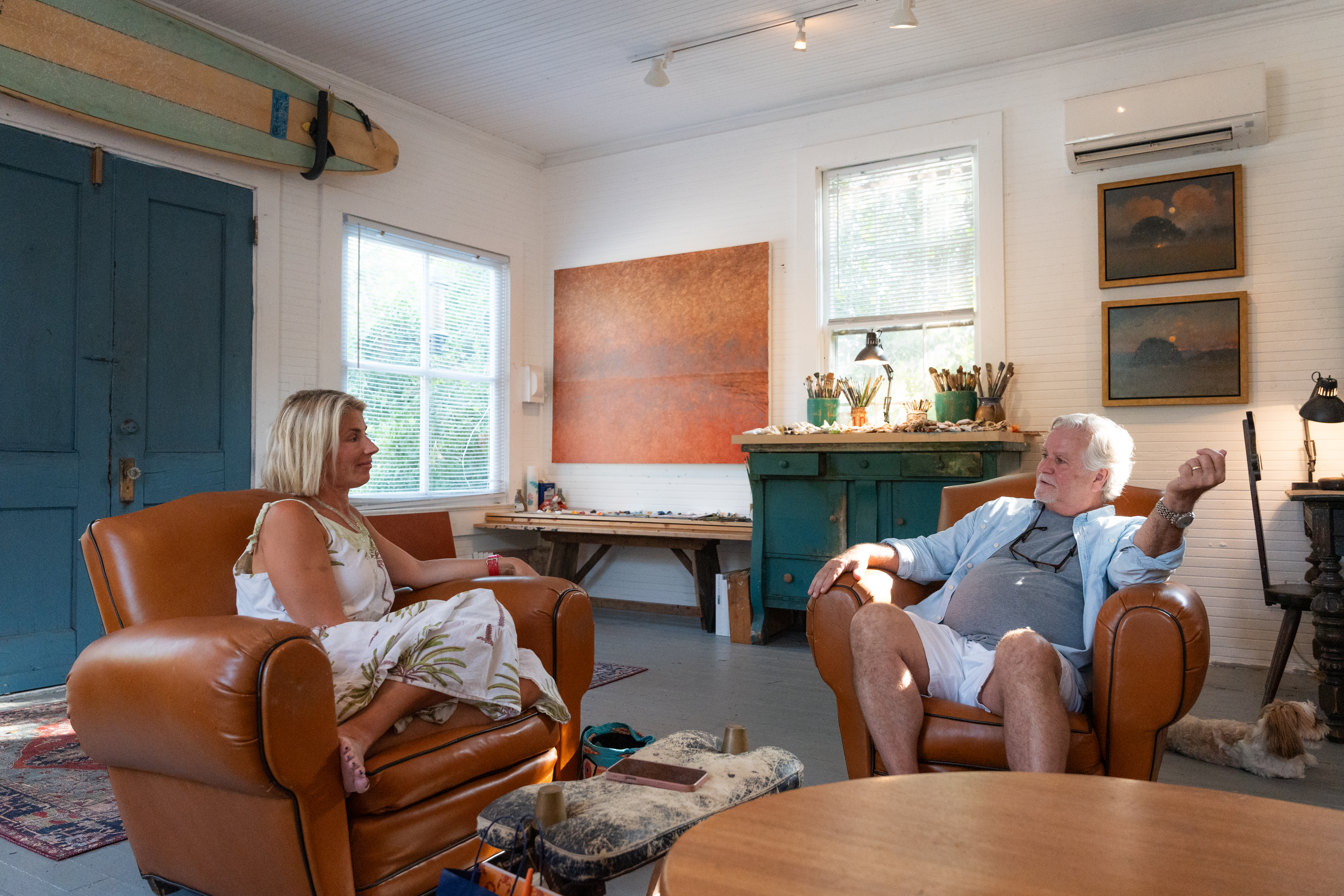
It feels surreal and hot on this late July night, sitting inside the little house on Middle Street that is Mickey Williams’ studio and one-time residence. I’ve passed it a hundred times, knowing the island lore, recognizing the happy trees out front and harboring the same desire so many people around here have: someday, I want a Mickey.
Everyone wants a piece of Mickey’s art. Not everyone gets one.
Tonight, though, I get something better. I get Mickey.
I take off my shoes, curl my legs underneath me, rest my chin in my hand, press record and go.
Around us are unfinished canvases in various stages and, front and center, the most gorgeous Mickey painting. Moon, check. Trees, check. Birds, check. Fire, check.
I ask about his first memory of art.
And suddenly we’re in San Francisco in 1968.
Mickey is in third grade, the son of a military family accustomed to packing up and starting over. He’s also the kid who can’t stay in his seat. The kid who gets into fights. The kid who draws when he’s supposed to be doing something else.
His teacher, Mr. Hicks, is, in Mickey’s telling, “a Dennis Hopper kind of guy.” Peace, love, no fighting, Vietnam-era San Francisco.
There is music coming from a building across the street from school and a rumor circulating among the third graders that there are naked hippies inside. Naturally, Mickey and his best friend decide this requires investigation.
They leave school grounds.
And stay gone.
For hours.
Two third graders have disappeared in San Francisco at the height of the Zodiac Killer era, and Mickey remembers the ensuing search as something approaching an Amber Alert before Amber Alerts existed. The boys are eventually found near the military runway, watching jets fly overhead.
The next morning, Mickey returns to school.
Mr. Hicks has a decision to make.
He gives him a wall.
There’s the wall, there’s the tempera paint. Mickey can stand there during class and paint.
Something happens.
His grades improve. He stays out of trouble. While his hands are painting, his brain is listening. Firing, he remembers, on all cylinders.
Then Mr. Hicks tells him, “I think you’re going to be an artist one day.”
I don’t know where Mr. Hicks is now. I like to imagine him in some cloud formation stretched across one of Mickey’s enormous moons, looking down and thinking, All right, man. You did it.
Because he did.
Mickey Williams became an artist.
Not an artist with a sensible job on the side. Not an artist who painted when there was time. An artist who supported a wife and children by selling what came off his brush.
That distinction matters.
For Mickey, providing for his family became tangled up with dignity and self-worth. He arranged his life around being both artist and father: carpool, dinner at the table, sporting events, every field trip he could volunteer for. Then, when everyone went to sleep, he returned to the studio and painted until one, two, three in the morning. Sometimes he survived on two or three hours of sleep.
Years earlier, the only art teacher Mickey ever formally studied under had told him he lacked the discipline required to become an artist.
Life has a sense of humor.
But life also broke him open.
After his marriage ended, Mickey found himself back in this studio, alone and with very little. His neighbors sensed something underneath the happy exterior. Things began appearing at his door: food, small kindnesses, evidence that somebody was paying attention.
One Sunday morning, a little girl named Izzy arrived carrying a breakfast sandwich she had made for him. She had earned the money herself to buy the bread, bacon and eggs.
“That’s when I thought, okay,” Mickey tells me. “This is my community.”
I had told Mickey earlier that his paintings make me feel something I have trouble naming. Longing, maybe. A kind of beautiful loneliness. Peace. Wonder. The almost unbearable awareness that this much beauty exists around us and we probably aren’t paying enough attention.
Mickey gets it. That feeling is there when he paints, and when the work is done, it becomes ours to think on, hold, heal and come back to.
Then we talk about the fires.
Mickey tells me they came from a darker place. Over time, he realized they had become something else: gathering, family, friendship, community, even the ability to sit peacefully with yourself.
I had the fires all wrong.
I thought the fires were where the cool kids hung out in Mickey’s paintings. I assumed they weren’t for me.
Now I know everyone is invited.
The fires are Mickey beckoning us closer. Come sit. Let the warmth slow you down and settle your soul.
Sitting inside Mickey’s studio, surrounded by his paintings, makes me question my own belonging. To this island. To this life I have created. To who I actually am, how I got so lucky and whether I am worthy of any of it.
Vulnerability.
Maybe that’s what Mickey has been offering us all along.
An artist has to make himself vulnerable to the world. Mickey puts something of himself on the canvas and then asks us to meet him there. If we’re willing, his paintings ask something vulnerable of us, too.
I look again at the painting in front of me.
Moon. Trees. Birds. Fire.
By the time I leave, I know I could recognize a Mickey Williams painting anywhere in the world.
But now I know something else.
Maybe that longing I’ve always felt looking at his work isn’t about wanting to be somewhere else at all.
Maybe it’s the feeling of searching your whole life for where you belong and finally realizing you’re already there.